Circuit breakers act as the protective mechanism of modern electrical systems in case of faults that could lead to extensive damage. A Moulded Case Circuit Breaker (MCCB) is one of the more capable electrical protective devices, serving many purposes and finding its applications in industries and commerce, and in residences needing solid circuit protection.
In this article, an attempt has been made to explain what a molded case circuit breaker is, its constituent elements, how it works, advantages, and finally gives hands-on instructions for its installation and operation.
The Advantages of Moulded Case Circuit Breakers
An MCCB is an intelligent circuit protection device that offers protection to circuits against possible overcurrent, short circuits, and other electrical faults. Besides this protection, the MCCBs can also provide circuit isolation for the maintenance of a part of the electrical installation or its emergency disconnection.
Among the advantages of MCCBs are:
Enhanced Safety: MCCBs detect faults in the electricity supply and interrupt them to protect both equipment and personnel from any kind of electrical risk.
Adaptability: MCCBs have adjustable trip settings and a wide current rating range, suitable for multiple applications.
High Durability: MCCBs are designed to bear high fault currents and frequent tripping.
Key Components of a Moulded Case Circuit Breaker
MCCBs are made up of several important components, serving a certain vital function for effectiveness.
Molded Case (Frame): The case, made of tough insulating materials (glass polyester or thermoset resin), holds all the components of MCCB in place.
Terminals: Terminals connect the MCCB to external circuits and devices. Proper terminal connections must be ensured to avoid overheating and to ensure good current flow.
Operating Mechanism: This part essentially operates manually or automatically with the help of a handle or a button for switching the breaker circuit on/off.
Trip Unit: The trip unit is believed to be the ‘brain’ of the MCCB, comprising current- and temperature-sensitive elements that constantly observe the condition of a circuit.
Arc Chamber: The arc chamber is designed to extinguish the electric arc generated when the MCCB trips. This energy will safely dissipate through components within the arc chamber, such as arc contacts and chutes.
How Does an MCCB Work?
The MCCB works on the integration of thermal and magnetic protection. Therefore, it can respond efficiently to different kinds of faults.
Basic Mechanism: The MCCB at all times monitors the flow of current. The moment it detects that something has gone amiss trips into action automatically.
Tripping Mechanism:
Thermal Protection: Comprising a bimetallic strip; in case of an overload, on getting heated substantially the strip bends to release the tripping mechanism that switches off the current and saves from overheating.
Magnetic Protection: The MCCB possesses an electromagnetic coil, which acts to detect the surge of current in case of a short circuit. The coil, in turn, develops a strong magnetic field that trips the breaker, thus stopping the flow of electricity instantly.
Additional Functionalities: These MCCBs can also act as emergency switches for disconnecting parts of a circuit in case of an immediate shutdown.
Understanding MCCB Ratings and Features
Basically, these ratings are the understanding on the basis of selecting an appropriate MCCB for any given application.
1. Rated Current (In): This is the maximum current the MCCB can sustain without tripping under normal conditions. This rating value defines the MCCB’s primary function of protection against overload.
2. Rated Frame Current (Inm): The maximum current the structure of the MCCB can sustain. It forms the frame size of the MCCB and enables it to bear a range of rated currents.
3. Rated Working Voltage (Ue): The steady voltage at which the MCCB can operate reliably over extended periods.
4. Rated Insulation Voltage (Ui): The highest voltage that the MCCB can bear without the danger of an insulation breakdown, usually tested under ideal conditions.
5. Impulse Withstand Voltage (Uimp): This is the transient voltage due to lightning or power surges that the MCCB can bear without damage.
6. Short Circuit Breaking Capacities (Icu and Ics)
7. Ultimate Short Circuit Breaking Capacity (Icu): The maximum fault current an MCCB shall be able to interrupt without damage to structural integrity.
8. Service Short Circuit Breaking Capacity (Ics): The maximum fault current the MCCB can bear without malfunctioning. An MCCB can function after withstanding a fault up to its Ics limit but may also have to be replaced if the fault has been greater than this value.
9. Lifespan Ratings
9.1. Electrical Life: The number of fault trips the MCCB can make before it becomes unreliable.
9.2. Mechanical Life: The number of manual on-off operations the MCCB can carry out before its mechanisms wear out.
MCCB vs. MCB: Key Differences
MCCBs and MCBs (miniature circuit breakers) are both circuit breakers. However, they have been tailored for different fields of application. Their main differences are given in the table below.
Feature
MCCB
MCB
Current Range
10A to 2,500A
Typically up to 100A
Short Circuit Breaking Capacity
10,000 to 200,000 amps
Generally below 18,000 amps
Adjustable Trip Settings
Yes, adjustable for different current levels and response times
No, fixed trip settings
Applications
Industrial and commercial environments, high-power equipment like motors and generators
Residential and light commercial (lighting, outlets)
Physical Size
Larger due to higher current handling and safety features
Smaller, designed for lower power circuits
Resettable after Tripping
Yes, typically reset manually or remotely
Yes, typically reset manually
Installation
Main distribution boards, sub-feeders for high-load equipment
Household and small-scale distribution boards
MCCBs work best for applications that involve industry and commercial purposes, while for residential and small commercial settings, MCBs are majorly applied.
Installation Guidelines for MCCBs
Proper installation will determine whether MCCBs will work safely and efficiently or not. Here are some major guidelines one should follow:
Main Power Distribution Board: Mount MCCBs in the main distribution for system protection and an emergency disconnecting switch.
Sub-Feeder Circuits: Additional selective protection can be installed using MCCBs at subfeeder circuits so that only those parts of the systems are isolated, especially where equipment of high demand is used.
Guidelines for Safe Installation
Proper Sizing and Rating: The MCCB selected shall be rated based on the needs of the current and voltage of the circuit.
Correct Wiring: Terminals should not be loose to avoid loose wiring and prevent the possibility of overheating.
Professional Installation: Have the MCCB installed by a licensed electrician for compliance with local safety standards and codes.
Environmental: Keep the MCCBs away from extreme temperatures, dust, and moisture. In outdoor installation and other harsh industrial conditions, enclosures may be necessary.
Conclusion
The MCCBs are multi-application, reliable circuit breakers that increase safety in industrial and commercial applications. They carry heavy currents, protect equipment against faults, and offer necessary customizability via adjustable trip settings.
Proper selection of the MCCB from reliable electric equipment suppliers and correct installation ensure effectiveness in safeguarding electrical systems and valuable assets in exacting environments.
FAQ
What is the difference between MCCB and MCB?
The MCCBs deal with higher currents and, therefore, are adequate for industrial use, while the MCBs are normally used for residential use.
How do I choose the right MCCB for my application?
Consider the load type, current and voltage requirements, and installation environment. You can also check for ratings and consult a licensed electrician.
Can an MCCB be reset after it trips?
Yes, MCCBs can be manually or remotely reset, but repeated tripping should be investigated due to the possibility of a recurring fault.
What maintenance is required for an MCCB?
Its maintenance involves regular inspection, wear checks, connection tightness, and tripping tests for longevity and reliability purposes.
Why are MCCBs preferred in industrial applications?
The MCCB offers larger ratings, trip settings, and strength that make it very appropriate for application in the protection of high-demand equipment.
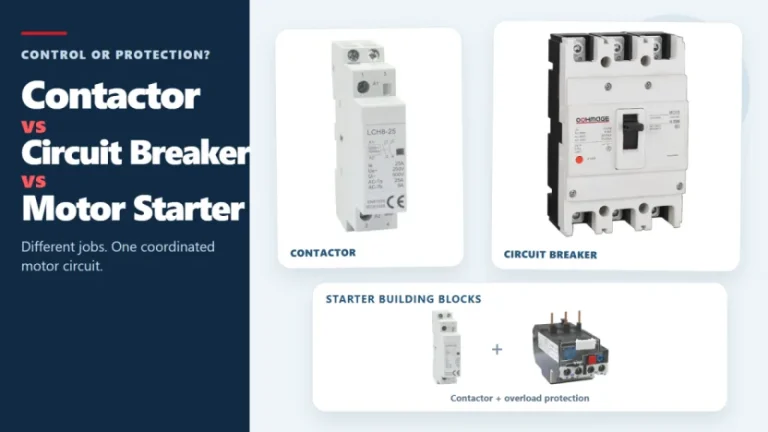
Figure 1. Contactors, circuit breakers, and motor starters solve different control and protection tasks. These three devices often appear in the same motor-control panel, but they solve different problems. A contactor handles frequent, remote, or automatic switching during normal operation. A circuit breaker interrupts abnormal current within its rated capability. A motor starter normally combines […]
Introduction The concept of remote tripping is simple, but in actual operation, project teams often encounter difficulties in specifying the components. The panel factory may require circuit breakers triggered by fire alarm relays, PLC outputs, building management system instructions, or other coordinated control. At this point, “diversion tripping” is only the first step in the […]
The main types of circuit breakers used in low-voltage distribution include miniature circuit breakers (MCBs), molded case circuit breakers (MCCBs) and residual-current devices such as RCCBs and RCBOs. They are not interchangeable. MCBs and MCCBs are selected for overcurrent protection in different circuit roles, an RCCB provides residual-current protection without integral overcurrent protection, and an […]