Circuit Breaker vs. Isolator: Key Differences and When to Use Each
Published: Author: Conor
Electrical safety devices are very important in managing and safeguarding power systems at residential and industrial levels. Of these, two of the most important devices are circuit breakers and isolators. Many people confuse these two with each other, but both have different functions. This article tries to explain by citing differences in terms of various aspects.
About Circuit Breakers
Circuit breakers are widely applied in residential, commercial, and industrial systems as an essential layer for protection operating with high load handling.
Circuit breakers are designed to automatically “trip” or shut off the power in a circuit when an abnormal condition occurs. They accomplish it through various mechanisms, thermal, magnetic, or electronic triggers.
Each type of circuit breaker works to protect the circuit by breaking the flow of electricity under hazardous conditions. They can be reset either manually or automatically after the issue.
Main Types of Circuit Breakers
Miniature Circuit Breakers (MCBs): This is a common type for miniature circuit breaker manufacturers. Common for residential circuits for low-power overload and short circuit protection.
Molded Case Circuit Breakers (MCCBs): Used in commercial and industrial applications where bigger circuits with bigger capacities need protection.
An isolator, also called an isolator switch, is a manually operated switch used to isolate those parts of the electrical circuit from the main supply. The major function of the isolator is for visible disconnect, ensuring that sections of the circuit are fully de-energized for maintenance or repair. Isolators have no overload or fault condition protection and will not interrupt live electrical loads.
How Isolators Work
Designed to be operated manually, isolators will often be used after a circuit has been switched off by a circuit breaker. After disconnecting the power supply, the isolators completely separate the equipment or the circuit from the electrical feeding, for maintenance personnel to safely work on it. Many isolators give a clear visual indication of the de-energized condition of the circuit when the device is in the “off” position.
Types of Isolators
Single Break Isolators: Use a single set of contacts to disconnect one part of a circuit. They are simpler and cost-effective but have limited applications.
Double Break Isolators: Use two sets of contacts and provide a more secure disconnect. Common in industrial applications.
Rotary Isolators: Based on a rotary mechanism, they are used in residential and commercial settings for appliance or small equipment isolation.
Key Differences Between Circuit Breakers and Isolators
Feature
Circuit Breaker
Isolator
Function
Protects circuits by interrupting power during faults
Isolates sections of a circuit for safe maintenance
Operation
Automatic, with sensors for detecting overloads or short circuits
Manual, operated under no-load conditions
Usage Conditions
Operates under load and during fault conditions
Used only after the circuit is de-energized
Safety
Provides both circuit protection and fire prevention
Ensures safe working conditions for maintenance
Cost
Generally more expensive due to complexity
Typically more affordable and simpler to operate
Visual Disconnect
May not have a visible disconnect
Provides a visible disconnect, confirming de-energized status
Applications of Circuit Breakers and Isolators
Both circuit breakers and isolators play significant roles in electrical systems, yet they are used in different scenarios.
Circuit Breakers
In every residential fuse box protect the household circuits.
They are in use industrially in switch gear to provide control to extensive electrical networks and equipment protection.
In commercial buildings, they are highly essential to safeguard highly powered electrical systems.
Isolators
Normally in industrial settings for maintenance work where parts of a circuit need to be completely de-energized.
Isolation switch manufacturers recommend applying them to HVAC and solar installations to ensure that the equipment remains safely serviceable.
Applied in commercial buildings as extra disconnects, mainly when at high voltages where isolation with circuit protection is necessary.
Pros and Cons of Circuit Breakers and Isolators
Circuit Breakers
Benefits
Automatically trip during fault conditions, providing continuous protection to the circuit.
Come in a range of types suitable for various electrical loads.
Can be reset with ease without requiring replacements.
Limitations
Do not provide any visible disconnect hence require isolators in addition to when maintenance needs to be carried out.
Generally, more costly compared to isolators since they add complexity and functionality.
Isolators
Benefits
Provide visible disconnect hence maintenance safety ensured.
Simple in design and has few moving parts. They are less costly and easier to operate.
Limitations
Can’t disconnect a live load and rely on circuit breakers to carry out fault interruption.
Need to be operated manually, which may be a bit slower than the automatic circuit breakers.
When to Use a Circuit Breaker vs. an Isolator
Use circuit breakers when you require protection automatically due to faults overload or short circuits. A circuit breaker is vital in any system where there is a possibility of electrical fault either for equipment protection or prevention against fire. It is employed when maintenance work may need safe access to a specific section of the circuit.
On the other hand, isolators can safely disconnect parts of a system, especially where industrial or high-voltage systems require some clear visual indication of disconnection.
In practice, circuit breakers and isolators often find application together on the same larger installations, with the circuit breaker providing active protection and the isolator giving maintenance safety.
OOHMAGE: Your Reliable Electrical Equipment Supplier
With an ISO 9001:2015 certificate, OOHMAGE provides you with the right electrical equipment. Our products have been widely used in industrial, commercial, and residential applications. Advanced electric protection devices, including MCBs, isolation switches, MCCBs, and so on, from OOHMAGE are of the best quality to protect users’ safety. Contact us to get the best quote!
FAQ
Can I use an isolator instead of a circuit breaker?
No, an isolator and a circuit breaker perform different roles. An isolator is for disconnecting sections of a circuit for maintenance purposes, while a circuit breaker acts as protection against overloads and faults.
Do isolators protect against electric shocks?
No, isolators are not for protection against electric shock or fault conditions. They merely disconnect the circuits for maintenance in safe ways.
When should I use both a circuit breaker and an isolator?
Both are employed in high-power or industrial applications where the need for circuit protection calls for circuit breakers and safe disconnect during maintenance calls for isolators.
Are there legal requirements for using circuit breakers and isolators?
Yes, many regions have circuit breakers and isolators installed based on safety like NEC (US), BS 7671 (UK), and AS/NZS 3000 (Australia) for installation correctly to ensure safety and standards.
How often should isolators and circuit breakers be inspected?
It is recommended to inspect circuit breakers and isolators annually or more frequently in high-risk environments to ensure they are functioning correctly and safely.
Do isolators have a load-carrying capability?
Isolators should not operate the circuit in case the latter is under load because they can’t interrupt live circuits.
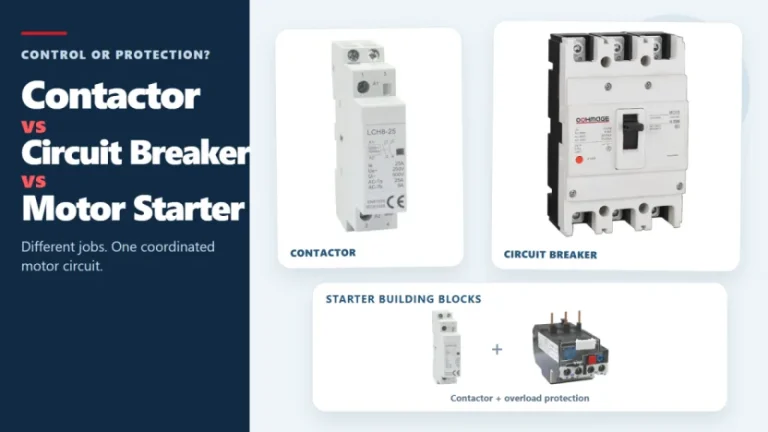
Figure 1. Contactors, circuit breakers, and motor starters solve different control and protection tasks. These three devices often appear in the same motor-control panel, but they solve different problems. A contactor handles frequent, remote, or automatic switching during normal operation. A circuit breaker interrupts abnormal current within its rated capability. A motor starter normally combines […]
Introduction The concept of remote tripping is simple, but in actual operation, project teams often encounter difficulties in specifying the components. The panel factory may require circuit breakers triggered by fire alarm relays, PLC outputs, building management system instructions, or other coordinated control. At this point, “diversion tripping” is only the first step in the […]
The main types of circuit breakers used in low-voltage distribution include miniature circuit breakers (MCBs), molded case circuit breakers (MCCBs) and residual-current devices such as RCCBs and RCBOs. They are not interchangeable. MCBs and MCCBs are selected for overcurrent protection in different circuit roles, an RCCB provides residual-current protection without integral overcurrent protection, and an […]