Contacts and relays basically look alike, since both are electrically operated switches. However, they serve different purposes, differing in power-handling capabilities and, therefore, in their applications.
The major purpose of a relay in an electrical system is to be used for low-power systems in handling smaller loads. On the other hand, contactors are designed for use in high-power circuits, normally within industrial applications.
These distinctions are important to understand. Using the wrong one might result in circuit damage or other safety hazards. Selections between contactor and relay often take into account considerations such as the electrical load, type of application, and particular operation requirements of the circuit.
What is a Relay?
A relay is an electromechanical switch that is actuated to provide power to smaller loads or low-power circuits. Relays are widely used in control circuits to switch signals and small currents. This is often used as an interface between a low-power control system and higher-powered machinery.
How Relays Work
The principle of operation of relays involves an electromagnetic coil that, with the provision of energy, moves contacts to open or close the circuit. Through this mechanism, relays function to drive a secondary circuit using a fairly low-power signal to yield precise control without needing high currents.
Types of Relays
Electromagnetic Relays: These are relays with operation principles involving the use of an electromagnet for the control of the switching on and off. Normally applied in simple automation.
Solid-State Relays (SSRs): They use semiconductor technology for switching. SSRs offer fast operation and silent operation and are ideal in applications requiring frequent switching.
Reed Relays: The contacts of the reed relay are sealed in a glass tube. They are suitable for signal processing and high-speed switching.
What is a Contactor?
A contactor is an electrically operated switch that features contacting to control high-power electrical loads. For large currents and high voltages, contactors are more robust than relays and are widely used in industry to control heavy-duty electrical equipment such as motors, compressors, and lighting systems.
How Contactors Work
The operation of contactors is similar to that of relays. An electromagnetic coil moves the contacts to open or close a circuit.
However, because contactors are of a high-power design, they also include arc-suppression features that manage the intense currents responsible for arcing when the contactor switches are turned on and off.
Types of Contactors
AC Contactors: An AC contactor is designed specifically for AC circuits. It is used in motor controls and lighting.
DC Contactors: They are optimized for DC circuits, and applications starting from battery systems to electric vehicles.
Magnetic Contactors: They make use of magnetic force to close a circuit. Thus, they are suitable for remote control in operating industrial machinery.
Contactor and Relay: Pros and Cons
Understanding the pros and cons of contactors and relays helps in making an informed decision based on application needs.
Relays
Pros:
Compact size and lightweight.
Low cost for low-power applications.
Available in multiple types, such as solid-state, electromagnetic, etc., to suit different applications.
Cons:
Less power handling capacity.
No arc suppression, hence cannot be applied on high-power systems.
Shorter life in conditions of high load.
Contactors
Pros:
High power handling-capacity applications, thus very suitable for heavy-duty applications.
They are designed with arc suppression in order to handle large currents safely
Durable and built for continuous operation in an industrial environment.
Cons:
Higher cost compared to relays.
Bulkier in design, so it takes up more space.
Requires additional components to provide precise low-power control.
Contactor and Relay: Key Differences
Contactor
Relay
Power Handling Capacity
Low currents
Higher currents
Arc Suppression Requirements
Not integrated into a relay
Have an arc suppression mechanism
Auxiliary Contacts
Not include auxiliary contacts
Include auxiliary contacts
Size and Design
Compact and lightweight
Larger and more robust
Power Handling Capacity
Relays: Relays normally handle signals and loads of low power and thus operate at only a few amps. Because of this, relays are applicable for use in control circuits and signal processing.
Contactors: Contactors have been designed to handle higher currents and drive loads ranging from tens to hundreds of amps in the case of heavy-duty industrial circuits.
Arc Suppression Requirements
Relays: Arc suppression is generally not integrated into a relay design because the low currents that most relays handle do not usually cause significant arcing.
Contactors: Have an arc suppression mechanism that avoids damage and gives safety while interrupting high-power circuits.
Auxiliary Contacts
Relays: Generally do not include auxiliary contacts because they serve for simpler tasks in switching.
Contactors: Often include auxiliary contacts providing feedback for the control circuit, and allow certain flexibility for monitoring and safety functions.
Size and Design
Relays: Compact and lightweight, fit for installations where space is restricted.
Contactors: Larger and more robust, for the mechanical demands of high-power switching in industrial applications.
Contactor and Relay: Applications
Relay Applications
The relay has vast applications in areas where low power control is required. Some of the common usages are:
Home Automation: The relays control all the lighting, alarm systems, and other smart home devices.
Automotive Circuits: These are used in signal switching and are normally used in headlights, horns, and other vehicle electronics.
Signal Processing: Reed relays are particularly in high demand within telecommunications and audio systems.
Control Panels: This is often used in control panels where large currents are not involved in switching signals.
Contactor Applications
Contactors, due to their high power capacity, are commonly used in the following settings.
Industrial Automation: In controlling motors, pumps, and compressors in manufacturing settings.
HVAC Systems: In switching large fans, compressors, and other high-powered HVAC components.
Lighting Control: Large lighting loads in commercial buildings and outdoor spaces are controlled.
Motor Control: It is used for starting, stopping, and reversing large motors in an industry.
Final Thoughts
Because of power-handling capability and design features, other than looking similar in appearance, the function and application of contactors and relays differ a great deal. Relays operate best in low-power applications, handling signals mainly for switching, and hence find ideal applications in automation, control panels, and home systems.
Contactors, on their part, are heavy-duty devices meant to serve large electrical loads and can be commonly seen in industrial applications where high currents require reliable management.
The device applied depends on the particular needs of an electrical system, regarding issues such as power needs, application environment, and prevailing safety standards. You can only realize optimal performance and safety when you use the correct component.
To ensure safety, choosing the right equipment from reliable electric equipment suppliers is a must. OOHMAGE is a professional manufacturer that provides you with quality electrical devices for wide uses.
FAQ
1. Can a relay be used instead of a contactor?
Relays are for low-power applications and cannot replace contactors in high-power applications. Using a relay on the load that needs a contactor will lead to overheating, an electric circuit failure, and sometimes fire.
2. Are contactors and relays the same?
No, despite both being switches, relays normally operate on low-power applications, while contactors are designed to operate in high-power applications. The internal design, power handling capacity, and application vary.
3. What are the main types of relays?
Relays exist in such types as electromagnetic, solid-state, thermal, and even reed relays. Each relay type has different applications, which range from signal control to motor protection.
4. Do contactors need maintenance?
Yes, contactors do require regular maintenance so they can perform well in an industrial setting. Inspections shall be directed at wear and tear, contact integrity, and arc suppression systems.
6. When should I use both a contactor and a relay?
In complex systems, both devices are used together: a relay for low-power signal control and a contactor for high-power switching. Relays in complex electrical installations switch low-power signals, enabling the contactors to switch high-power circuits like those for motors or big pieces of equipment.
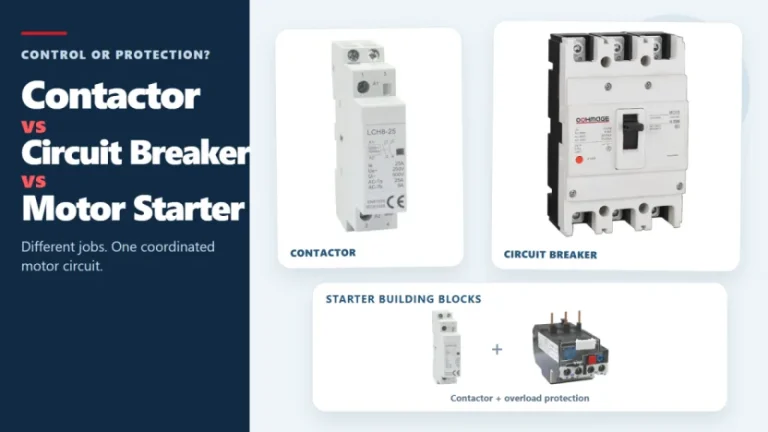
Figure 1. Contactors, circuit breakers, and motor starters solve different control and protection tasks. These three devices often appear in the same motor-control panel, but they solve different problems. A contactor handles frequent, remote, or automatic switching during normal operation. A circuit breaker interrupts abnormal current within its rated capability. A motor starter normally combines […]
The main types of circuit breakers used in low-voltage distribution include miniature circuit breakers (MCBs), molded case circuit breakers (MCCBs) and residual-current devices such as RCCBs and RCBOs. They are not interchangeable. MCBs and MCCBs are selected for overcurrent protection in different circuit roles, an RCCB provides residual-current protection without integral overcurrent protection, and an […]
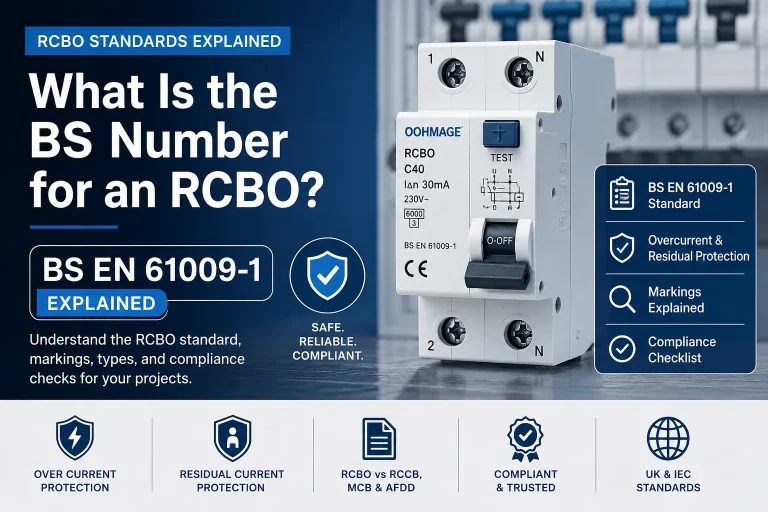
Introduction If you are searching for the RCBO BS number, the answer most commonly required in UK and IEC-based electrical procurement is BS EN 61009-1. This is the principal product standard associated with residual current circuit breakers with overcurrent protection used in residential, commercial, and similar installations. However, merely the BS number is not sufficient […]