How to Choose the Right Delay Timers for Your Needs
Published: Author: Conor
In various fields, there is always a need for a device that can control the machine’s energy system and current flow. Sometimes, we need our machine to keep working even after it is switched off. Conversely, it’s better for the machine to function a few seconds after getting a power supply. In such cases, an off delay timer, an efficient delay timer, comes to the rescue.
A delay timer allows you to control all kinds of machines according to your needs. Whether the machine is in your home or the factory, it can be handled efficiently with the help of delay timers.
This article provides you with a detailed explanation of delay timers and everything you need to know about them.
What is a Delay Timer?
Delay Timers slow down the electrical system or circuit’s activation and deactivation time for a certain period. It controls the running process, conserves energy, and enhances the efficiency of the machine or system. Further, delay timers ensure the action happens only after a set duration. There are two types of delay timers. Let’s head over to overview them.
On-Delay vs. Off-Delay Timers
Many operations in the control circuit of the system will be easy to manage by using delay timers. They are of two categories, which are on-delay and off delay timers.
On-Delay Timers
On-delay timers are also known as delay-on timers as they lag between the activation of input and output signals. In other words, once you switch on the machine, the on delay timer will start after a few seconds or minutes because of on-delay timers. It makes it possible to set a delay time or operation duration before it activates the circuit.
Off-Delay Timers
Off-delay timers are the opposite of on-delay timers. They keep the circuit or system running for a few seconds or time after input signals have switched off. For example, you may turn off the switch of your motor, but it will keep running for a few seconds because of off-delay timers.
Detailed Comparison of On-Delay vs Off-Delay Timers
Both timers serve a similar purpose of delaying the time, but they have different functions while activating the machine.
Equipment
On-Delay Timers
Off-Delay Timers
Timing Function
Delay between activation of the input and activation of the output signal.
The delay between removal of input and deactivation of output signals
Delayed Time
Upon switching on the input signal, the output signal stays inactive for a specific time.
After switching off the input signal, the output signal stays active for a specific time.
Output Signal Behavior
The output signal stays inactive for a specific time after turning off an input signal.
The output signal stays active even upon turning off the input signal.
Process Needs
Use for the immediate activation
Let your device keep running for a few seconds after switching off.
Types of Delay Timers
Every timer works for different applications and serves various purposes. We will review a few types of delay timers and their uses.
Mechanical Timer
They are the simplest type of delay timers, also known as manual timers. They use mechanical movement (springs and gears) to regulate time. While they are commonly used in household appliances like kitchen timers, they are less suited for high-precision or industrial applications where accuracy is critical.
Electronic Timer
This kind of timer works with an electric circuit to control the delays. Modern electronic timers, including programmable logic controllers (PLCs), are designed for more complex applications. They provide more precise control of time intervals. These timers use integrated circuits (ICs) to perform accurate timing functions, especially in automated systems and industrial applications.
Flasher Timer
It contains a flash that continuously switches on and off for certain time intervals. Flash typically occurs after the usage of input voltage. It indicates the continuation of a process or system, like emergency lightning.
Programmable Timer
Programmable timers are best for the complex and challenging systems. These timers are especially useful in industrial settings where multiple timing sequences are required. They are used in systems like conveyor belts and automated machinery where customized control is necessary.
How Do Delay Timers Work
Delay timers control the flow of the process or system. They control the activation and deactivation of a process after a specific time rather than an immediate action.
The delay timer works when it receives the input signal and starts calculating the preset time of the process. During this preset or delay time, other system or devices gets ready to start properly. Upon the completion of the delay time, the process either starts or stops based on the installation of the type of delay timer.
An on-delay timer will initiate the circuit current flow after its preset time. In comparison, off-delay will let the circuit stop its activity after its preset time.
Applications of Delay Timers
Delay relay timers are useful in so many fields and daily life. Some of its uses are as follows.
Industrial Automation
In factories, the delay timers ensure that the machines start or stop at an accurate time. So, it helps to avoid damage to the machine or any inconvenience in production. Delay timers enhance the whole process in industries.
HVAC Systems
You can save energy and prolong the lifespan of your heating and cooling system with the help of delay timers. These timers control when the units should turn on or off to avoid frequent cycling.
Lighting Systems
Delay timers are handy in lighting systems because they can keep the lights on after turning them off. Like stairways or parking lots, lights will stay active for a few minutes after someone has left. It provides safety and convenience.
Motor Control
Frequent on and off of motors will heat the motor system and wiring. Delay timers control the activation and deactivation of the motor. It reduces unnecessary wear and prevents motors from heating.
Choosing the Right Relay Delay Timer
One must consider a few factors before choosing a delay timer.
Delay Timing Range
The timing range of how long the device can control the machine is different for each one. So, ensuring the timer supports the time range you need to control your machine is important.
Delay Voltage
If you use an incompatible timer, it can damage your machine or even the system. So, before selecting the delay timer, ensure it matches your system’s voltage requirements.
Current Rating
Check that the delay timer can handle the current flow of your machine through it. Avoiding it can lead your machine to malfunction or severe damage by overheating.
Size and Mounting
The timer’s size is another thing you must be aware of. You will need a proper place and size to fit the timer for your needs. Otherwise, the delay timer will not be able to perform its activities.
Benefits of Using Delay Relay Timer
Energy Saving
By using delay timers to control when the machine and devices run, you can reduce energy waste because it prevents the machine from running for too long when not needed.
Extended Equipment Lifespan
By carefully managing when the machine should run or stop, it reduces the unnecessary wear and tear of the machine. This helps increase the machine’s lifespan and reduces the need for repairs.
Safety
By delaying the turning on and off of the machine in certain processes, you can ensure that the machine works under certain conditions. It protects both the machine and the worker.
Smoother operations
Mistakes can be made by humans but not by machines. That is why, by controlling the system and working more efficiently, relay delay timers ensure that all the processes work in the correct order and at the right time.
Delay Timer Common Issues and Troubleshooting
Even though the delay timers are safe and reliable, there can still be some issues. However, there is also a way to fix each one of them.
Timer Not Working
If the timer is not working properly, you first need to check if it is wired properly and receiving the correct power. If that is not the issue, then check for any loose connections.
Incorrect Timing
Double-check the setting to see if the timer is functioning at the wrong time or not according to the set period. If you use the electronic timer, check if the components, like the capacitor, need replacing.
Overheating
If the timer starts to overheat, the reason can be that the electrical load is too high. To avoid heating, ensure the timer is compatible enough to handle the current running through it.
Final Thoughts
Relay delay timers are extremely useful tools for controlling your machine and system efficiency. It controls the turning on and off of the machine and system to avoid any damage or waste of energy. Whether you need it for simple household devices or heavy industrial machinery, it comes in all types and sizes.
However, it is important to understand each type like off delay timer and how they work before choosing the one from electric equipment suppliers. Using delay timers is a simple yet effective way to enhance the performance of your machine while preventing it from damage and increasing its lifespan.
FAQs
How does a delay timer save energy?
Sometimes, a person forgets to turn on and off the machine, which can result in a massive loss of energy. Here, delay timers promptly control the machine’s functioning and save energy.
When does the delay timer overheat?
A delay timer will heat up if you are not using the right type of it according to your machine. The timer won’t be able to handle the current flowing through it. For heavy machinery, it is important to use a compatible delay timer to handle its electricity flow.
Which type of delay timer is best for complex systems?
For complex systems, the programmable delay timers will be an ideal option. They are perfect because you can set them with specific time cycles and even program them according to your tasks.
Can I use a delay timer for household devices?
Yes, delay timers are very important for household devices like lighting systems or small motors. They offer convenience and save energy in daily usage.
What are the key factors in choosing the right delay timer?
Before getting a delay timer, it is important to consider a few key factors, including timing range, voltage compatibility, current rating, size, and mounting. Ignoring any of these can lead your equipment to severe damage and malfunctioning.
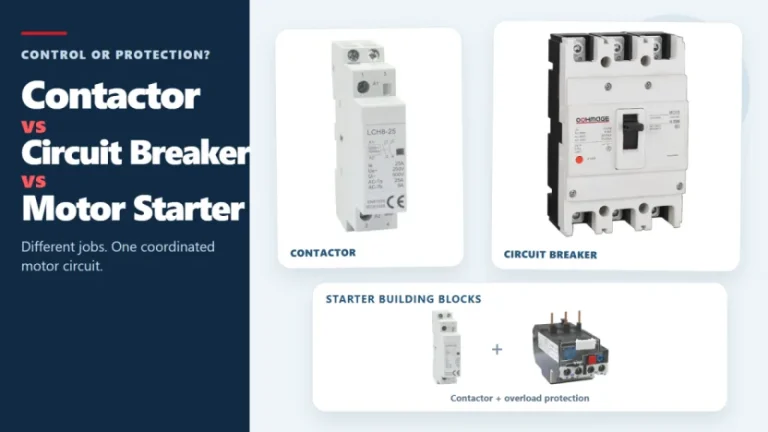
Figure 1. Contactors, circuit breakers, and motor starters solve different control and protection tasks. These three devices often appear in the same motor-control panel, but they solve different problems. A contactor handles frequent, remote, or automatic switching during normal operation. A circuit breaker interrupts abnormal current within its rated capability. A motor starter normally combines […]
The main types of circuit breakers used in low-voltage distribution include miniature circuit breakers (MCBs), molded case circuit breakers (MCCBs) and residual-current devices such as RCCBs and RCBOs. They are not interchangeable. MCBs and MCCBs are selected for overcurrent protection in different circuit roles, an RCCB provides residual-current protection without integral overcurrent protection, and an […]
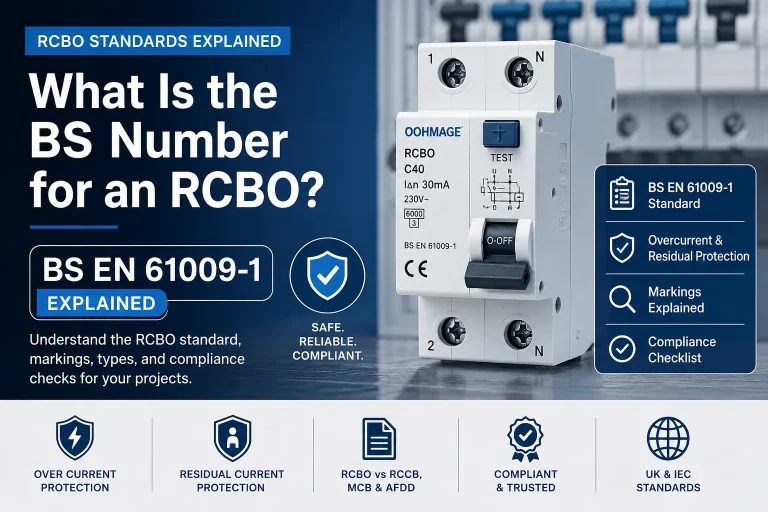
Introduction If you are searching for the RCBO BS number, the answer most commonly required in UK and IEC-based electrical procurement is BS EN 61009-1. This is the principal product standard associated with residual current circuit breakers with overcurrent protection used in residential, commercial, and similar installations. However, merely the BS number is not sufficient […]