Your Ultimate Guide to MCB Distribution Boards: An In-Depth Look at MCB Circuit Breaker Characteristics and Core Functions
Published: Author: Joanna
Introduction
As modern infrastructure expands across residential developments, commercial facilities, industrial plants, and renewable energy projects, the need for reliable localized electrical protection has become more critical than ever. Electrical systems today must safely handle increasing load density, continuous operation, and growing dependence on sensitive electronic equipment. In this environment, the role of the MCB circuit breaker and the MCB distribution board has become foundational to safe low-voltage power distribution.
Over the past several decades, modern low-voltage systems have steadily replaced traditional fuse-based protection with modular circuit breaker technology. Unlike disposable fuses, MCB circuit breakers provide resettable, fast-response protection against overloads and short circuits while improving operational convenience and maintenance efficiency.
This technical guide explores the engineering characteristics, operational mechanics, board architecture, and real-world applications of modern MCB protection systems. It also examines regional installation challenges in Southeast Asia, proper tripping curve selection, and procurement best practices for contractors, panel builders, and EPC companies.
What Is an MCB Circuit Breaker?
An MCB circuit breaker (Miniature Circuit Breaker) is an automatically operated electromechanical protection device designed to protect electrical circuits from damage caused by overloads and short circuits.
Unlike traditional fuse systems, an MCB circuit breaker disconnects the circuit during abnormal current conditions and can be reset after the fault is cleared. This resettable characteristic significantly improves operational efficiency and reduces replacement costs.
Modern MCB circuit breakers are engineered with several key characteristics:
Compact modular construction
DIN-rail mounting compatibility
Thermal and magnetic protection mechanisms
Standardized current ratings, typically up to 125A
High mechanical and electrical endurance
Today, the MCB circuit breaker serves as the primary safety barrier in residential, commercial, and light industrial power systems. High-quality manufacturers design these devices to operate safely through thousands—or even millions—of switching cycles under demanding operating conditions.
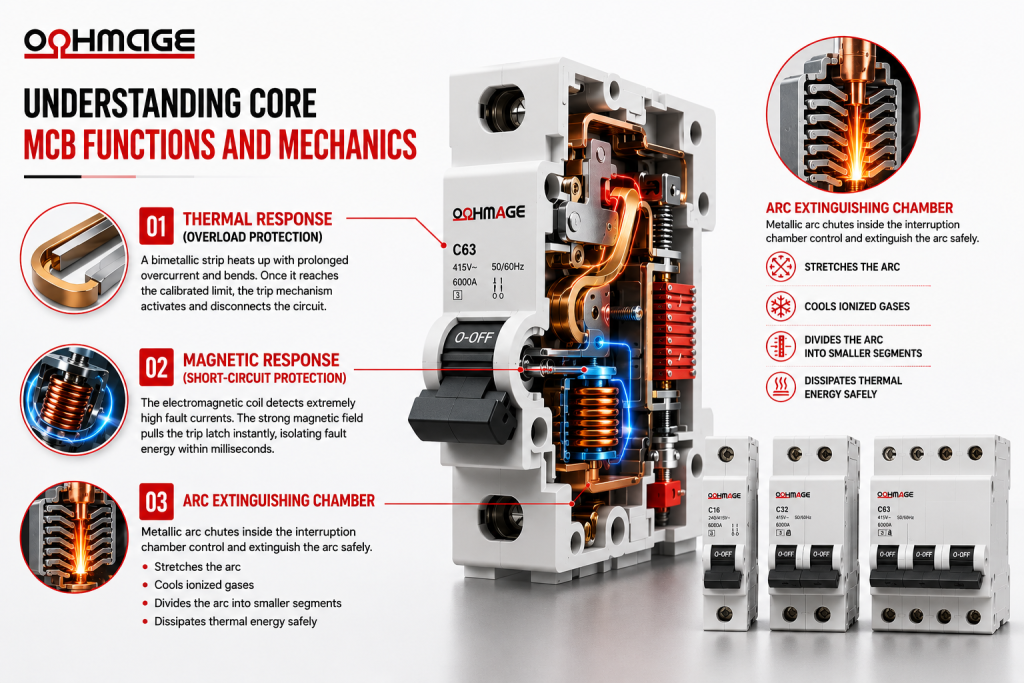
Understanding Core MCB Functions and Mechanics
The Thermal Response (Overload Protection)
One of the most important MCB functions is overload protection.
Inside the MCB circuit breaker is a bimetallic strip that reacts to prolonged overcurrent conditions. When current exceeds the rated value for an extended period, the strip heats gradually and bends due to the different thermal expansion rates of the metals.
Once the bending reaches a calibrated threshold, the trip mechanism activates and disconnects the circuit. This controlled response prevents cable insulation degradation, overheating, and potential fire hazards caused by sustained overload conditions.
The Magnetic Response (Short-Circuit Protection)
The second core MCB function is instantaneous short-circuit protection.
The MCB circuit breaker contains an electromagnetic coil that responds immediately to extremely high fault currents. During a short circuit, the massive current surge generates a strong magnetic field that pulls the trip latch almost instantly.
This rapid operation isolates dangerous fault energy within milliseconds, minimizing equipment damage and reducing arc flash risks.
The Arc Extinguishing Chamber
When breaker contacts separate under fault conditions, an electrical arc forms between the contacts. This arc can reach extremely high temperatures and must be controlled rapidly.
Modern MCB circuit breakers use metallic arc chutes inside the interruption chamber. These structures:
Stretch the arc
Cool ionized gases
Divide the arc into smaller segments
Dissipate thermal energy safely
Efficient arc extinguishing is essential for breaker reliability and operational safety.
The Anatomy of a Modern MCB Distribution Board
Enclosure and Structural Integrity
The MCB distribution board enclosure protects internal components from environmental exposure, accidental contact, and mechanical damage.
Commercial and industrial boards often use:
Cold-rolled steel enclosures for durability and structural strength
Powder-coated finishes for corrosion resistance
High-grade halogen-free plastics for specialized environments requiring lightweight or non-conductive properties
Proper enclosure design also supports ventilation and thermal management.
Busbars and DIN Rails
The standardized 35mm DIN rail forms the mechanical mounting platform for modular MCB devices. It allows fast installation, secure positioning, and simplified maintenance.
Copper busbars inside the MCB distribution board distribute electrical current evenly to multiple breakers while minimizing thermal losses and voltage drop. Proper busbar sizing is critical for preventing overheating in high-density installations.
Neutral and Earth Terminal Blocks
Neutral terminal blocks provide organized return current paths, while earth bars ensure safe grounding throughout the board.
Correct earth bonding is essential because it:
Clears fault currents safely
Reduces shock hazards
Supports proper operation of protective devices
Poor neutral or earth routing can compromise both safety and protection performance.
Global Standards with Regional Context: Southeast Asia Applications
Electrical infrastructure in Southeast Asia presents unique environmental and urbanization challenges. The design of an MCB distribution board must account for regional operating conditions.
Combating High Humidity and Heat (Indonesia & Malaysia)
Tropical coastal environments in Indonesia and Malaysia expose electrical systems to:
High humidity
Salt-laden air
Elevated ambient temperatures
In these conditions, panel builders often specify:
Higher IP-rated MCB distribution boards
Anti-corrosion busbars
Improved ventilation and thermal management
Without proper protection, moisture-induced micro-shorts and corrosion can lead to nuisance tripping and premature breaker failure.
Rapid urbanization in Vietnam and Thailand has increased demand for compact electrical systems in high-rise commercial and residential developments.
To maximize circuit density without sacrificing safety, engineers deploy:
Multi-row MCB distribution board designs
Compact modular MCB layouts
Optimized internal airflow structures
These designs help maintain reliable thermal dissipation despite space constraints.
Selecting the Correct MCB Circuit Breaker Tripping Curves
Choosing the correct magnetic tripping curve is critical for preventing nuisance tripping while maintaining safe fault protection.
Type B Curves (Resistive Loads)
Type B MCB circuit breakers trip at approximately 3 to 5 times rated current.
Typical applications include:
Residential outlets
Standard lighting circuits
Commercial office loads
These circuits usually have low inrush current characteristics.
Type C Curves (Inductive Loads)
Type C breakers trip at approximately 5 to 10 times rated current.
They are commonly used for:
Air conditioning systems
Small motors
Commercial equipment
Light industrial applications
Type C curves handle moderate startup surges effectively.
Type D Curves (High Inrush Loads)
Type D breakers trip at approximately 10 to 20 times rated current.
They are designed for:
Large transformers
Heavy machinery
X-ray systems
High-inrush industrial equipment
Without Type D protection, these systems may experience nuisance tripping during startup.
MCB Tripping Curve Comparison Table
Tripping Curve
Instantaneous Trip Range
Typical Application
Load Type
Type B
3–5 × rated current
Residential lighting and outlets
Resistive loads
Type C
5–10 × rated current
HVAC systems, small motors
Moderate inductive loads
Type D
10–20 × rated current
Heavy machinery, transformers
High inrush loads
Best Practices for B2B Procurement and Compliance
For EPC companies, contractors, and property developers, compliance and manufacturing quality are critical considerations when sourcing MCB protection systems.
Projects outside the U.S. commonly require compliance with:
IEC 60898-1 for residential and commercial protection
IEC 60947-2 for industrial low-voltage circuit breakers
Local grid authority requirements
Project-specific testing documentation
When selecting suppliers, procurement teams should evaluate:
Manufacturing quality control systems
Precision CNC machining capability
Automated assembly consistency
Testing and certification documentation
Technical engineering support
Reliable OEM manufacturers provide long-term product consistency and compliance assurance for large-scale infrastructure projects.
Final Thoughts
Modern electrical infrastructure depends on precisely calibrated protection systems to maintain safe, reliable, and efficient power distribution. The MCB circuit breaker and MCB distribution board are now indispensable components in residential, commercial, and industrial installations worldwide.
Understanding core MCB functions, proper board architecture, environmental installation considerations, and correct tripping curve selection helps engineers and contractors improve both safety and operational reliability.
Before finalizing procurement decisions, electrical wholesalers, panel builders, and EPC contractors should carefully assess:
Installation environment
Load characteristics
Thermal conditions
Compliance requirements
Future expansion capability
Well-designed MCB systems reduce operational risk, simplify maintenance, and support long-term infrastructure reliability.
FAQs
What is the main difference between an MCB and an MCCB?
An MCB circuit breaker is typically used for lower-current residential and commercial applications, while an MCCB (Molded Case Circuit Breaker) supports higher current ratings, adjustable protection settings, and industrial-level fault interruption capability.
Can I install a Type C MCB circuit breaker in a standard residential property?
Yes, but only if the connected loads justify the higher magnetic trip threshold. Standard residential lighting and outlets often use Type B breakers, while Type C is more suitable for circuits with moderate inrush current such as air conditioners or pumps.
How do I calculate the total capacity needed for an MCB distribution board?
Calculate the total expected load current, apply diversity and safety margins, evaluate future expansion requirements, and verify busbar and incoming supply ratings before selecting the MCB distribution board size and configuration.
Brand Introduction
OOHMAGE provides electrical protection solutions including MCBs, electrical switches, and related protection devices for residential, commercial, and industrial electrical systems.
A single-line diagram can look simple and still be difficult to read. One line may represent a multiphase circuit, a small symbol may stand for a major protective device, and a short label may carry the information that determines what equipment belongs downstream. The most reliable way to read a single-line diagram is to follow […]
Figure 1. Three-phase SPD selection starts with system facts, not the largest kA number. A three-phase surge protector should not be selected by the largest kA number on its label. First confirm the system voltage, whether a neutral is present, the earthing arrangement, the installation point, and the required SPD type. Then compare Uc, Up, […]
An AC-only miniature circuit-breaker,you cannot treat it as a DC circuit by default.Confirm before using: If the manufacturer explicitly rates the selected model for the required DC voltage, pole arrangement, polarity where applicable, fault current, and breaking capacity.Some breakers carry both AC and DC ratings, but these alone cannot reflect the actual situation. If the […]