What Is an RCCB? A Deep Dive into RCCB Meaning and the Core Differences in RCCB and ELCB
Published: Author: Joanna
Introduction
Electrical safety has become one of the most critical considerations in modern residential, commercial, and industrial power systems. As electrical installations become more complex and connected loads continue to increase, the risks associated with leakage current, insulation failure, and accidental electric shock also rise significantly. Protective devices are therefore essential for maintaining safe and reliable operation.
Among these devices, the RCCB plays a major role in preventing electric shock and reducing fire hazards caused by leakage currents. RCCBs are widely used in homes, office buildings, factories, renewable energy systems, and modern infrastructure projects where electrical safety standards demand fast and reliable fault protection.
Understanding RCCB meaning and the key differences between RCCB vs ELCB is important when selecting the correct protection solution. Although both devices are designed to improve electrical safety, their operating principles, protection performance, and application suitability differ considerably. This article explains how RCCBs work, their internal components, common types, and why RCCBs have become the preferred leakage protection device in modern electrical systems.
What Is an RCCB?
An RCCB (Residual Current Circuit Breaker) is an electrical protection device designed to detect leakage current and automatically disconnect power when dangerous current imbalance occurs between the live and neutral conductors.
The primary function of an RCCB is to protect people and equipment from:
Electric shock
Leakage-current-related fire hazards
Insulation failure risks
Ground fault conditions
Unlike standard overcurrent protection devices such as MCBs (Miniature Circuit Breakers), an RCCB does not primarily protect against overloads or short circuits. Instead, it focuses on detecting leakage currents that may occur when current flows unintentionally through a person, damaged insulation, or grounding path.
Modern electrical systems rely heavily on RCCBs because leakage faults may not generate enough current to trip conventional circuit breakers. In these situations, the RCCB provides a critical additional layer of protection.
Understanding RCCB Meaning in Electrical Protection Systems
Why RCCBs Are Important for Electrical Safety
To fully understand RCCB meaning, it is important to recognize the hazards associated with leakage current.
When insulation deteriorates or accidental contact occurs, electrical current may flow through unintended paths. Even relatively small leakage currents can:
Cause severe electric shock
Damage sensitive equipment
Generate heat that may lead to fire
RCCBs reduce these risks by disconnecting the circuit extremely quickly once leakage current exceeds a predefined threshold.
The importance of RCCBs in electrical safety includes:
Preventing fatal electric shock incidents
Protecting users in wet or high-risk environments
Reducing fire risks caused by insulation breakdown
Improving overall electrical system safety compliance
Common RCCB Ratings and Configurations
RCCBs are available in several configurations depending on application requirements.
Common configurations include:
2-pole RCCBs for single-phase systems
4-pole RCCBs for three-phase systems
Various sensitivity ratings such as:
30mA (personal protection)
100mA (equipment/fire protection)
300mA and above (industrial applications)
The correct configuration depends on system voltage, load type, and required protection level.
How Does an RCCB Work?
Normal Operating Conditions
Under normal conditions, the current flowing through the live conductor is equal to the current returning through the neutral conductor. Because these currents are balanced, the RCCB remains closed and allows normal power flow.
Leakage Current Detection
If insulation failure or accidental contact occurs, some current leaks to ground instead of returning through the neutral conductor. This creates an imbalance between live and neutral currents.
The RCCB continuously monitors this balance. Once the leakage current exceeds the device’s sensitivity threshold, the RCCB detects the imbalance and initiates tripping.
Automatic Circuit Disconnection
The RCCB activates its internal tripping mechanism almost instantly after detecting dangerous leakage current. This rapid response minimizes shock duration and reduces the likelihood of severe injury or electrical fire.
Fast disconnection time is one of the key advantages of RCCBs in modern protection systems.
Main Components of an RCCB
Differential Current Transformer
The differential current transformer is the sensing element of the RCCB. It continuously compares current flowing through the live and neutral conductors.
Under balanced conditions, magnetic fields cancel each other. Leakage current creates imbalance, which the transformer detects.
Tripping Mechanism
The tripping mechanism disconnects the circuit once leakage current exceeds the specified limit. It must operate quickly and reliably under fault conditions.
Test Button and Manual Controls
Most RCCBs include a test button that allows users to simulate leakage current conditions. Regular testing verifies that the RCCB remains operational.
Manufacturers typically recommend periodic testing as part of preventive maintenance procedures.
Housing and Terminal Connections
The enclosure provides insulation and user protection, while terminal connections ensure secure electrical contact during installation and operation.
Proper terminal tightening is essential to avoid overheating and connection failure.
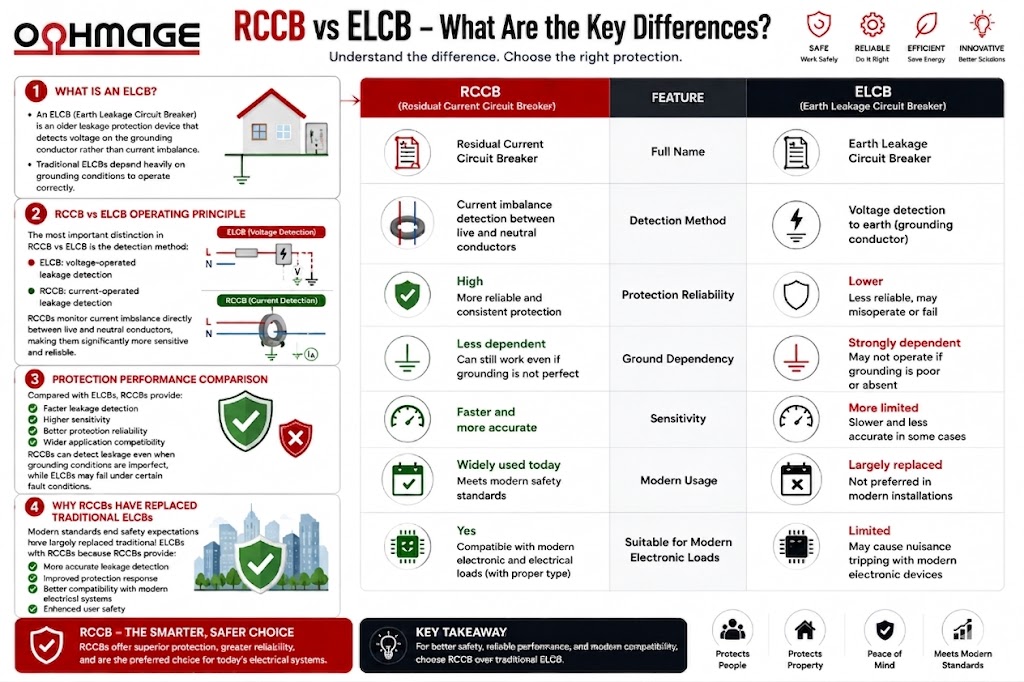
RCCB vs ELCB – What Are the Key Differences?
What Is an ELCB?
An ELCB (Earth Leakage Circuit Breaker) is an older leakage protection device that detects voltage on the grounding conductor rather than current imbalance.
Traditional ELCBs depend heavily on grounding conditions to operate correctly.
RCCB vs ELCB Operating Principle
The most important distinction in RCCB vs ELCB is the detection method:
ELCB: voltage-operated leakage detection
RCCB: current-operated leakage detection
RCCBs monitor current imbalance directly between live and neutral conductors, making them significantly more sensitive and reliable.
Protection Performance Comparison
Compared with ELCBs, RCCBs provide:
Faster leakage detection
Higher sensitivity
Better protection reliability
Wider application compatibility
RCCBs can detect leakage even when grounding conditions are imperfect, while ELCBs may fail under certain fault conditions.
Why RCCBs Have Replaced Traditional ELCBs
Modern standards and safety expectations have largely replaced traditional ELCBs with RCCBs because RCCBs provide:
More accurate leakage detection
Improved protection response
Better compatibility with modern electrical systems
Enhanced user safety
Types of RCCBs Used in Modern Electrical Systems
AC Type RCCBs
AC Type RCCBs detect sinusoidal alternating current leakage. They are commonly used in standard residential and commercial applications.
A Type RCCBs
A Type RCCBs detect both AC leakage and pulsating DC leakage currents generated by electronic devices and modern power supplies.
B Type RCCBs
B Type RCCBs provide advanced protection for:
Variable frequency drives
EV charging systems
Renewable energy inverters
Industrial automation systems
These devices can detect smooth DC leakage currents that standard RCCBs may not identify.
Selective and Time-Delay RCCBs
Selective RCCBs are designed for coordination between multiple protection devices. Time-delay functionality prevents unnecessary upstream tripping.
Applications of RCCBs in Real-World Electrical Systems
Residential Electrical Systems
RCCBs protect homeowners from electric shock hazards caused by damaged appliances, wiring faults, or accidental contact.
Commercial Buildings
Commercial facilities use RCCBs to protect office equipment, lighting systems, and public electrical installations.
Industrial Facilities
Industrial systems require RCCBs to protect machinery, personnel, and critical electrical infrastructure under demanding operating conditions.
Renewable Energy and EV Charging Systems
Modern renewable energy systems and EV chargers increasingly require advanced RCCB protection due to electronic power conversion equipment and DC leakage risks.
Common RCCB Installation and Selection Mistakes
Several common errors reduce RCCB effectiveness:
Selecting incorrect current ratings
Improper neutral conductor wiring
Using RCCBs without proper grounding practices
Confusing RCCBs with MCBs or ELCBs
Ignoring compatibility with modern electronic loads
Improper installation can prevent the RCCB from operating correctly during dangerous leakage conditions.
Key Factors to Consider When Selecting an RCCB
Current and Leakage Sensitivity Ratings
The RCCB must match:
System current requirements
Required leakage sensitivity
Application safety level
Lower sensitivity ratings provide faster personal protection but may increase nuisance tripping in certain environments.
Pole Configuration
Single-phase systems typically use 2-pole RCCBs, while three-phase systems require 4-pole designs.
Standards and Compliance
RCCBs should comply with recognized IEC and international electrical safety standards to ensure tested performance and safe operation.
Compatibility with Modern Electrical Loads
Modern installations increasingly include:
Variable frequency drives
EV charging equipment
Solar inverters
Electronic power supplies
These loads may require advanced RCCB types for reliable protection.
RCCB vs ELCB Comparison Table
Feature
RCCB
ELCB
Full Name
Residual Current Circuit Breaker
Earth Leakage Circuit Breaker
Detection Method
Current imbalance detection
Voltage detection to earth
Protection Reliability
High
Lower compared to RCCB
Ground Dependency
Less dependent on grounding quality
Strongly dependent on grounding
Sensitivity
Faster and more accurate
More limited
Modern Usage
Widely used today
Largely replaced
Suitable for Modern Electronic Loads
Yes (with proper type selection)
Limited compatibility
Industry Trends in RCCB Technology
RCCB technology continues to evolve alongside modern electrical systems.
Current trends include:
Smart RCCBs with monitoring and communication features
More compact modular designs
Improved leakage detection sensitivity
Better compatibility with electronic loads
Integration into smart distribution systems and digital monitoring platforms
As renewable energy and EV infrastructure continue to grow, RCCBs will play an even greater role in electrical safety.
Final Thoughts
Understanding RCCB meaning is essential for designing safe and reliable electrical systems. RCCBs provide critical protection against electric shock and leakage-related hazards that conventional overcurrent devices cannot detect effectively.
The comparison of RCCB vs ELCB clearly demonstrates why RCCBs have become the preferred solution in modern installations. Their improved sensitivity, reliability, and compatibility with modern electrical loads make them an essential component of today’s protection systems.
Selecting the correct RCCB type, rating, and configuration helps improve electrical safety, reduce fire risks, and support long-term system reliability.
FAQs
What is an RCCB and what does it do?
An RCCB is a leakage protection device that detects current imbalance between live and neutral conductors and disconnects power to prevent electric shock and fire hazards.
What is the difference between RCCB vs ELCB?
RCCBs detect current imbalance directly, while traditional ELCBs detect voltage on the grounding conductor. RCCBs are generally more sensitive and reliable.
How often should an RCCB be tested?
Most manufacturers recommend periodic testing using the built-in test button, often monthly or according to maintenance schedules and local electrical regulations.
Brand Introduction
OOHMAGE provides electrical protection solutions including RCCBs, electrical switches, and related protection devices for residential, commercial, and industrial electrical systems.
Figure 1. Contactors, circuit breakers, and motor starters solve different control and protection tasks. These three devices often appear in the same motor-control panel, but they solve different problems. A contactor handles frequent, remote, or automatic switching during normal operation. A circuit breaker interrupts abnormal current within its rated capability. A motor starter normally combines […]
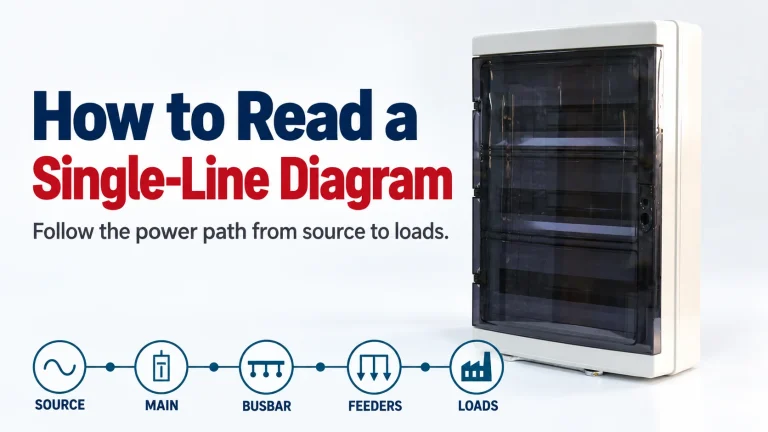
A single-line diagram can look simple and still be difficult to read. One line may represent a multiphase circuit, a small symbol may stand for a major protective device, and a short label may carry the information that determines what equipment belongs downstream. The most reliable way to read a single-line diagram is to follow […]
Figure 1. Three-phase SPD selection starts with system facts, not the largest kA number. A three-phase surge protector should not be selected by the largest kA number on its label. First confirm the system voltage, whether a neutral is present, the earthing arrangement, the installation point, and the required SPD type. Then compare Uc, Up, […]