Electrical Safety 101: How to Properly Size Your Fuse Holder, AC Fuse Holder, and Amp Fuse Holder
Published: Author: Joanna
Introduction
Overcurrent protection is one of the most important aspects of electrical safety in residential, commercial, industrial, and renewable energy systems. Electrical faults such as overloads and short circuits can quickly generate excessive heat, damage wiring, destroy equipment, and even cause fires if circuits are not properly protected. While fuses themselves are critical protective devices, the importance of the Fuse Holder is often underestimated.
A properly selected Fuse Holder ensures that the fuse operates safely and reliably under both normal and fault conditions. Choosing the wrong fuse holder can result in overheating, loose electrical contact, reduced protection performance, or premature equipment failure. In severe cases, undersized or mismatched fuse holders can create dangerous fire hazards.
Understanding how to correctly size a Fuse Holder, including selecting the appropriate AC Fuse Holder and amp fuse holder, is essential for safe electrical system design and long-term reliability. This guide explains the key technical considerations, common mistakes, and practical selection methods for modern fuse holder applications.
What Is a Fuse Holder and Why Does Proper Sizing Matter?
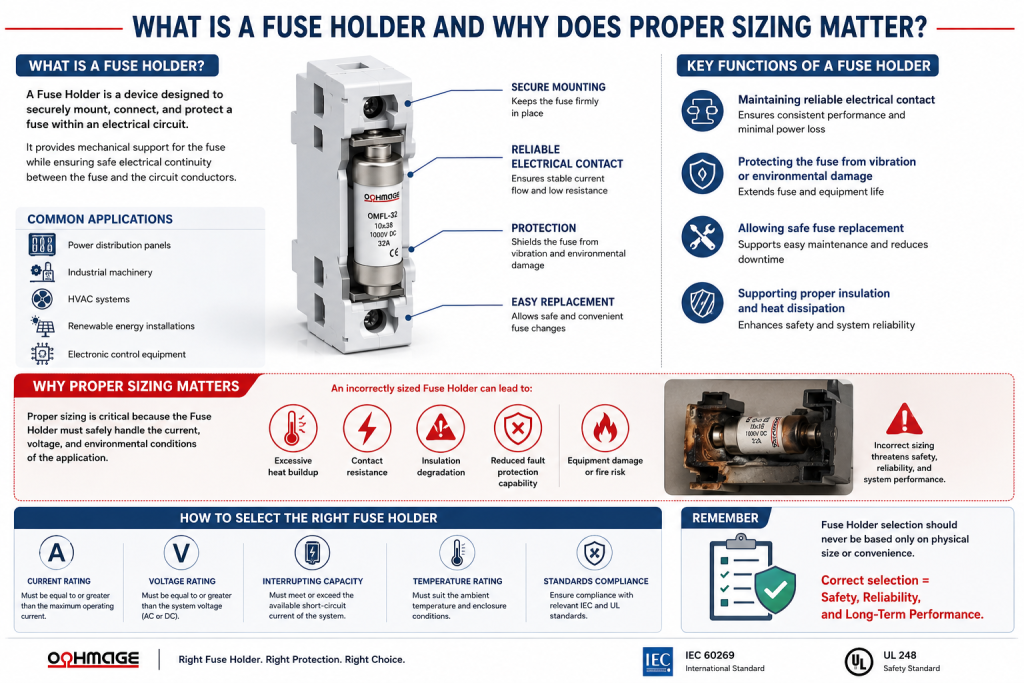
A Fuse Holder is a device designed to securely mount, connect, and protect a fuse within an electrical circuit. It provides mechanical support for the fuse while ensuring safe electrical continuity between the fuse and the circuit conductors.
Fuse holders are used in a wide range of electrical systems, including:
Power distribution panels
Industrial machinery
HVAC systems
Renewable energy installations
Electronic control equipment
The Fuse Holder serves several important functions:
Maintaining reliable electrical contact
Protecting the fuse from vibration or environmental damage
Allowing safe fuse replacement
Supporting proper insulation and heat dissipation
Proper sizing is critical because the Fuse Holder must safely handle the current, voltage, and environmental conditions of the application. An incorrectly sized Fuse Holder can lead to:
Excessive heat buildup
Contact resistance
Insulation degradation
Reduced fault protection capability
Equipment damage or fire risk
For this reason, Fuse Holder selection should never be based only on physical size or convenience.
Understanding the Basics of Fuse Holder Ratings
Correct Fuse Holder sizing starts with understanding the electrical and environmental ratings that define safe operation.
Current Rating (Amp Rating)
The current rating indicates the maximum continuous current the holder can safely carry without overheating. This is where the concept of an amp fuse holder becomes important.
An amp fuse holder must always be selected to match or exceed the expected circuit current. If the holder’s current rating is too low, excessive heat may develop at the terminals or fuse contacts.
For continuous loads, additional safety margin is usually recommended to prevent long-term thermal stress.
Voltage Rating
Voltage rating determines the maximum voltage the Fuse Holder can safely withstand while maintaining insulation integrity.
A Fuse Holder designed for low-voltage systems should never be used in higher-voltage applications, even if the current rating appears acceptable. Improper voltage selection increases the risk of insulation breakdown and arcing.
Interrupting Capacity
Interrupting capacity refers to the ability of the fuse and Fuse Holder combination to safely withstand and isolate fault currents during short-circuit conditions.
Applications with high available fault current require properly rated holders capable of safely containing thermal and mechanical stress.
High temperatures can reduce current-carrying capability, while vibration may loosen electrical connections over time.
How to Properly Size a Fuse Holder
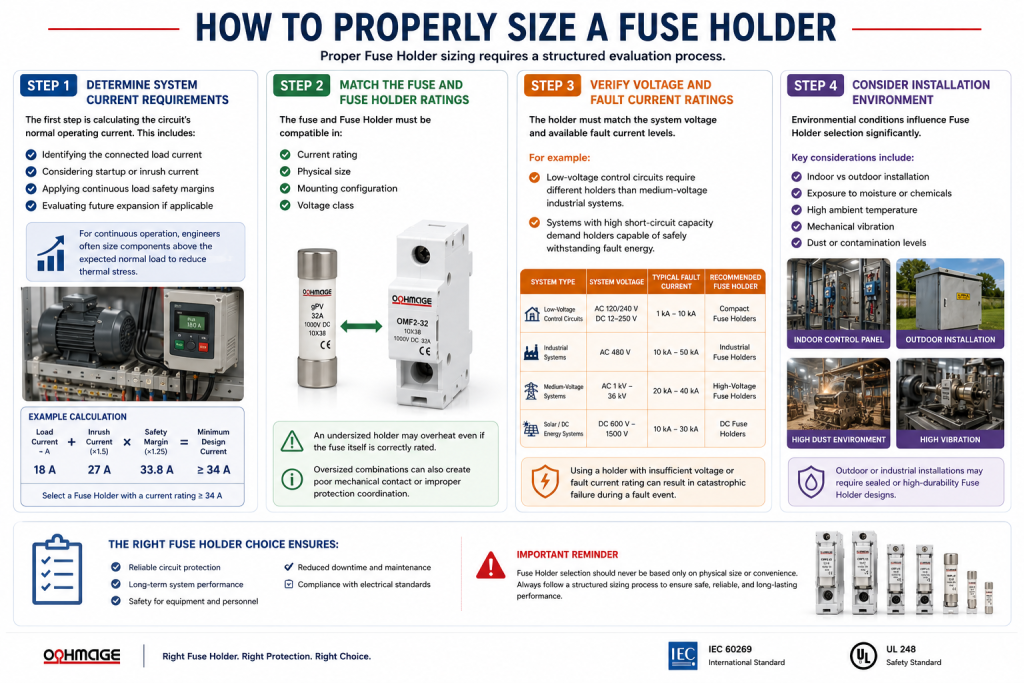
Proper Fuse Holder sizing requires a structured evaluation process.
Step 1 – Determine System Current Requirements
The first step is calculating the circuit’s normal operating current. This includes:
Identifying the connected load current
Considering startup or inrush current
Applying continuous load safety margins
Evaluating future expansion if applicable
For continuous operation, engineers often size components above the expected normal load to reduce thermal stress.
Step 2 – Match the Fuse and Fuse Holder Ratings
The fuse and Fuse Holder must be compatible in:
Current rating
Physical size
Mounting configuration
Voltage class
An undersized holder may overheat even if the fuse itself is correctly rated. Oversized combinations can also create poor mechanical contact or improper protection coordination.
Step 3 – Verify Voltage and Fault Current Ratings
The holder must match the system voltage and available fault current levels.
For example:
Low-voltage control circuits require different holders than medium-voltage industrial systems.
Systems with high short-circuit capacity demand holders capable of safely withstanding fault energy.
Outdoor or industrial installations may require sealed or high-durability Fuse Holder designs.
Understanding AC Fuse Holder Selection
What Is an AC Fuse Holder?
An AC Fuse Holder is specifically designed for alternating current (AC) circuits. It provides insulation and contact characteristics optimized for AC voltage behavior and fault interruption.
Unlike DC systems, AC current naturally passes through zero during each cycle, which affects arc interruption characteristics. This is one reason AC and DC fuse holders are not always interchangeable.
Common Types of AC Fuse Holders
Several AC Fuse Holder configurations are commonly used:
Panel-mounted fuse holders
DIN rail fuse holders
Inline fuse holders
Cartridge fuse holders
Each type serves different installation and maintenance requirements.
Typical Applications of AC Fuse Holders
AC Fuse Holders are widely used in:
Power distribution panels
HVAC systems
Industrial equipment
Commercial buildings
Renewable energy systems using AC distribution
Their selection depends on current rating, accessibility, mounting method, and environmental conditions.
Choosing the Right Amp Fuse Holder
Why Amp Rating Is Critical
The amp rating of an amp fuse holder determines how much current it can safely carry over time.
If the holder is underrated:
Terminal overheating may occur
Contact surfaces may degrade
Electrical resistance increases
Fire risk rises significantly
Oversized vs Undersized Fuse Holders
Both oversized and undersized holders can create problems.
Fuse Holder Condition
Potential Risk
Result
Undersized amp fuse holder
Overheating and contact failure
Reduced safety and equipment damage
Oversized holder with poor fit
Weak electrical contact
Arcing and unstable operation
Incorrect voltage rating
Insulation failure
Arc flash or electrical hazard
Improper environmental rating
Corrosion or thermal stress
Reduced lifespan and reliability
Matching Amp Fuse Holders to Application Type
Different systems require different amp fuse holder solutions:
Residential systems: compact low-current holders
Commercial systems: higher-capacity distribution holders
Industrial systems: rugged heavy-duty holders
High-power systems: high interrupting-capacity holders
Correct application matching improves both protection performance and equipment lifespan.
Common Fuse Holder Sizing Mistakes
Several common mistakes reduce Fuse Holder safety and reliability:
Ignoring voltage compatibility
Using the wrong amp fuse holder
Overlooking ambient temperature derating
Choosing incorrect mounting styles
Using incompatible fuse and holder combinations
Many electrical failures are caused not by the fuse itself, but by poor Fuse Holder selection or installation.
Real-World Applications of Properly Sized Fuse HoldersIndustrial Power Distribution
Industrial systems use Fuse Holders to protect:
Motors
Drives
Control systems
Production equipment
High-current industrial applications require durable holders with strong thermal performance.
Commercial and Building Systems
Commercial facilities depend on Fuse Holders for:
Lighting circuits
HVAC systems
Backup power equipment
Distribution panels
Reliable Fuse Holder performance helps minimize downtime and maintenance issues.
Renewable Energy and Backup Power Systems
Solar and battery systems often require specialized fuse holder solutions due to:
High DC current
Environmental exposure
Elevated operating temperatures
Correct holder selection improves safety and long-term reliability.
Electronic Equipment and Control Panels
Compact Fuse Holders are widely used in:
PLC control panels
Automation systems
Sensitive electronic devices
Space-saving designs must still maintain adequate thermal and electrical performance.
Safety Standards and Compliance for Fuse Holders
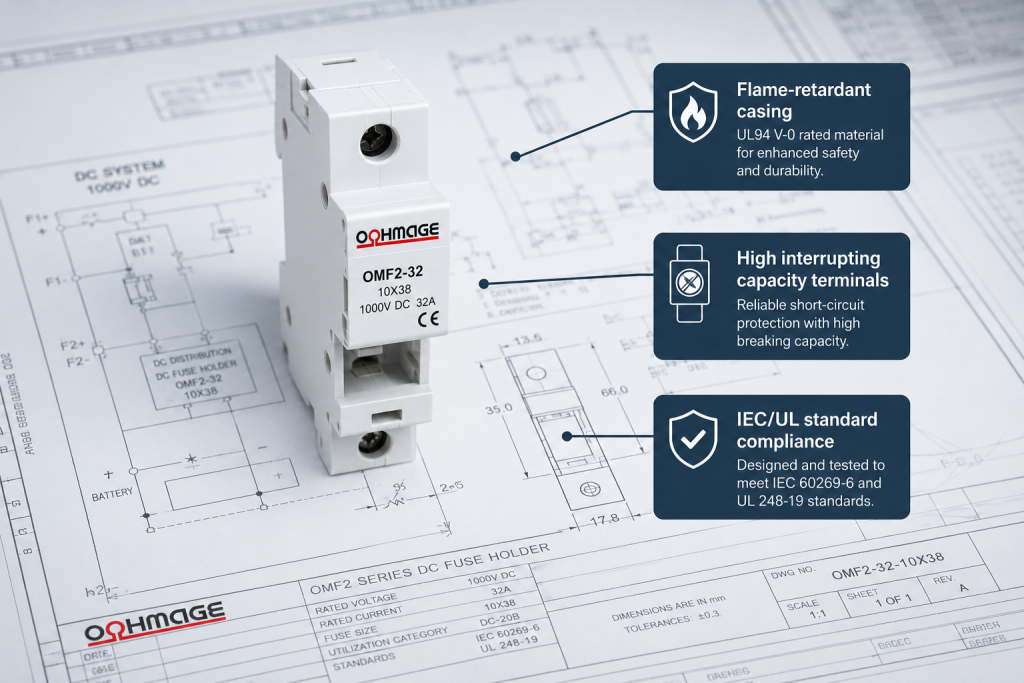
Fuse Holders should comply with recognized international standards to ensure safe operation.
Important standards include:
IEC standards for fuse systems
UL certification requirements
Temperature rise testing standards
Short-circuit performance verification
Certified Fuse Holders provide greater confidence in:
Electrical safety
Mechanical durability
Thermal performance
Long-term reliability
Testing and compliance are especially important in industrial and commercial applications.
Industry Trends in Modern Fuse Holder Design
Fuse Holder technology continues to evolve with changing electrical system demands.
Current trends include:
More compact modular designs
Improved touch-safe protection features
Better thermal performance materials
Integrated fuse status indicators
Smart monitoring capability for critical systems
Modern designs increasingly focus on easier maintenance, higher reliability, and improved operator safety.
Final Thoughts
Proper Fuse Holder sizing is a fundamental part of electrical safety and system reliability. Whether selecting a standard Fuse Holder, an AC Fuse Holder, or a specialized amp fuse holder, correct sizing ensures safe current carrying capability, reliable fuse operation, and long-term equipment protection.
Electrical engineers, installers, and maintenance personnel should always evaluate current rating, voltage compatibility, interrupting capacity, environmental conditions, and compliance requirements before selecting a fuse holder. Careful selection reduces risk, improves operational reliability, and helps prevent costly electrical failures.
FAQs
What is a Fuse Holder used for?
A Fuse Holder securely mounts and electrically connects a fuse within a circuit while supporting safe operation and fuse replacement.
What is the difference between an AC Fuse Holder and a DC fuse holder?
An AC Fuse Holder is designed for alternating current applications, while DC fuse holders are engineered to handle the different arc characteristics of direct current systems.
What standards apply to fuse holder selection?
Fuse Holder selection commonly follows IEC and UL standards covering electrical safety, temperature rise, insulation performance, and fault-current capability.
Figure 1. Contactors, circuit breakers, and motor starters solve different control and protection tasks. These three devices often appear in the same motor-control panel, but they solve different problems. A contactor handles frequent, remote, or automatic switching during normal operation. A circuit breaker interrupts abnormal current within its rated capability. A motor starter normally combines […]
The main types of circuit breakers used in low-voltage distribution include miniature circuit breakers (MCBs), molded case circuit breakers (MCCBs) and residual-current devices such as RCCBs and RCBOs. They are not interchangeable. MCBs and MCCBs are selected for overcurrent protection in different circuit roles, an RCCB provides residual-current protection without integral overcurrent protection, and an […]
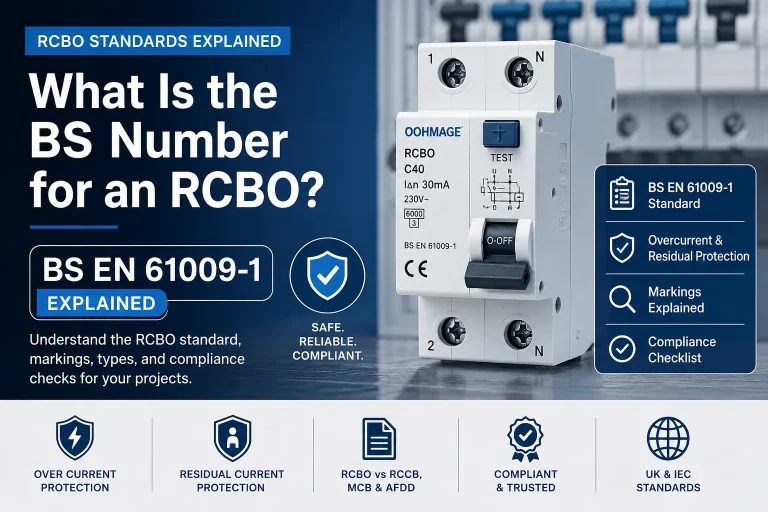
Introduction If you are searching for the RCBO BS number, the answer most commonly required in UK and IEC-based electrical procurement is BS EN 61009-1. This is the principal product standard associated with residual current circuit breakers with overcurrent protection used in residential, commercial, and similar installations. However, merely the BS number is not sufficient […]