Inspecting a Molded Case Circuit Breaker: What’s Inside and How to Spot Damage
Published: Author: Joanna
Introduction
Heavy-duty low-voltage protection serves as a vital backbone for commercial and industrial power distribution. Standard safety measures often fall short in facilities that handle massive, continuous electrical current. Consequently, these demanding environments benefit greatly from robust protection systems. Such systems help intercept catastrophic faults before they can damage machinery or ignite fires.
Natural mechanical and thermal wear gradually affects even the most durable protective equipment. Overlooking subtle signs of component degradation can lead to severe operational risks. For example, facilities might experience catastrophic arc flashes, melted busbars, and prolonged downtime. Therefore, waiting for a breaker to fail before replacing it creates a significant safety liability rather than a solid maintenance strategy.
This technical guide objectively explores how to inspect the internal and external architecture of an industrial breaker. Understanding the construction of these devices helps facility managers identify early physical symptoms of failure. Furthermore, this knowledge allows teams to isolate and replace compromised hardware before it negatively impacts grid reliability
What Is a Molded Case Circuit Breaker?
A Molded Case Circuit Breaker (MCCB) acts as a specialized, industrial-grade safety switch. Engineers design it to automatically cut off electrical flow during severe overloads or short circuits. While it serves a similar fundamental purpose to residential breakers, it operates on a vastly different scale.
Standard miniature circuit breakers (MCBs) typically reach their maximum capacity around 125 amps. Conversely, an MCCB easily handles massive, continuous current loads that often exceed 1600A. It also provides extreme short-circuit breaking capacities for heavy industrial applications.
Additionally, these industrial units offer highly adjustable trip settings. This feature allows electrical engineers to align the breaker’s response curve perfectly with the specific inrush currents of large motors or HVAC compressors. Proactive inspection remains a crucial safety protocol, as relying on visual guesswork is simply inadequate.
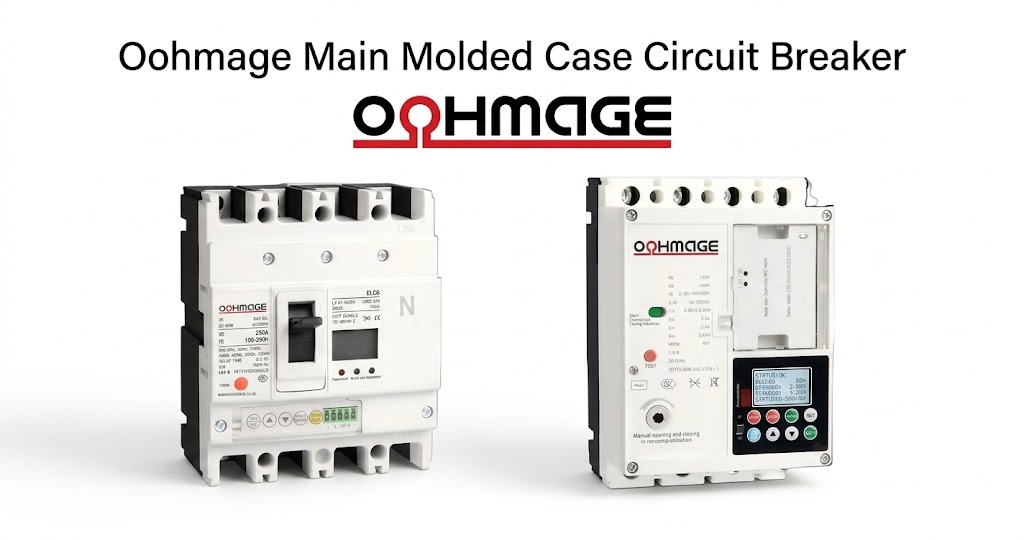
Leading manufacturers like oohmage engineer advanced units, such as the OMM6RT series, to deliver unparalleled resilience. Maintaining that high baseline of safety, however, requires rigorous and regularly scheduled diagnostics.
What Does a Standard Molded Case Circuit Breaker Contain?
To inspect a protective device properly, technicians should first familiarize themselves with its internal anatomy. Grasping what a standard MCCB contains helps demystify the diagnostic process. Ultimately, this understanding explains exactly why specific electrical failures occur in the field.
The Thermoset Housing
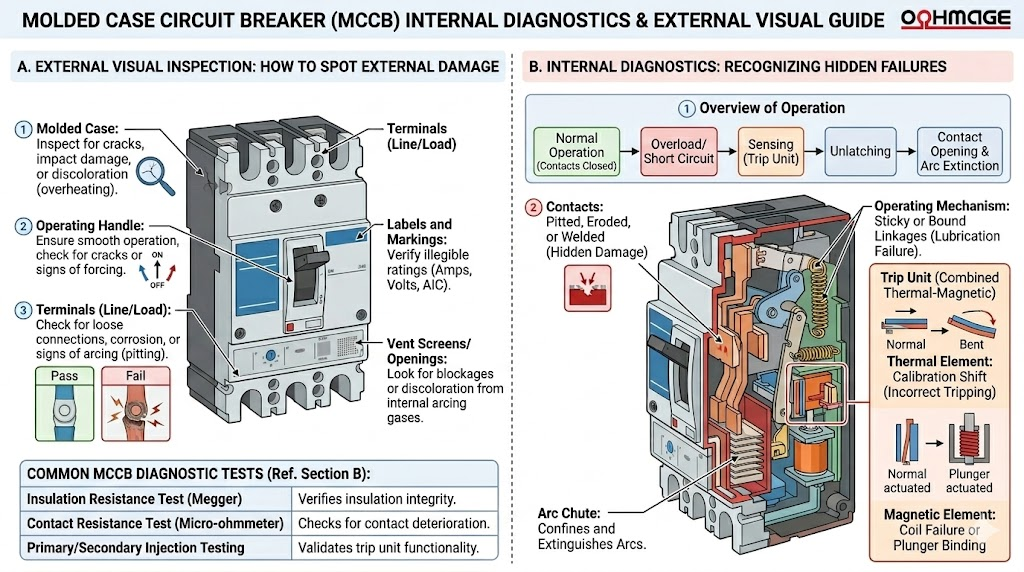
The foundation of the breaker features a rigid exterior casing, usually made from a specialized, glass-reinforced thermoset composite. Instead of standard plastic, manufacturers chemically engineer this material to offer exceptional double insulation. This insulation effectively protects human operators from live internal voltage.
More importantly, the casing possesses immense structural strength. It safely contains the explosive physical energy and expanding gases that extreme arc faults generate. Remarkably, it accomplishes this containment without shattering or melting
The Arc Extinguisher (Arc Chute)
Electricity often attempts to jump the physical gap between separating contacts when a breaker opens under a massive load. This jump creates a high-temperature plasma arc. To counter this hazard, the arc extinguisher uses a carefully engineered stack of V-shaped, parallel metal plates.
Electromagnetic forces rapidly push the newly formed plasma arc directly into the arc chute. Subsequently, the chute aggressively divides, stretches, and cools the plasma. The system continues this process until it completely extinguishes the dangerous arc.
The Operating Mechanism
A heavy-duty over-center toggle mechanism handles the physical opening and closing of the internal contacts. This mechanical assembly relies on compressed tension springs to guarantee a “quick-make” and “quick-break” action.
Because of this specific design, the internal copper contacts snap open or closed at lightning-fast speeds. This rapid movement occurs entirely independently of how quickly the human operator moves the external handle. Consequently, the mechanism prevents the contacts from lingering closely together and drawing sustained electrical arcs.
The Trip Unit (The “Brain”)
The trip unit effectively serves as the diagnostic command center of the breaker. Traditional thermal-magnetic mechanisms use a bimetallic strip that bends under the gradual heat of an overload. Alongside this strip, an electromagnetic coil reacts instantly to handle massive short circuits.
Modern breakers increasingly incorporate advanced electronic trip units (ETUs). These ETUs utilize internal microprocessors to monitor the electrical waveform with pinpoint precision. As a result, they offer highly customizable protection curves and advanced diagnostic reporting that mechanical units simply cannot match.
Visual Inspection: How to Spot External Damage
Performing a thorough visual inspection offers the first line of defense against unexpected switchgear failure. Over time, many critical internal degradations will manifest as distinct physical symptoms on the exterior housing.
Cracks and Carbon Tracking
Technicians should carefully examine the entire thermoset casing for hairline fractures or structural warping. A cracked casing completely compromises the breaker’s ability to safely contain an explosive short circuit.
Inspectors also look for “carbon tracking,” which appears as distinct, black soot paths or web-like burn marks on the plastic. Carbon tracking suggests that high-temperature arc gases are successfully escaping the internal chamber. This alarming symptom indicates a fatally compromised dielectric strength.
Terminal Discoloration and Heat Stress
Heavy-duty lugs and terminal connections frequently become common failure points over years of use. Loose connections or eroded internal contacts create a bottleneck for the electrical current. This bottleneck results in high contact resistance, which naturally generates intense localized heat. Visual signs of this dangerous thermal stress include:
Melted, discolored, or brittle wire insulation near the lugs.
Copper busbars that have turned purple, dark blue, or heavily oxidized due to extreme temperatures.
Warped or bubbling plastic around the breaker’s terminal shields.
Mechanical Binding of the Toggle
Evaluating the physical feel of the breaker’s handle provides immediate diagnostic feedback regarding its health. A well-maintained toggle switch should snap firmly and aggressively into the ON, OFF, and TRIPPED positions.
Conversely, a toggle might feel unusually stiff, require extreme force to move, or feel “spongy”. If it fails to lock into place securely, the internal operating mechanism is likely failing. This mechanical binding serves as an immediate red flag that the breaker cannot clear a fault fast enough during an emergency.
Internal Diagnostics: Recognizing Hidden Failures
Since the casing remains sealed, professional technicians rely on objective testing and environmental analysis. These methods help identify hidden failures occurring deep within the contact chambers.
Contact Wear and Pitting
The extreme heat of a plasma arc vaporizes a microscopic layer of the silver-alloy contact pads every time a breaker interrupts a severe short circuit. Repeated vaporization over years of heavy industrial use causes severe pitting and erosion on these surfaces.
Once the conductive alloy burns away, the contacts lose their ability to carry continuous current efficiently. Eventually, this degradation leads to permanent thermal failure and massive localized overheating.
Debris and Moisture Ingress
Aggressive environmental contamination threatens even the most robust protective devices. Microscopic debris frequently bypasses the outer casing in harsh industrial facilities, coastal infrastructure, or heavy mining operations.Symptoms of environmental ingress include:
Fine conductive dust from manufacturing processes settling across internal phase barriers, creating dangerous micro-shorts.
Coastal salt fog accelerating galvanic corrosion on the precise internal metallic linkages, causing them to seize.
Chemical vapors slowly breaking down the dielectric strength of the rigid polyester housing over time.
Verifying the Trip Mechanism
Technicians utilize the integrated “push-to-trip” button on the front faceplate to ensure responsive internal mechanics. Pressing this button physically unlatches the internal mechanism, effectively simulating a fault condition.
The breaker should trip immediately and forcefully, shifting the toggle into the center TRIPPED position. If it fails to do so, hardened lubricants or heavy corrosion likely coat the internal linkages. A breaker failing this test suffers from structural compromise.
When to Repair vs. When to Replace an MCCB
When to Repair vs. When to Replace an MCCB
Facility managers often wonder if they can refurbish an industrial breaker exhibiting signs of severe wear. However, a strict industry consensus advises against opening or repairing molded casing units in the field.
Manufacturers meticulously calibrate and permanently seal the thermoset casing to safely contain explosive arcs. Breaking that seal destroys the unit’s essential structural integrity. Field repairs of internal components introduce significant danger, instantly void OEM warranties, and violate international safety standards.
When a breaker shows signs of internal degradation, the safest protocol is immediate, complete hardware replacement. Technicians follow a strict electrical testing protocol to determine this necessity:
First, perform a comprehensive visual assessment to check for exterior cracking, heat warping, or carbon tracking.
Next, execute an insulation resistance (Megger) test across the poles to ensure the dielectric isolation remains intact.
Finally, conduct a primary current injection test utilizing calibrated digital equipment to verify accurate thermal and magnetic trip curves.
Decommission and replace the entire unit immediately if it fails any of these physical or electrical benchmarks.
Final Thoughts
Routine visual and mechanical inspections play a crucial role in maintaining regional grid reliability and ensuring personnel safety. The Molded Case Circuit Breaker represents a remarkable piece of engineering, yet it is certainly not immortal.
Allowing these devices to run until they catastrophically fail introduces immense financial liability and severe fire hazards. Electrical engineers can proactively replace heavily worn legacy units with advanced ETUs to future-proof their distribution networks. Upgrading to these smart breakers provides superior diagnostic visibility and significantly tighter protection tolerances.
We encourage transitioning to a technical consultation with the oohmage engineering team. Our specialists happily discuss bulk B2B procurement, seamless switchgear integration, and custom OEM solutions tailored for high-demand infrastructure.
FAQs
How often should an MCCB be inspected?
In standard, climate-controlled commercial environments, a thorough visual and mechanical inspection should occur annually. However, in harsh industrial settings—such as heavy manufacturing, wastewater treatment plants, or corrosive coastal environments—inspections and mechanical exercising should be conducted on a strict bi-annual schedule.
What causes the plastic casing on a Molded Case Circuit Breaker to melt?
The thermoset casing melts exclusively due to extreme, prolonged localized heat. This is almost always caused by high contact resistance at the terminal lugs (due to loose wiring or oxidized copper) or because the internal contact pads have completely eroded. It can also occur if the breaker is subjected to a continuous electrical overload that slightly exceeds its rating but does not surpass the threshold required to trip the thermal mechanism.
Can you clean the internal contacts of an MCCB?
No. Unlike massive Air Circuit Breakers (ACBs) which are designed to be disassembled for maintenance, an MCCB is a factory-sealed unit. Attempting to crack open the casing to file, sand, or clean the internal contacts will ruin the factory calibration, destroy the arc containment properties, and create a lethal hazard upon re-energization. If the internal contacts are compromised, the entire unit must be replaced.
Figure 1. Contactors, circuit breakers, and motor starters solve different control and protection tasks. These three devices often appear in the same motor-control panel, but they solve different problems. A contactor handles frequent, remote, or automatic switching during normal operation. A circuit breaker interrupts abnormal current within its rated capability. A motor starter normally combines […]
Introduction The concept of remote tripping is simple, but in actual operation, project teams often encounter difficulties in specifying the components. The panel factory may require circuit breakers triggered by fire alarm relays, PLC outputs, building management system instructions, or other coordinated control. At this point, “diversion tripping” is only the first step in the […]
The main types of circuit breakers used in low-voltage distribution include miniature circuit breakers (MCBs), molded case circuit breakers (MCCBs) and residual-current devices such as RCCBs and RCBOs. They are not interchangeable. MCBs and MCCBs are selected for overcurrent protection in different circuit roles, an RCCB provides residual-current protection without integral overcurrent protection, and an […]