Circuit Breaker vs Surge Protector – What’s the Difference?
Published: Author: Joanna
Introduction
Electrical panel protection often causes significant confusion among facility managers and even experienced property developers. When designing commercial and high-end residential infrastructure, distinguishing between different protective devices is critical for long-term safety. The confusion typically stems from a misunderstanding of the fundamental difference between an amperage-based fault and a voltage-based fault.
An amperage-based fault, known as an overcurrent, occurs when too much volume of electricity tries to squeeze through a wire. A voltage-based fault, known as a power spike or surge, occurs when the pressure of the electricity suddenly spikes to dangerous levels. Treating these two entirely different electrical anomalies as the same problem leads to severe infrastructure vulnerabilities.
This objective, highly technical guide clarifies the exact engineering mechanics behind these two critical devices. We will explore their internal deployment strategies, specific use cases, and how they complement one another in a modern distribution board. Understanding these distinctions ensures you procure the correct hardware to prevent costly downtime and dangerous electrical fires.
Understanding Overcurrent: What Is a Circuit Breaker?
A circuit breaker serves as the absolute primary safety barrier for any modern building infrastructure. Its exclusive design purpose is to protect the structural copper wiring hidden inside your walls from overheating and catching fire. When electrical current exceeds the safe carrying capacity of the wire, the breaker mechanically trips to sever the power connection instantly.
Modern breakers utilize a highly reliable thermal-magnetic tripping mechanism to handle two distinct types of amperage faults.
1、the thermal component handles sustained overloads—like plugging too many heavy appliances into a single outlet. The excess current slowly heats a precision bimetallic strip inside the breaker, causing it to bend and eventually trip the latch.
2、 the magnetic component handles instantaneous short circuits, such as a phase-to-neutral or phase-to-ground fault. A massive, sudden rush of fault current energizes an internal electromagnetic coil, pulling the trip armature in mere milliseconds to stop an electrical explosion.
Because of this life-saving thermal-magnetic function, the circuit breaker is a mandatory, code-required component in every single distribution board globally. You cannot legally energize a commercial or residential building without them. oohmage brings decades of engineering expertise to this exact field, manufacturing precision Miniature Circuit Breakers (MCBs) and Molded Case Circuit Breakers (MCCBs) designed for maximum reliability under extreme grid stress.
Understanding Overvoltage: What Is a Surge Protector?
While a breaker protects the wires in the wall, a Surge Protective Device (SPD) acts as an auxiliary safeguard for the devices plugged into those wires. An SPD is designed exclusively to protect highly sensitive microprocessors and electronics from transient voltage spikes. These transients are brief, highly destructive bursts of electrical pressure caused by lightning strikes, massive grid switching, or heavy machinery starting up nearby.
The internal architecture of a modern surge protector relies heavily on components like Metal Oxide Varistors (MOVs) or specialized gas discharge tubes. Think of an MOV as a highly intelligent pressure relief valve for electricity. During normal, stable voltage operation, the MOV remains completely passive, allowing power to flow smoothly to your equipment.
However, the exact millisecond a high-voltage transient enters the panel, the MOV changes its state. It instantly clamps down on the excessive electrical pressure, effectively absorbing the spike. The device then safely diverts or “shunts” this excess, destructive energy directly into the earth ground wire, away from your sensitive electronics. It is vital to understand that a surge protector does not monitor, measure, or limit the continuous volume of electrical current (Amps) flowing through the circuit.
Circuit Breaker vs Surge Protector: The Technical Differences
When evaluating the circuit breaker vs surge protector dynamic, panel builders must understand that these devices are not interchangeable. They perform entirely different diagnostic functions using completely different physical mechanics. Here is a direct, objective comparison of their operational realities:
The Trigger Condition: A circuit breaker monitors volume; it trips due to excessive electrical current (measured in Amps). A surge protector monitors pressure; it activates exclusively due to excessive electrical voltage (measured in Volts).
The Fault Reaction: When triggered, a breaker physically and mechanically disconnects the circuit, stopping all power flow to the connected area. When a surge protector triggers, it rapidly shunts the excess voltage to the ground while allowing normal, safe power to continue flowing to the equipment uninterrupted.
Component Lifespan: A high-quality circuit breaker can be manually reset thousands of times after routine overloads without losing its protective capability. A surge protector degrades slightly with every single strike it absorbs. Once the internal MOVs consume their sacrificial capacity, the device requires a physical replacement cartridge to restore protection.
The Role of a Dedicated Circuit Protector
To achieve true infrastructure resilience, electrical engineers design layered, multi-tiered defense systems. Relying on a single point of failure is unacceptable in modern commercial facilities. A comprehensive circuit protector strategy requires staging different protective devices in highly specific structural zones throughout the building.
This layered approach begins at the main incoming utility line. Engineers install heavy-duty Type 1 SPDs at this primary gateway to absorb massive, external atmospheric transients like direct lightning strikes before they enter the facility.
Moving deeper into the building, Type 2 SPDs are installed within the secondary sub-distribution boards. These units catch residual grid spikes and internal surges generated by large equipment within the facility itself.
Finally, Type 3 point-of-use protectors are deployed directly at the wall outlet to shield highly sensitive, specific hardware like computer servers or medical imaging equipment.
This zonal strategy perfectly illustrates why neither device can replace the other. A Type 1 SPD will save your factory from a lightning strike, but it will do absolutely nothing if a frayed wire causes a 50-Amp short circuit. Conversely, a main breaker will stop that short circuit instantly, but it will allow a 2,000-volt lightning transient to pass right through and destroy your servers. Both are fundamentally required.
Do You Need Both? Exploring the Circuit Breaker with Surge Protector
Modern facility design places a massive premium on physical space. As buildings become smarter and require more electrical circuits, the physical space inside consumer units and distribution boards becomes incredibly limited. This has driven a high demand for space-saving components that do not compromise on safety.
To solve this, panel builders frequently explore installing a circuit breaker with surge protector modules side-by-side on a standard 35mm DIN rail. This highly efficient engineering integration allows both amperage and voltage protection to exist within a highly compact footprint.
However, this integration requires careful wiring architecture. An SPD must always be protected by its own dedicated MCB (or an integrated backup fuse). Because MOVs are sacrificial components, they can occasionally fail and create a permanent short circuit at the end of their lifespan. If the SPD is not protected by an upstream circuit breaker, this MOV failure could cause the SPD to overheat and catch fire. Wiring the SPD directly downstream of a dedicated breaker ensures that if the surge module fails, the breaker trips, isolating the module and keeping the panel completely safe.
Real-World Applications in Modern Infrastructure
The necessity of dual protection becomes glaringly obvious when analyzing the complex demands of modern industrial and commercial infrastructure.
Industrial Automation and CNC Shops: Heavy manufacturing facilities utilize large induction motors that turn on and off hundreds of times a day. These constant motor starts create significant internal voltage spikes that bounce around the facility’s local grid. SPDs are an absolute necessity here to protect the highly expensive Programmable Logic Controllers (PLCs) and sensitive robotic motor drives from these internally generated transients.
Solar PV and EV Charging Stations: Renewable energy infrastructure resides outdoors, making it highly susceptible to atmospheric lightning transients. Solar arrays and EV charging stations require deploying both robust MCBs to manage heavy continuous current and DC-specific SPDs. The SPDs protect the incredibly sensitive solar inverters and the vehicle’s onboard battery management systems from sudden, weather-induced voltage destruction.
Key Factors When Procuring Protection Devices
Procurement managers and EPC contractors must strictly evaluate technical specifications when purchasing protective switchgear. Guessing these parameters leads to severe equipment vulnerability and rejected building inspections.
Matching kA Ratings to the Grid
Panel builders must meticulously match the ratings of the protective devices to the specific capacity of the local grid. For surge protectors, you must select the correct maximum discharge current (Imax). A higher Imax (e.g., 40kA) allows the unit to survive significantly larger lightning transients. For circuit breakers, you must select the appropriate short-circuit breaking capacity (Icu). A breaker with an inadequate Icu will physically explode if subjected to a fault current larger than its design limits.
International IEC Compliance
Global electrical markets enforce strict manufacturing and rigorous testing regulations to ensure public safety. There is a strict, non-negotiable requirement to procure circuit breakers that adhere completely to IEC 60898 (for residential) or IEC 60947 (for industrial applications). Simultaneously, Surge Protective Devices must adhere strictly to IEC 61643 standards. Procuring equipment that meets these rigorous international standards ensures comprehensive global compliance and guarantees long-term operational reliability.
Final Thoughts
Debating the merits of a circuit breaker vs surge protector presents a false dichotomy to facility managers. True electrical infrastructure resilience strictly requires the deployment of both technologies. A breaker acts as the muscular shield, preventing physical fires and structural damage, while the surge protector acts as a highly refined filter, preserving the lifespan of expensive, delicate electronics.
Electrical contractors bear the responsibility of educating their clients on the invisible, cumulative damage caused by daily voltage spikes. Making SPDs a standard, non-negotiable inclusion rather than an optional, premium upgrade is the hallmark of professional panel building.
We highly recommend transitioning to a technical consultation with the oohmage engineering team. Our experts can assist you in designing custom DIN-rail protection assemblies and provide streamlined bulk OEM procurement for your next major infrastructure project.
FAQs
Will a circuit breaker trip if there is a power surge?
Generally, no. A standard circuit breaker reacts exclusively to the volume of electrical current (Amps), not the pressure (Volts). A massive voltage spike, like a lightning transient, happens so incredibly fast (in microseconds) that a standard thermal-magnetic breaker does not have the physical time to react and trip before the damage is done to your electronics.
Can a surge protector prevent an electrical fire?
A surge protector is not designed to prevent electrical fires caused by overloaded wires or short circuits—that is strictly the job of the circuit breaker. However, a surge protector can prevent a specific type of fire: one caused by a massive lightning strike blowing out a delicate electronic appliance like a television or computer server.
How do I know when my surge protector needs to be replaced?
Professional DIN-rail mounted SPDs feature a clear visual indicator window on the front of the cartridge. Under normal, protected conditions, this window displays a green flag. When the internal MOVs have absorbed their maximum capacity of surges and degrade, the mechanism physically shifts to display a red flag. When you see the red flag, the unit is no longer providing protection and the cartridge must be replaced immediately.
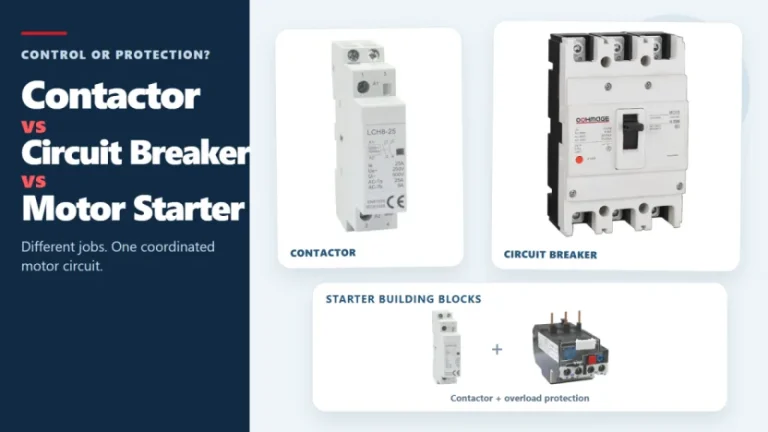
Figure 1. Contactors, circuit breakers, and motor starters solve different control and protection tasks. These three devices often appear in the same motor-control panel, but they solve different problems. A contactor handles frequent, remote, or automatic switching during normal operation. A circuit breaker interrupts abnormal current within its rated capability. A motor starter normally combines […]
Introduction The concept of remote tripping is simple, but in actual operation, project teams often encounter difficulties in specifying the components. The panel factory may require circuit breakers triggered by fire alarm relays, PLC outputs, building management system instructions, or other coordinated control. At this point, “diversion tripping” is only the first step in the […]
The main types of circuit breakers used in low-voltage distribution include miniature circuit breakers (MCBs), molded case circuit breakers (MCCBs) and residual-current devices such as RCCBs and RCBOs. They are not interchangeable. MCBs and MCCBs are selected for overcurrent protection in different circuit roles, an RCCB provides residual-current protection without integral overcurrent protection, and an […]