Qual è il valore nominale in kA di un interruttore automatico? (Spiegazione della capacità di interruzione)
Pubblicato: Autore: Conor
A circuit breaker’s kA marking describes a specified short-circuit rating under stated test conditions. One kiloampere equals 1,000 amperes. Read the declared rating together with the applicable standard, rated voltage and AC/DC conditions; it is different from the normal current rating in amperes.
Se state scegliendo un interruttore per un quadro elettrico, una macchina o un impianto, questo valore non è facoltativo. Quando si verifica un cortocircuito, la corrente di guasto può raggiungere migliaia o addirittura decine di migliaia di ampere in pochi millisecondi. Se la portata nominale in kA dell'interruttore è troppo bassa, potrebbe non riuscire a eliminare il guasto in modo sicuro, con conseguente rischio di danni alle apparecchiature, pericolo di incendio o esito negativo dell'ispezione.
This guide explains kA markings, the ratings to verify for different breaker types, and the checks an electrical professional needs for selection.
Che cos’è il valore nominale in kA di un interruttore automatico?
Check which short-circuit rating the manufacturer declares. Icn applies to relevant household and similar circuit breakers; Icu and Ics apply to relevant industrial circuit breakers. Their test duties differ, so these markings should not be treated as interchangeable.
Ad esempio:
A declared 10 kA rating corresponds to 10,000 amperes under its specified voltage, standard and test conditions.
A declared 25 kA rating corresponds to 25,000 amperes under its specified voltage, standard and test conditions; it does not alone establish suitability for continued service after a fault.
Questo valore non ha nulla a che vedere con la corrente di funzionamento normale. Il circuito potrebbe trasportare solo 20 A o 100 A durante il funzionamento normale, ma una corrente di guasto può essere centinaia di volte superiore per un breve istante. Ecco perché il valore nominale in kA è una specifica di sicurezza, non una specifica di praticità.
Manufacturer documentation may identify different short-circuit ratings, including:
Icn – Rated short-circuit capacity for relevant household and similar circuit breakers
Ics – Capacità di interruzione in caso di cortocircuito dell'impianto
A number alone does not establish that a breaker can remain in service after a fault. Follow the manufacturer’s inspection and replacement instructions. Verify the installation’s prospective short-circuit current against the applicable declared rating or an exact manufacturer-documented coordinated combination.
Capacità di picco vs corrente normale
Un interruttore ha due valori di corrente nominale molto diversi:
Corrente nominale (In): La quantità di corrente che l'interruttore è in grado di trasportare in modo continuo.
Capacità di rottura (kA): Quanta corrente di guasto è in grado di interrompere in caso di cortocircuito.
A breaker can have an appropriate normal current rating and still have insufficient short-circuit breaking capacity. Both ratings need to be checked; a correct ampere rating does not establish suitability for the available fault current.
Tipi di interruttori automatici e relativi valori nominali in kA
Breaker categories do not establish universal kA ranges. Verify the selected model’s declared ratings, voltage and applicable standard.
Tabella di confronto rapido
Breaker information
Cosa verificare
Household and similar circuit breaker
Applicable standard, declared Icn and rated voltage
Industrial circuit breaker
Applicable standard, declared Icu and Ics at the specified voltage
Coordinated breaker combination
Exact device references, permitted conditions and manufacturer-verified combination tables
Compare the selected model’s declared ratings with the calculated prospective short-circuit current at its installation point. Where a coordinated combination is used, verify the exact devices and permitted conditions in the manufacturer’s documentation.
MCB breaking-capacity ratings vary by model, voltage and applicable standard. Small normal loads do not establish a low prospective short-circuit current.
Tra i carichi più comuni figurano:
Circuiti di illuminazione
Prese di corrente
Piccoli elettrodomestici
Supply characteristics and circuit impedance affect prospective fault current. Verify the declared rating at the installation point rather than selecting from a generic category range.
For an MCCB, check the declared Icu and Ics at the required voltage, together with its current rating and protection settings.
Sono ampiamente utilizzati in:
Pannelli industriali
Centri di controllo motori
Impianti di climatizzazione
Apparecchiature OEM
Frame size and application alone do not establish breaking capacity or suitability for continued service after a fault. Reassess fault current and coordination when the supply system changes.
iii) Interruttori automatici per circuiti pneumatici (ACB)
An ACB may be used in main distribution applications, but its ratings depend on the selected model and voltage. Do not assume a universal kA rating from the breaker category.
Verify the manufacturer’s declared short-circuit ratings, protection settings and coordination data for the selected ACB and its installation.
Perché il rating KA è importante
Insufficient short-circuit breaking capacity is a serious specification issue. Verify the prospective fault current and the selected breaker’s applicable rating, or a manufacturer-documented coordinated combination. Breaking capacity alone does not establish overall installation safety, selectivity, assembly suitability or compliance with the project’s applicable requirements.
Come determinare il valore nominale corretto in kA
La scelta della capacità di frenata corretta segue una logica ingegneristica ben definita.
i) Determinare la corrente di guasto massima
La corrente di cortocircuito disponibile nel punto di installazione costituisce il valore di riferimento. Occorre innanzitutto determinare questo valore: è il punto di partenza per la scelta.
ii) Valutare un’espansione futura
Changes to transformers, generators or other supply arrangements can change fault levels. Reassess the fault study and coordination when the electrical system changes; do not assume that every load increase has the same effect.
iii) Adeguare la classificazione all'applicazione
Starting and inrush currents affect the selection of trip characteristics and protection settings. They do not, by themselves, determine the required short-circuit breaking capacity. Determine prospective fault current from the electrical system and installation conditions. A kA breaking-capacity rating is not a surge-protection rating.
iv) Coordinarsi con altri dispositivi di protezione
A higher kA rating does not guarantee selective tripping. Selectivity depends on the exact upstream and downstream devices, their settings and the fault-current range. Check manufacturer coordination tables to establish whether selectivity is total or limited to a stated current.
v) Attenersi alle linee guida del produttore
I valori di capacità di interruzione vengono verificati tramite prove. Attenersi sempre ai valori nominali certificati e alle norme IEC o locali applicabili. I diversi marchi effettuano le prove sui propri dispositivi in modo diverso. Attenersi alle indicazioni del produttore e alle norme applicabili.
Consigli pratici per la scelta degli interruttori automatici
Quando si esamina o si sceglie un interruttore, è bene tenere presenti i seguenti punti:
Verify the applicable short-circuit rating: Check the breaker or documented combination against the calculated prospective fault current at the specified voltage. Do not substitute a generic kA margin for these checks.
Compare suitable models: Select from models that meet the assessed short-circuit duty and the installation’s other requirements. A higher kA value alone does not establish a better overall fit.
Verify panel and busbar suitability: Assess the assembly separately using its manufacturer’s documentation and the actual prospective fault current and protection conditions.
Consider service conditions: Check temperature, humidity, dust and other applicable conditions against the selected device’s manufacturer instructions.
Verifica le certificazioni e le norme: Verificare che la capacità di frenata sia stata testata e sia conforme ai requisiti del progetto.
Follow manufacturer instructions: Check the exact device documentation for installation, coordination, inspection and replacement requirements.
Conclusione
Breaking capacity is one part of circuit-breaker selection. The installation also needs appropriate voltage and current ratings, trip characteristics, coordination and suitability for the service conditions. Have a qualified electrical professional assess the system and verify the exact manufacturer’s documentation before installation.
Prima di procedere alla scelta definitiva di un interruttore:
Verificare la corrente di guasto disponibile
Verificare la capacità di interruzione dell'interruttore (kA)
Verificare il coordinamento con i pannelli e i dispositivi a monte
Tenere conto della futura espansione del sistema
For an Oohmage quotation, provide the application requirements and the model information to be checked. Confirm the applicable product datasheet and declared ratings before specifying a breaker.
Domande frequenti
1. Where should prospective fault current be assessed?
Prospective fault current depends on the supply arrangement and circuit impedance, not only the connected load. A qualified electrical professional should determine the fault level at each installation point and reassess it when the supply system changes.
2. Quali effetti a catena possono verificarsi se aumento il valore nominale in kA di un interruttore?
A replacement needs checks for voltage, current rating, trip characteristics, physical compatibility and coordination. A higher breaker breaking-capacity rating does not, by itself, establish the required assembly rating. Assess the assembly against the actual prospective fault current and applicable protection conditions.
3. How are kA, kAIC, Icn, Icu and Ics related?
kA is a unit of current. kAIC is used to express an interrupting rating in kiloamperes. Icn, Icu and Ics identify different short-circuit ratings or test duties under their applicable standards. Compare the declared value, voltage, standard and test conditions; these markings should not be treated as interchangeable.
4. È possibile che un interruttore soddisfi il requisito in kA ma non superi comunque l'ispezione?
Yes. Breaking capacity is only one selection criterion. An assessment also needs to consider the assembly, voltage and current ratings, protection settings, coordination and applicable installation requirements. A sufficient kA value alone does not establish compliance.
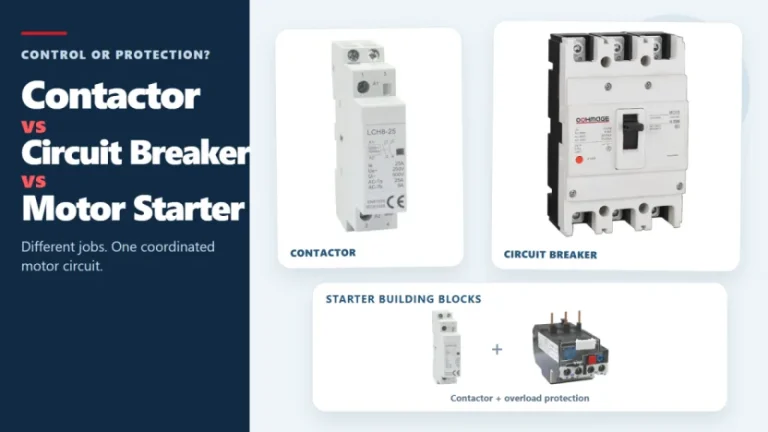
Figura 1. I contattori, gli interruttori automatici e gli avviatori per motori svolgono diverse funzioni di controllo e protezione. Questi tre dispositivi sono spesso presenti nello stesso quadro di comando del motore, ma risolvono problemi diversi. Un contattore gestisce le commutazioni frequenti, a distanza o automatiche durante il normale funzionamento. Un interruttore automatico interrompe le correnti anomale entro i limiti della sua capacità nominale. Un avviatore motore combina normalmente […]
Introduzione Il concetto di sgancio remoto è semplice, ma nella pratica operativa i team di progetto incontrano spesso difficoltà nella scelta dei componenti. Il produttore dei quadri elettrici potrebbe richiedere interruttori automatici azionati da relè di allarme antincendio, uscite PLC, comandi del sistema di gestione dell’edificio o altri sistemi di controllo coordinati. A questo punto, l“”intervento di deviazione» rappresenta solo il primo passo nel […]
Le principali tipologie di interruttori automatici utilizzati nella distribuzione a bassa tensione includono gli interruttori automatici miniaturizzati (MCB), gli interruttori automatici in involucro stampato (MCCB) e i dispositivi di protezione da corrente residua, quali gli RCCB e gli RCBO. Questi dispositivi non sono intercambiabili. Gli MCB e gli MCCB vengono scelti per la protezione da sovracorrente in diversi ruoli all’interno dei circuiti, mentre un RCCB fornisce protezione da corrente residua senza protezione da sovracorrente integrata, e un […]