O que é a classificação em kA de um disjuntor? (Explicação sobre a capacidade de interrupção)
Publicado: Autor: Conor
A circuit breaker’s kA marking describes a specified short-circuit rating under stated test conditions. One kiloampere equals 1,000 amperes. Read the declared rating together with the applicable standard, rated voltage and AC/DC conditions; it is different from the normal current rating in amperes.
Se você estiver escolhendo um disjuntor para um quadro, uma máquina ou uma instalação, esse número não é opcional. Quando ocorre um curto-circuito, a corrente de falha pode atingir milhares ou até mesmo dezenas de milhares de amperes em milissegundos. Se a capacidade nominal em kA do disjuntor for muito baixa, ele pode não eliminar a falha com segurança — o que pode causar danos ao equipamento, risco de incêndio ou reprovação na inspeção.
This guide explains kA markings, the ratings to verify for different breaker types, and the checks an electrical professional needs for selection.
O que é a classificação em kA de um disjuntor?
Check which short-circuit rating the manufacturer declares. Icn applies to relevant household and similar circuit breakers; Icu and Ics apply to relevant industrial circuit breakers. Their test duties differ, so these markings should not be treated as interchangeable.
Por exemplo:
A declared 10 kA rating corresponds to 10,000 amperes under its specified voltage, standard and test conditions.
A declared 25 kA rating corresponds to 25,000 amperes under its specified voltage, standard and test conditions; it does not alone establish suitability for continued service after a fault.
Esse valor não tem nada a ver com a corrente nominal de operação. Seu circuito pode conduzir apenas 20 A ou 100 A durante a operação normal, mas uma corrente de falha pode ser centenas de vezes maior por um breve momento. É por isso que a classificação em kA é uma especificação de segurança — e não uma especificação de conveniência.
Manufacturer documentation may identify different short-circuit ratings, including:
Icn – Rated short-circuit capacity for relevant household and similar circuit breakers
UTI – Rated ultimate short-circuit breaking capacity for relevant industrial circuit breakers
Ics – Capacidade de interrupção de curto-circuito do serviço
A number alone does not establish that a breaker can remain in service after a fault. Follow the manufacturer’s inspection and replacement instructions. Verify the installation’s prospective short-circuit current against the applicable declared rating or an exact manufacturer-documented coordinated combination.
Capacidade de ruptura versus corrente normal
Um disjuntor tem duas intensidades de corrente bem diferentes:
Corrente nominal (Em): A intensidade de corrente que o disjuntor suporta continuamente.
Capacidade de ruptura (kA): Qual a intensidade da corrente de falha que ele é capaz de interromper durante um curto-circuito.
A breaker can have an appropriate normal current rating and still have insufficient short-circuit breaking capacity. Both ratings need to be checked; a correct ampere rating does not establish suitability for the available fault current.
Tipos de disjuntores e suas classificações comuns em kA
Breaker categories do not establish universal kA ranges. Verify the selected model’s declared ratings, voltage and applicable standard.
Tabela de comparação rápida
Breaker information
O que verificar
Household and similar circuit breaker
Applicable standard, declared Icn and rated voltage
Industrial circuit breaker
Applicable standard, declared Icu and Ics at the specified voltage
Coordinated breaker combination
Exact device references, permitted conditions and manufacturer-verified combination tables
Compare the selected model’s declared ratings with the calculated prospective short-circuit current at its installation point. Where a coordinated combination is used, verify the exact devices and permitted conditions in the manufacturer’s documentation.
MCB breaking-capacity ratings vary by model, voltage and applicable standard. Small normal loads do not establish a low prospective short-circuit current.
Entre as cargas mais comuns estão:
Circuitos de iluminação
Tomadas elétricas
Pequenos eletrodomésticos
Supply characteristics and circuit impedance affect prospective fault current. Verify the declared rating at the installation point rather than selecting from a generic category range.
For an MCCB, check the declared Icu and Ics at the required voltage, together with its current rating and protection settings.
São amplamente utilizados em:
Painéis industriais
Centros de controle de motores
Sistemas de climatização
Equipamentos OEM
Frame size and application alone do not establish breaking capacity or suitability for continued service after a fault. Reassess fault current and coordination when the supply system changes.
iii) Disjuntores a ar (ACB)
An ACB may be used in main distribution applications, but its ratings depend on the selected model and voltage. Do not assume a universal kA rating from the breaker category.
Verify the manufacturer’s declared short-circuit ratings, protection settings and coordination data for the selected ACB and its installation.
Por que a classificação KA é importante
Insufficient short-circuit breaking capacity is a serious specification issue. Verify the prospective fault current and the selected breaker’s applicable rating, or a manufacturer-documented coordinated combination. Breaking capacity alone does not establish overall installation safety, selectivity, assembly suitability or compliance with the project’s applicable requirements.
A seleção da capacidade de frenagem correta segue uma lógica de engenharia clara.
i) Identificar a corrente máxima de falha
A corrente de curto-circuito disponível no ponto de instalação é o valor de referência. Obtenha esse valor primeiro — ele serve como base para a seleção.
ii) Considerar uma expansão futura
Changes to transformers, generators or other supply arrangements can change fault levels. Reassess the fault study and coordination when the electrical system changes; do not assume that every load increase has the same effect.
iii) Adequar a classificação à aplicação
Starting and inrush currents affect the selection of trip characteristics and protection settings. They do not, by themselves, determine the required short-circuit breaking capacity. Determine prospective fault current from the electrical system and installation conditions. A kA breaking-capacity rating is not a surge-protection rating.
iv) Coordenar com outros dispositivos de proteção
A higher kA rating does not guarantee selective tripping. Selectivity depends on the exact upstream and downstream devices, their settings and the fault-current range. Check manufacturer coordination tables to establish whether selectivity is total or limited to a stated current.
v) Siga as orientações do fabricante
Os valores de capacidade de ruptura são verificados por meio de testes. Siga sempre as classificações certificadas e as normas IEC ou locais aplicáveis. As marcas realizam testes em seus dispositivos de maneiras diferentes. Siga as orientações do fabricante e as normas aplicáveis.
Dicas práticas para a escolha de disjuntores
Ao analisar ou selecionar um disjuntor, tenha em mente os seguintes pontos:
Verify the applicable short-circuit rating: Check the breaker or documented combination against the calculated prospective fault current at the specified voltage. Do not substitute a generic kA margin for these checks.
Compare suitable models: Select from models that meet the assessed short-circuit duty and the installation’s other requirements. A higher kA value alone does not establish a better overall fit.
Verify panel and busbar suitability: Assess the assembly separately using its manufacturer’s documentation and the actual prospective fault current and protection conditions.
Consider service conditions: Check temperature, humidity, dust and other applicable conditions against the selected device’s manufacturer instructions.
Verifique as certificações e normas: Certifique-se de que a capacidade de frenagem seja testada e esteja em conformidade com os requisitos do projeto.
Follow manufacturer instructions: Check the exact device documentation for installation, coordination, inspection and replacement requirements.
Conclusão
Breaking capacity is one part of circuit-breaker selection. The installation also needs appropriate voltage and current ratings, trip characteristics, coordination and suitability for the service conditions. Have a qualified electrical professional assess the system and verify the exact manufacturer’s documentation before installation.
Antes de definir a escolha de qualquer disjuntor:
Confirme a corrente de falha disponível
Verifique a capacidade de interrupção do disjuntor (kA)
Verifique a coordenação com os painéis e os dispositivos a montante
Leve em consideração o crescimento futuro do sistema
For an Oohmage quotation, provide the application requirements and the model information to be checked. Confirm the applicable product datasheet and declared ratings before specifying a breaker.
Perguntas frequentes
1. Where should prospective fault current be assessed?
Prospective fault current depends on the supply arrangement and circuit impedance, not only the connected load. A qualified electrical professional should determine the fault level at each installation point and reassess it when the supply system changes.
2. Que efeitos em cadeia podem ocorrer se eu aumentar a capacidade nominal em kA de um disjuntor?
A replacement needs checks for voltage, current rating, trip characteristics, physical compatibility and coordination. A higher breaker breaking-capacity rating does not, by itself, establish the required assembly rating. Assess the assembly against the actual prospective fault current and applicable protection conditions.
3. How are kA, kAIC, Icn, Icu and Ics related?
kA is a unit of current. kAIC is used to express an interrupting rating in kiloamperes. Icn, Icu and Ics identify different short-circuit ratings or test duties under their applicable standards. Compare the declared value, voltage, standard and test conditions; these markings should not be treated as interchangeable.
4. Um disjuntor pode atender ao requisito de kA e, mesmo assim, ser reprovado na inspeção?
Yes. Breaking capacity is only one selection criterion. An assessment also needs to consider the assembly, voltage and current ratings, protection settings, coordination and applicable installation requirements. A sufficient kA value alone does not establish compliance.
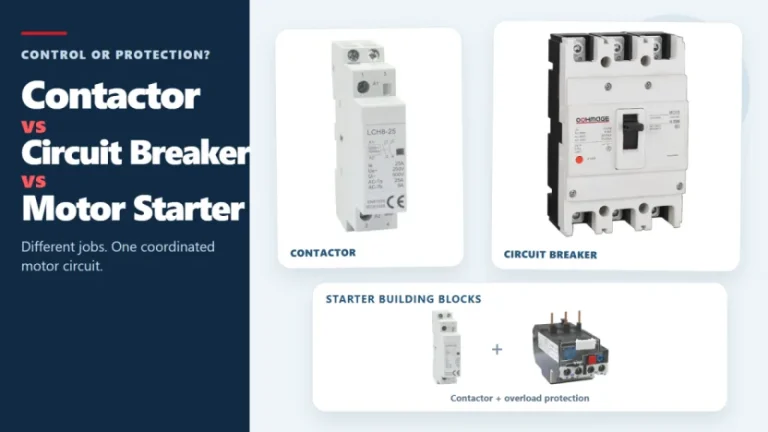
Figura 1. Contatores, disjuntores e acionadores de motor desempenham diferentes funções de controle e proteção. Esses três dispositivos costumam estar presentes no mesmo painel de controle do motor, mas resolvem problemas distintos. Um contator é responsável pela comutação frequente, remota ou automática durante a operação normal. Um disjuntor interrompe correntes anormais dentro de sua capacidade nominal. Um partidor de motor normalmente combina […]
Introdução O conceito de desligamento remoto é simples, mas, na prática, as equipes de projeto frequentemente enfrentam dificuldades na especificação dos componentes. A fábrica de painéis pode exigir disjuntores acionados por relés de alarme de incêndio, saídas de PLC, instruções do sistema de gerenciamento predial ou outro tipo de controle coordenado. Nesse ponto, o “desligamento por desvio” é apenas o primeiro passo no […]
Os principais tipos de disjuntores utilizados na distribuição de baixa tensão incluem disjuntores miniatura (MCBs), disjuntores em caixa moldada (MCCBs) e dispositivos de corrente residual, como RCCBs e RCBOs. Eles não são intercambiáveis. Os MCBs e MCCBs são selecionados para proteção contra sobrecorrente em diferentes funções do circuito; um RCCB oferece proteção contra corrente residual sem proteção integral contra sobrecorrente; e um […]