Định mức kA trên cầu dao là gì? (Giải thích về khả năng ngắt mạch)
Ngày đăng: Tác giả: Conor
A circuit breaker’s kA marking describes a specified short-circuit rating under stated test conditions. One kiloampere equals 1,000 amperes. Read the declared rating together with the applicable standard, rated voltage and AC/DC conditions; it is different from the normal current rating in amperes.
Nếu bạn đang chọn một bộ ngắt mạch cho tủ điện, máy móc hoặc cơ sở, con số này là bắt buộc. Khi xảy ra ngắn mạch, dòng điện sự cố có thể tăng vọt lên hàng nghìn hoặc thậm chí hàng chục nghìn ampe trong vài mili giây. Nếu định mức kA của cầu dao quá thấp, thiết bị này có thể không xử lý được sự cố một cách an toàn — dẫn đến hư hỏng thiết bị, nguy cơ cháy nổ hoặc không đạt tiêu chuẩn kiểm định.
This guide explains kA markings, the ratings to verify for different breaker types, and the checks an electrical professional needs for selection.
Định mức kA trên bộ ngắt mạch là gì?
Check which short-circuit rating the manufacturer declares. Icn applies to relevant household and similar circuit breakers; Icu and Ics apply to relevant industrial circuit breakers. Their test duties differ, so these markings should not be treated as interchangeable.
Ví dụ:
A declared 10 kA rating corresponds to 10,000 amperes under its specified voltage, standard and test conditions.
A declared 25 kA rating corresponds to 25,000 amperes under its specified voltage, standard and test conditions; it does not alone establish suitability for continued service after a fault.
Giá trị này không liên quan gì đến dòng điện hoạt động bình thường. Mạch của bạn có thể chỉ mang dòng điện 20 A hoặc 100 A trong điều kiện hoạt động bình thường, nhưng dòng điện sự cố có thể là cao hơn hàng trăm lần trong một khoảnh khắc ngắn ngủi. Đó là lý do tại sao thông số kA là một tiêu chuẩn an toàn — chứ không phải là tiêu chuẩn tiện lợi.
Manufacturer documentation may identify different short-circuit ratings, including:
Icn – Rated short-circuit capacity for relevant household and similar circuit breakers
A number alone does not establish that a breaker can remain in service after a fault. Follow the manufacturer’s inspection and replacement instructions. Verify the installation’s prospective short-circuit current against the applicable declared rating or an exact manufacturer-documented coordinated combination.
Dòng điện quá tải so với dòng điện định mức
Một bộ ngắt mạch có hai mức dòng điện định mức rất khác nhau:
Dòng điện định mức (Trong): Dòng điện tối đa mà cầu dao có thể chịu được trong thời gian liên tục.
Khả năng chịu tải cực đại (kA): Lượng dòng điện sự cố mà nó có thể ngắt được trong trường hợp ngắn mạch.
A breaker can have an appropriate normal current rating and still have insufficient short-circuit breaking capacity. Both ratings need to be checked; a correct ampere rating does not establish suitability for the available fault current.
Các loại cầu dao và mức định mức kA thông dụng của chúng
Breaker categories do not establish universal kA ranges. Verify the selected model’s declared ratings, voltage and applicable standard.
Bảng so sánh nhanh
Breaker information
Cần kiểm tra những gì
Household and similar circuit breaker
Applicable standard, declared Icn and rated voltage
Industrial circuit breaker
Applicable standard, declared Icu and Ics at the specified voltage
Coordinated breaker combination
Exact device references, permitted conditions and manufacturer-verified combination tables
Compare the selected model’s declared ratings with the calculated prospective short-circuit current at its installation point. Where a coordinated combination is used, verify the exact devices and permitted conditions in the manufacturer’s documentation.
MCB breaking-capacity ratings vary by model, voltage and applicable standard. Small normal loads do not establish a low prospective short-circuit current.
Các loại tải trọng phổ biến bao gồm:
Mạch chiếu sáng
Ổ cắm điện
Thiết bị gia dụng nhỏ
Supply characteristics and circuit impedance affect prospective fault current. Verify the declared rating at the installation point rather than selecting from a generic category range.
For an MCCB, check the declared Icu and Ics at the required voltage, together with its current rating and protection settings.
Chúng được sử dụng rộng rãi trong:
Tấm panel công nghiệp
Trung tâm điều khiển động cơ
Hệ thống HVAC
Thiết bị OEM
Frame size and application alone do not establish breaking capacity or suitability for continued service after a fault. Reassess fault current and coordination when the supply system changes.
iii) Công tắc ngắt mạch không khí (ACB)
An ACB may be used in main distribution applications, but its ratings depend on the selected model and voltage. Do not assume a universal kA rating from the breaker category.
Verify the manufacturer’s declared short-circuit ratings, protection settings and coordination data for the selected ACB and its installation.
Tại sao xếp hạng KA lại quan trọng
Insufficient short-circuit breaking capacity is a serious specification issue. Verify the prospective fault current and the selected breaker’s applicable rating, or a manufacturer-documented coordinated combination. Breaking capacity alone does not establish overall installation safety, selectivity, assembly suitability or compliance with the project’s applicable requirements.
Việc lựa chọn khả năng chịu tải khi đứt dây tuân theo một logic kỹ thuật rõ ràng.
i) Xác định dòng điện sự cố tối đa
Dòng điện ngắn mạch có sẵn tại điểm lắp đặt là giá trị tham chiếu. Hãy xác định giá trị này trước tiên — đây là giá trị tham chiếu để lựa chọn.
ii) Xem xét việc mở rộng trong tương lai
Changes to transformers, generators or other supply arrangements can change fault levels. Reassess the fault study and coordination when the electrical system changes; do not assume that every load increase has the same effect.
iii) Phù hợp giữa xếp hạng và ứng dụng
Starting and inrush currents affect the selection of trip characteristics and protection settings. They do not, by themselves, determine the required short-circuit breaking capacity. Determine prospective fault current from the electrical system and installation conditions. A kA breaking-capacity rating is not a surge-protection rating.
iv) Phối hợp với các thiết bị bảo vệ khác
A higher kA rating does not guarantee selective tripping. Selectivity depends on the exact upstream and downstream devices, their settings and the fault-current range. Check manufacturer coordination tables to establish whether selectivity is total or limited to a stated current.
v) Tuân thủ hướng dẫn của nhà sản xuất
Các giá trị giới hạn chịu tải được xác minh thông qua thử nghiệm. Luôn tuân thủ các thông số kỹ thuật đã được chứng nhận và các tiêu chuẩn IEC hoặc tiêu chuẩn địa phương có liên quan. Các thương hiệu thực hiện thử nghiệm thiết bị của mình theo các phương pháp khác nhau. Hãy tuân thủ hướng dẫn của nhà sản xuất và các tiêu chuẩn có liên quan.
Những lời khuyên thiết thực khi lựa chọn cầu dao tự động
Khi xem xét hoặc lựa chọn một bộ ngắt mạch, hãy lưu ý những điểm sau:
Verify the applicable short-circuit rating: Check the breaker or documented combination against the calculated prospective fault current at the specified voltage. Do not substitute a generic kA margin for these checks.
Compare suitable models: Select from models that meet the assessed short-circuit duty and the installation’s other requirements. A higher kA value alone does not establish a better overall fit.
Verify panel and busbar suitability: Assess the assembly separately using its manufacturer’s documentation and the actual prospective fault current and protection conditions.
Consider service conditions: Check temperature, humidity, dust and other applicable conditions against the selected device’s manufacturer instructions.
Kiểm tra các chứng nhận và tiêu chuẩn: Đảm bảo rằng khả năng chịu tải khi gãy đã được kiểm tra và đáp ứng các yêu cầu của dự án.
Follow manufacturer instructions: Check the exact device documentation for installation, coordination, inspection and replacement requirements.
Kết luận
Breaking capacity is one part of circuit-breaker selection. The installation also needs appropriate voltage and current ratings, trip characteristics, coordination and suitability for the service conditions. Have a qualified electrical professional assess the system and verify the exact manufacturer’s documentation before installation.
Trước khi chốt lựa chọn bất kỳ loại cầu dao nào:
Xác nhận dòng điện sự cố có thể xảy ra
Kiểm tra khả năng ngắt mạch của cầu dao (kA)
Kiểm tra sự phối hợp với các bảng điều khiển và các thiết bị ở giai đoạn trước
Cần tính đến khả năng mở rộng hệ thống trong tương lai
For an Oohmage quotation, provide the application requirements and the model information to be checked. Confirm the applicable product datasheet and declared ratings before specifying a breaker.
Câu hỏi thường gặp
1. Where should prospective fault current be assessed?
Prospective fault current depends on the supply arrangement and circuit impedance, not only the connected load. A qualified electrical professional should determine the fault level at each installation point and reassess it when the supply system changes.
2. Nếu tôi tăng định mức kA của một cầu dao, những tác động dây chuyền nào có thể xảy ra?
A replacement needs checks for voltage, current rating, trip characteristics, physical compatibility and coordination. A higher breaker breaking-capacity rating does not, by itself, establish the required assembly rating. Assess the assembly against the actual prospective fault current and applicable protection conditions.
3. How are kA, kAIC, Icn, Icu and Ics related?
kA is a unit of current. kAIC is used to express an interrupting rating in kiloamperes. Icn, Icu and Ics identify different short-circuit ratings or test duties under their applicable standards. Compare the declared value, voltage, standard and test conditions; these markings should not be treated as interchangeable.
4. Một cầu dao có thể đáp ứng yêu cầu về kA nhưng vẫn không qua được kiểm tra không?
Yes. Breaking capacity is only one selection criterion. An assessment also needs to consider the assembly, voltage and current ratings, protection settings, coordination and applicable installation requirements. A sufficient kA value alone does not establish compliance.
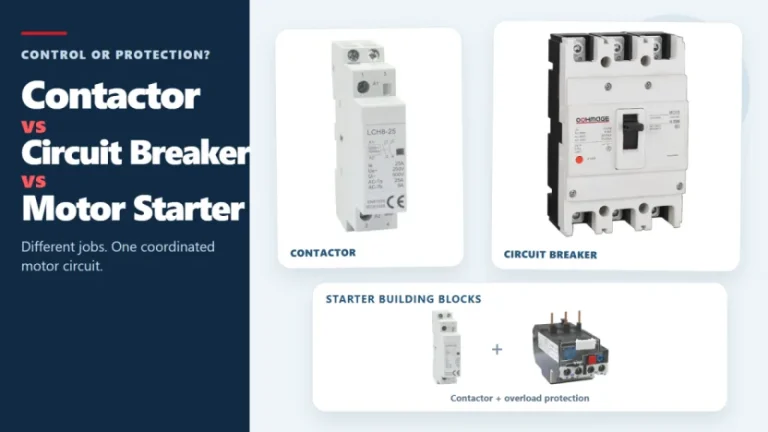
Hình 1. Công tắc tơ, cầu dao và bộ khởi động động cơ đảm nhiệm các nhiệm vụ điều khiển và bảo vệ khác nhau. Ba thiết bị này thường xuất hiện trong cùng một tủ điều khiển động cơ, nhưng chúng giải quyết các vấn đề khác nhau. Công tắc tơ đảm nhiệm việc chuyển mạch thường xuyên, từ xa hoặc tự động trong quá trình vận hành bình thường. Bộ ngắt mạch ngắt dòng điện bất thường trong phạm vi khả năng định mức của nó. Bộ khởi động động cơ thường kết hợp […]
Giới thiệu: Khái niệm về ngắt mạch từ xa tuy đơn giản, nhưng trong thực tế vận hành, các nhóm dự án thường gặp khó khăn trong việc xác định các thành phần cần thiết. Nhà máy sản xuất tủ điện có thể yêu cầu các bộ ngắt mạch được kích hoạt bởi rơle báo cháy, tín hiệu đầu ra từ PLC, lệnh từ hệ thống quản lý tòa nhà hoặc các cơ chế điều khiển phối hợp khác. Tại thời điểm này, “ngắt mạch chuyển hướng” chỉ là bước đầu tiên trong […]
Các loại cầu dao chính được sử dụng trong hệ thống phân phối điện hạ áp bao gồm cầu dao mini (MCB), cầu dao vỏ đúc (MCCB) và các thiết bị bảo vệ dòng dư như RCCB và RCBO. Các loại này không thể thay thế lẫn nhau. MCB và MCCB được lựa chọn để bảo vệ quá dòng trong các vai trò mạch khác nhau, trong khi RCCB cung cấp bảo vệ dòng dư mà không có chức năng bảo vệ quá dòng tích hợp, và […]