Voltage Protector vs. Surge Protector: Key Differences and Applications
Published: Author: Conor
Sudden power problems do not damage electrical equipment in the same way. Some failures come from long-term voltage instability, while others happen in a split second due to high-energy surges. That’s exactly why a voltage protector and a surge protector serve different purposes—and why using the wrong one can still leave your equipment exposed.
In simple terms, voltage protectors handle ongoing high or low voltage, while surge protectors block brief voltage spikes caused by lightning or grid switching. They are not interchangeable.
In this guide, we explain the real technical differences, typical commercial and industrial use cases, and how to choose the right protection device for your electrical system.
Voltage Fluctuations: Why Electrical Equipment Fails
Voltage fluctuations occur when the supply voltage moves outside its normal operating range. In commercial and industrial environments, this usually happens due to unstable grids, overloaded circuits, large motors starting and stopping, or upstream distribution issues.
These fluctuations fall into two very different categories, and each causes a different type of damage.
Sustained Overvoltage or Undervoltage: When voltage stays too high or too low for minutes or hours, motors and compressors suffer the most. Overvoltage leads to overheating and insulation breakdown, while undervoltage increases current draw and shortens equipment lifespan.
Instant Voltage Surges: These are extremely fast spikes, often lasting microseconds. Lightning strikes, utility switching, and sudden load changes are common causes. Even though they are brief, their energy can instantly damage circuit boards, power supplies, and control systems.
Understanding which of these risks dominates your site is the foundation of proper protection. One device cannot solve both problems.
Voltage Protector vs. Surge Protector: Core Differences
The difference between a voltage protector and a surge protector comes down to duration and response strategy. One disconnects power during unsafe voltage conditions, while the other absorbs and redirects sudden excess energy.
Key Differences at a Glance
Feature
Voltage Protector
Surge Protector
Primary Risk Addressed
Sustained High / Low Voltage
Instant Voltage Spikes
Protection Method
Cuts Power Outside Safe Range
Diverts Excess Energy to Ground
Response Behavior
Short Delay, Safety Disconnection
Near-Instant Reaction
Typical Protection Scope
Motors, Compressors, Heavy Loads
Electronics, Control Systems
Common Failure It Prevents
Overheating, Motor Burnout
PCB Damage, Power Supply Failure
A voltage protector acts like a gatekeeper. If incoming power is unsafe, it simply does not allow electricity to reach the equipment. This prevents long-term stress and hidden damage that often leads to early failure.
A surge protector works more like a shock absorber. It stays passive most of the time and reacts only when a high-energy spike appears. Its role is to sacrifice itself, if necessary, to protect sensitive electronics downstream.
Because their protection mechanisms are fundamentally different, choosing between them should be based on load type and power quality, not price or convenience.
What Is a Voltage Protector (And When You Actually Need One)
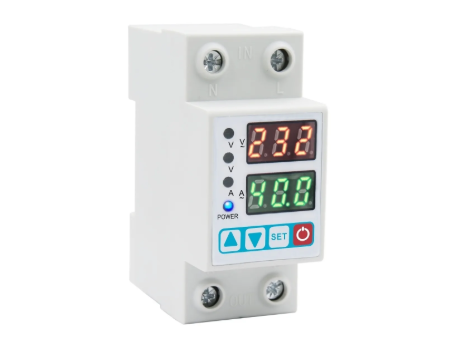
A voltage protector is designed to protect equipment from ongoing overvoltage and undervoltage by disconnecting power when voltage moves outside a safe range. It does not absorb energy or suppress spikes—it prevents unsafe power from reaching the load in the first place.
This makes voltage protectors especially effective for motor-driven and compressor-based equipment that cannot tolerate prolonged voltage stress.
How a Voltage Protector Works in Real Systems
A voltage protector continuously monitors incoming supply voltage. Once the voltage exceeds preset upper or lower limits, the device disconnects the load to prevent damage. When voltage returns to a stable range and remains there for a short delay, power is restored automatically.
This delay is critical. It prevents rapid on-off cycling during unstable conditions, which can be just as damaging as voltage fluctuations themselves.
Typical Technical Specifications
Specification
Typical Range
Why It Matters
Operating Voltage Range
140–280 V
Defines acceptable input range
Cut-off Voltage
300–320 V
Prevents overheating and insulation failure
Recovery Voltage
220–240 V
Ensures safe restart conditions
Response Time
0.1–0.5 s
Fast enough for protection, slow enough to avoid false trips
Rated Current
10–30 A
Must match load current
Certifications
CE, ISO
Required for compliance and liability control
Tip: Underrated current capacity is a common mistake. If the voltage protector is sized too close to the load’s maximum current, nuisance tripping becomes inevitable.
When a Voltage Protector Is the Right Choice
You should use a voltage protector when:
Power supply shows frequent undervoltage or overvoltage
Equipment includes motors, compressors, or inductive loads
Restart timing matters for system stability
Grid quality is inconsistent or shared with heavy machinery
Typical applications include:
Refrigerators and freezers
Air conditioners and HVAC units
Pumps, compressors, and workshop equipment
Commercial kitchen appliances
What a Voltage Protector Does NOT Do
This boundary is critical in B2B projects:
It does not suppress lightning-induced surges
It does not absorb high-energy spikes
It does not protect sensitive electronics from transient surges
If surge risk exists, additional surge protection is required.
What Is a Surge Protector (And What It Does NOT Protect)
A surge protector protects equipment from short-duration, high-energy voltage spikes by diverting excess energy away from connected devices, usually to ground. It reacts extremely fast but only during surge events.
Surge protectors are designed for electronics and control systems, not for correcting unstable voltage levels.
How Surge Protection Works
Most surge protectors use components such as MOVs (Metal Oxide Varistors) or SPDs (Surge Protection Devices). Under normal voltage, these components remain inactive. When a voltage spike exceeds a defined threshold, they conduct and redirect excess energy away from the load.
This reaction happens in nanoseconds, which is why surge protectors are effective against lightning-induced spikes and switching surges.
Typical Technical Specifications
Specification
Typical Range
Practical Meaning
Joule Rating
1000–3000 J
Total energy absorption capacity
Clamping Voltage
330–400 V
Voltage level where protection activates
Response Time
<1 ns
Ability to react to fast spikes
Outlet Count
4–12
Load distribution capacity
Certifications
UL, CE
Safety and regulatory compliance
Tip: A higher joule rating does not mean infinite protection. Surge protectors degrade over time and must be replaced after repeated surge events.
Where Surge Protectors Are Most Effective
Surge protectors are best used for:
Computers and servers
TVs and display systems
Routers, modems, and networking equipment
PLCs, control panels, and instrumentation
These devices are highly sensitive to even brief voltage spikes.
What a Surge Protector Does NOT Protect Against
This is where many installations go wrong:
It does not correct undervoltage
It does not prevent overheating from long-term overvoltage
It does not protect motors from voltage instability
Using a surge protector alone for heavy appliances creates a false sense of protection.
Voltage protectors and surge protectors solve different failure mechanisms. In commercial and industrial environments, they are often used together, not as substitutes.
Typical Applications in Commercial & Industrial Settings
Motor-Driven And High-Inertia Loads
Motor-driven equipment reacts poorly to unstable voltage. Even small, long-term deviations increase heat, current draw, and mechanical stress.
Recommended protection: Voltage Protector
Typical examples include:
HVAC systems and commercial air conditioners
Refrigeration units and cold storage equipment
Pumps, compressors, and workshop machinery
In these applications, voltage protectors prevent slow, cumulative damage that often goes unnoticed until a motor fails prematurely.
Electronics, Control Systems, And IT Equipment
Electronic systems fail differently. They are less affected by gradual voltage changes but highly vulnerable to instant surges.
Recommended protection: Surge Protector
Common applications include:
Servers, computers, and networking equipment
PLCs, control panels, and automation systems
Displays, POS systems, and communication devices
Here, protection is about reaction speed, not voltage regulation.
Mixed-Load Commercial Environments
Most commercial and industrial sites run mixed loads—motors and electronics on the same distribution system.
Recommended approach: Layered protection
Voltage protectors for motor-heavy circuits
Surge protectors for electronic and control circuits
This layered setup reduces downtime, simplifies troubleshooting, and limits liability when failures occur.
6. How to Choose the Right Protection Device for Your Project
Step 1: Assess Power Quality, Not Just Equipment
Start by identifying the dominant risk:
Frequent voltage drops or overvoltage → Voltage instability
Lightning exposure or grid switching events → Surge risk
Field measurements, power logs, or even maintenance records often reveal this quickly.
Step 2: Match Protection To Load Type
Choose protection based on how the load behaves, not its price or size.
Motors and compressors → Voltage protection
Electronics and control systems → Surge protection
If both exist, plan for both.
Step 3: Size The Device Correctly
Incorrect sizing is a common cause of failure.
Voltage protectors must match or exceed load current
Surge protectors must match expected surge exposure
Undersized devices trip frequently or degrade too fast.
Step 4: Check Certifications And Compliance Requirements
For B2B projects, certification is not optional.
CE / UL compliance
Project-specific electrical standards
Insurance and liability requirements
Certified protection devices reduce approval delays and after-sales disputes.
Step 5: Plan For Long-Term Reliability
Protection devices are not “install and forget” components.
Voltage protectors need proper delay and recovery settings
Surge protectors degrade and require periodic replacement
A small maintenance plan prevents large, unexpected failures later.
Recommendation
In many commercial projects, the safest strategy is combining voltage protection and surge protection at different points in the system. This approach addresses both long-term instability and instant electrical threats without overcomplicating the design.
Conclusion
Most electrical failures are not random. They follow clear patterns based on power quality and load behavior. Voltage protectors and surge protectors address different failure mechanisms, which is why treating them as interchangeable often leads to equipment damage, downtime, or warranty disputes.
If your facility struggles with ongoing overvoltage or undervoltage, voltage protection helps prevent long-term stress on motors, compressors, and heavy loads. If your system is exposed to lightning, grid switching, or sudden spikes, surge protection shields sensitive electronics and control systems from instant failure. In many commercial and industrial environments, using both—at the right points in the system—offers the most reliable protection strategy.
At Oohmage, we design voltage protectors and surge protection devices specifically for real-world electrical conditions, not ideal lab scenarios. Our products meet international safety standards and are built to support engineers, integrators, and distributors who need predictable performance and clear protection boundaries.
Figure 1. Three-phase SPD selection starts with system facts, not the largest kA number. A three-phase surge protector should not be selected by the largest kA number on its label. First confirm the system voltage, whether a neutral is present, the earthing arrangement, the installation point, and the required SPD type. Then compare Uc, Up, […]
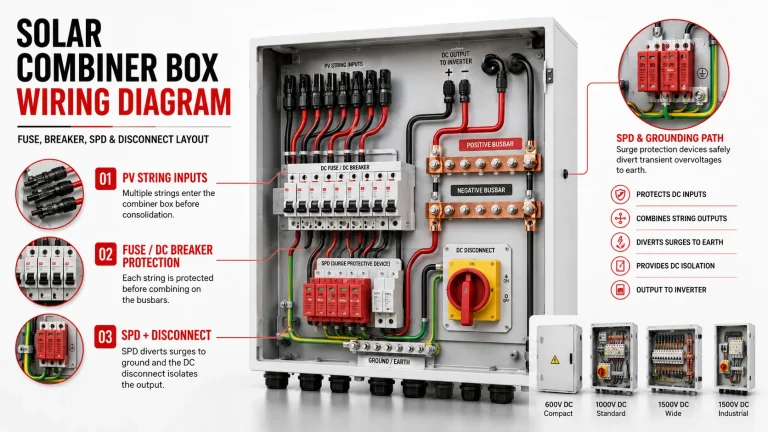
Introduction The wiring diagram of the solar energy combiner box shows how multiple photovoltaic strings enter the combiner box, pass through the string protection device, connect to the positive and negative busbars, ground the surge protection device, and connect to the inverter through the DC circuit breaker. In other words, this diagram not only indicates […]
In today’s connected world, electrical devices are more integral than ever before. Whether it’s home appliances, office equipment, or industrial machinery, almost every electrical device relies on power from the grid. Power surges—spikes in electrical voltage—are a common issue, and they can cause severe damage to sensitive electronics. This is where surge protectors come in. […]