Distribution Board Sizes How Many Ways Do You Need
Yayın tarihi: Yazar: Whelve
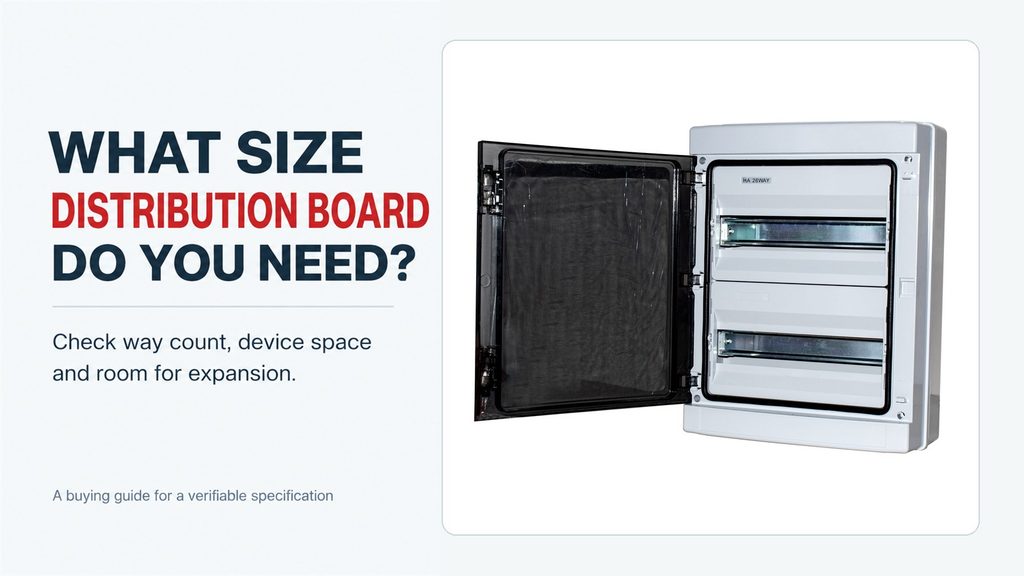
Figure 1. Board selection starts with the circuit schedule, device space, and planned reserve.
A request for a “12 way distribution board” can sound specific, but it leaves the layout unresolved. One project may use mostly single-pole devices; another may need multi-pole devices, an incomer, surge protection, metering, or more terminal space. The same number on two product labels does not promise the same usable configuration.
Quick answer: Choose a distribution board from a verified circuit and device schedule, then confirm how the manufacturer defines ways and usable space for that specific board. The required size depends on the supply system, the number and pole arrangement of outgoing devices, incomer and accessory space, installation conditions, and planned expansion. Single-phase and three-phase distribution boards should not be compared by the advertised way count alone.
This guide turns a rough way-count request into a specification a supplier can review. Electrical design, protection coordination, load calculations, and installation still belong with qualified professionals.
What Does Way Mean on a Distribution Board
The number of ways describes the outgoing capacity or positions provided by a particular distribution board system. However, way, module, pole, and outgoing circuit are not universally interchangeable terms.
A single-pole protective device may use one position in one product system. A multi-pole device occupies adjacent positions. An RCCB, RCBO, surge protective device, main switch, meter, or another accessory may require a different amount of space. Some boards separate the incomer from outgoing ways, while other enclosure layouts use shared modular space. Three-phase boards can also describe their outgoing capacity differently from single-phase boards.
Use the product data sheet as the final reference: check how that manufacturer counts ways, which devices the system accepts, and what usable space remains after the specified equipment is installed.
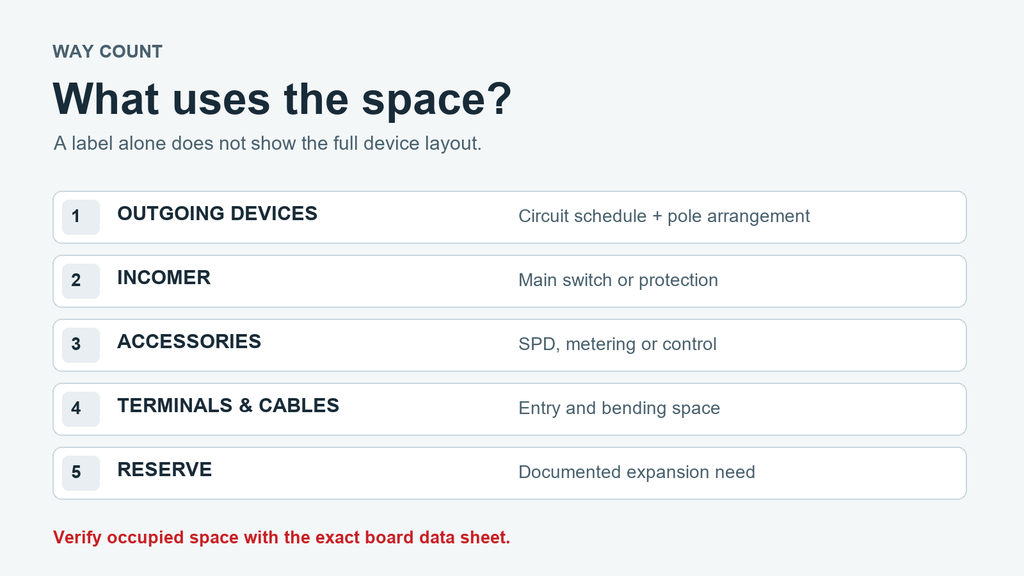
Figure 2. Check outgoing devices, the incomer, accessories, terminals and cables, and reserve against the exact board data sheet.
Why Distribution Board Size Is More Than a Circuit Count
The word size can refer to several different things: the external dimensions of the enclosure, the number of rows, the modular capacity, the advertised ways, or the electrical ratings of an assembled board. A useful quotation needs these meanings separated.
Start with the circuit schedule
Start with the current circuit schedule. It identifies each outgoing circuit, its function, and the pole arrangement specified by the electrical designer. Ten outgoing circuits do not always occupy ten identical positions.
Keep the schedule current. An added EV charger, photovoltaic system, machine, or sub-distribution board may change the device list and enclosure requirement. Send those changes back to the project designer instead of estimating them from a blog article.
Check the device footprint
The device list also has a physical footprint. Check the references, widths, and pole arrangements of the selected MCBs, RCCBs, RCBOs, SPDs, switches, and other devices against the intended board system.
Do not assume that two product families with the same device name have the same width or approval for the assembly. “MCB” alone does not establish mechanical fit, busbar compatibility, terminal arrangement, or assembly performance.
Include the incomer and accessories
Outgoing circuits are only part of the board. The design may also call for a main switch or protective incomer, surge protection, metering, control equipment, neutral and protective-earth terminals, labels, or communication accessories.
Then check cable entry and conductor bending space. A board can have enough apparent device positions and still be unsuitable if it cannot accommodate the specified cables, terminals, or entry direction. Ask for a dimensional drawing; a front-view photograph is insufficient.
A problem belongs on the drawing before it reaches the people on site.
Plan reserve space from real expansion needs
Reserve space should solve a foreseeable need. No spare capacity can make later changes difficult, while an unnecessarily large enclosure costs more, takes wall space, and may complicate installation.
There is no spare-way percentage that works for every country and project. Base the reserve on foreseeable expansion, the governing design rules, and the manufacturer’s configuration. Record its purpose in the schedule so the supplier does not mistake it for unused space.
Match the enclosure to the environment
Indoor or outdoor location, surface or flush mounting, material, cable entry, temperature, exposure, and maintenance access can all affect the enclosure choice. If an IP rating is required, state the required rating and the actual installation conditions.
IEC 60529 classifies degrees of protection provided by enclosures through the IP Code. An IP rating is not a promise that an enclosure is suitable for every outdoor location, cleaning method, or exposure. Final suitability depends on the complete product, installation, sealing, maintenance, and local requirements.
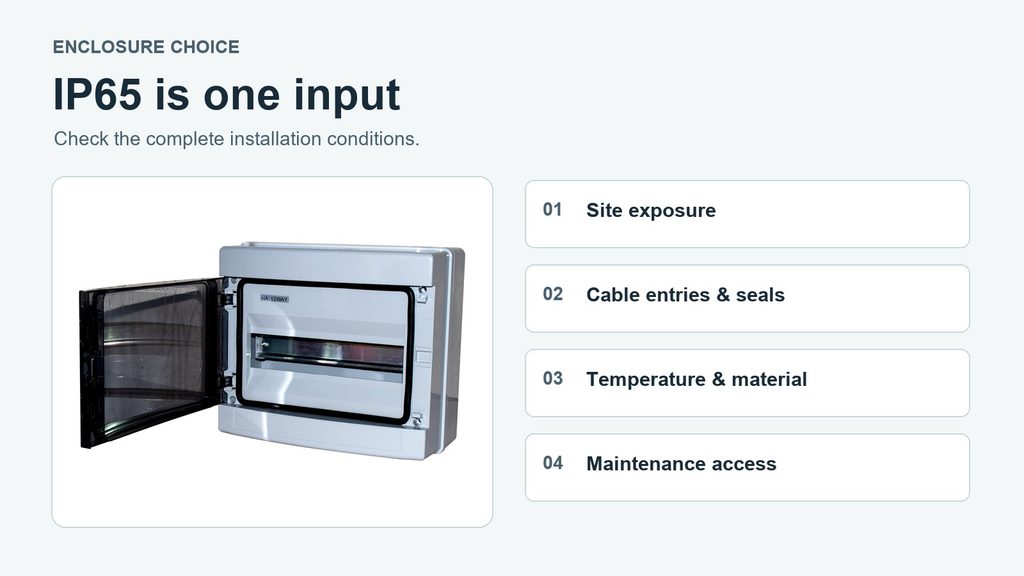
Figure 3. An IP65 label is one input; exposure, cable entries, material, and maintenance also need review.
Single Phase and Three Phase Board Sizes Are Not Directly Comparable
A 12 way single-phase board and a 12 way three-phase board are not equivalent simply because the labels match. Internal layout, busbar system, accepted device combinations, and even the way-count convention can differ.
A three-phase design may include both single-pole and multi-pole outgoing devices. The electrical designer determines the phase arrangement; the buyer should not infer it from the advertised way count. Because multi-pole devices also take more adjacent space, multiplying or dividing that count does not create a reliable universal circuit total.
Kontrol et
Single-phase quotation
Three-phase quotation
Supply information
Provide the project supply and neutral arrangement
Provide the three-phase system information and whether the design requires a neutral
Device schedule
List the specified single-pole and multi-pole devices
List the mix of single-pole and multi-pole devices and the designer-approved phase arrangement
Meaning of ways
Confirm the definition in that series data sheet
Confirm exactly how the manufacturer states outgoing and triple-pole capacity
Review documents
Circuit schedule and component list
Circuit schedule, component list, and the professionally reviewed phase arrangement
IEC 61439-3:2024 defines requirements for a specific class of low-voltage distribution boards intended to be operated by ordinary persons. Whether that standard applies to a project or product must be confirmed from the assembly type, intended use, manufacturer documentation, and local requirements. The standard name should not be used as a blanket claim for every distribution board.
How to Compare 4 8 12 18 24 and More Ways
A search for a 12 way or 24 way distribution board gives a supplier a useful starting point, not a finished specification. Treat the number as a prompt to check the actual layout.
Advertised range
Nasıl yorumlanmalı?
What to confirm before ordering
4 to 8 ways
A compact range, not automatic proof that it suits a small project
Actual devices, pole count, incomer, accessories, and expansion requirement
12 ways
A common comparison term, not a universal promise of 12 identical circuits
Board type, manufacturer’s counting method, and device widths
15 to 18 ways
Capacity that may belong to a particular enclosure family or compact layout
Model dimensions, internal arrangement, cable entry, and component list
24 ways
A common search and purchasing term that still needs a complete schedule
Device mix, reserved space, maintenance access, and installation environment
36 to 54 ways
A larger enclosure range, not automatic evidence of better safety or suitability
Assembly design, manufacturer limits, project conditions, and professional review
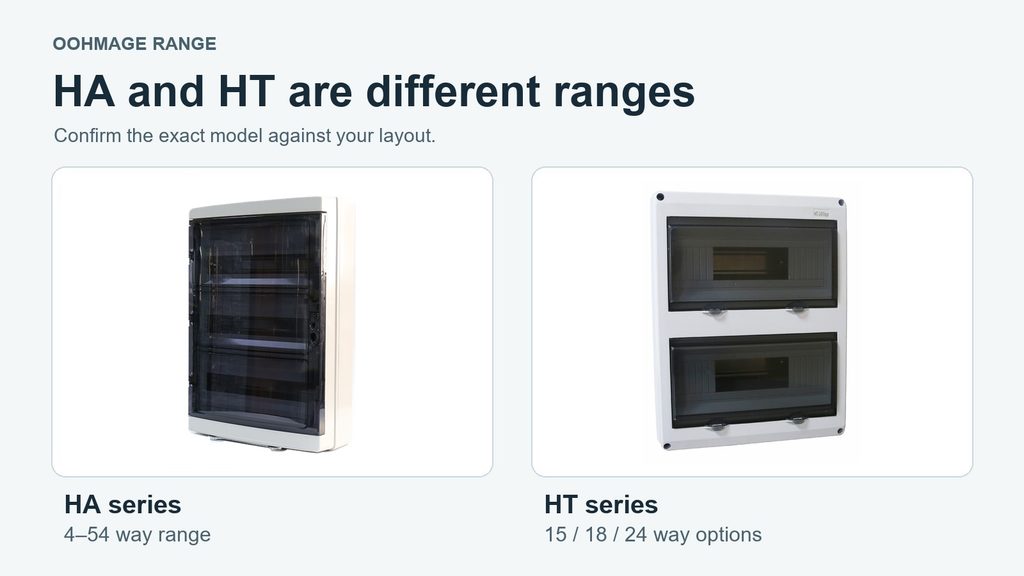
OOHMAGE’s current distribution-box category lists the HA series across a 4–54 way range and the HT series in 15, 18, and 24 way options. These are selection ranges, not a promise that every model is a complete three-phase assembly or fits a particular project. Send the layout, component dimensions, installation conditions, quantity, and destination market so the exact model can be confirmed.
Figure 4. Published HA and HT way ranges are a starting point; confirm the exact model and internal layout.
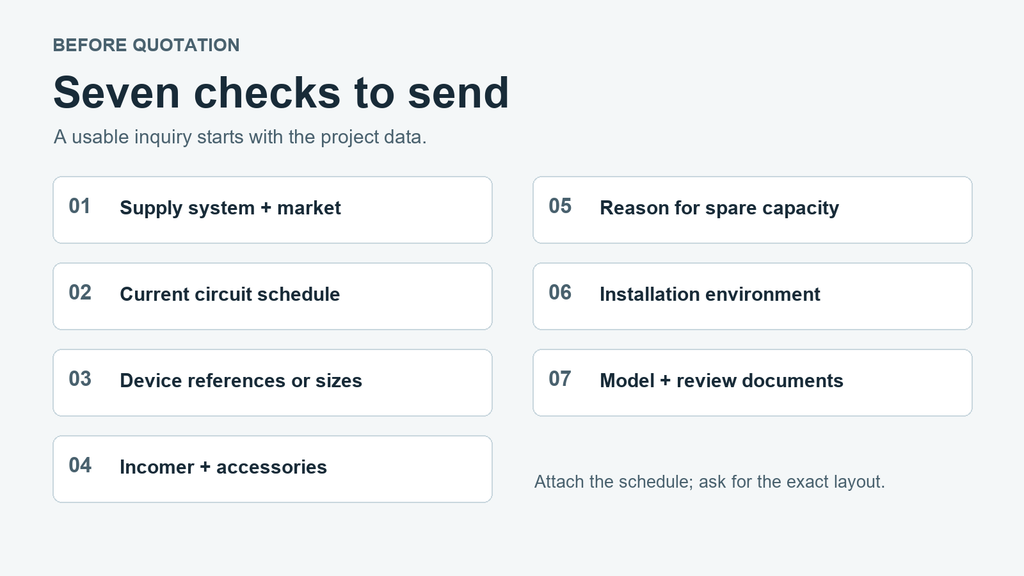
Seven Checks Before You Request a Quote
1 Provide the supply system and destination market
Give the destination country or region and the supply information from the project documents. Terminology, required documentation, and installation rules vary by market; a sales team should not have to infer the system from “distribution board.”
2 Send the current circuit schedule
Attach the current panel schedule or an equivalent circuit list. State each circuit’s function and specified pole arrangement. Mark future circuits separately so the supplier can distinguish the installed requirement from the space being reserved.
3 List the exact devices or their verified dimensions
List the planned MCB, RCCB, RCBO, SPD, switch, meter, and other device references when they are known. If brands are still open, send the design requirements and verified dimensions. Critical protection parameters should come from the design, not a supplier’s guess.
4 Identify the incomer and accessory requirements
State whether the plan includes a main switch, protective incomer, metering, surge protection, control equipment, communication accessories, or extra terminals. For the proposed board, ask which of these use advertised ways and which require separate space.
5 Define the reason for spare capacity
Name the additions you expect instead of adding an arbitrary spare percentage. A production line, extra floor, EV charging circuit, or photovoltaic connection may call for a different review from unspecified “future use.” The project designer should confirm the electrical implications.
6 Describe the installation environment
State whether the enclosure is installed indoors or outdoors, surface-mounted or flush-mounted, and whether it faces dust, water jets, heat, corrosion, direct weather, or restricted maintenance access. Include the required IP rating and cable-entry direction, but allow the supplier and project professional to check the complete suitability.
7 Ask for documents that allow a real review
Ask for the exact model, dimensional drawing, definition of ways, accepted device arrangement, relevant ratings, and available conformity documents. For a configured assembly, include whatever its technical reviewer needs. A quotation without an identifiable model and supporting data is difficult to verify.
Figure 5. Send the circuit schedule and installation details, then request a model and document set that can be reviewed.
A Buyer Ready Distribution Board RFQ Table
Copy the following table into an inquiry alongside the design schedule. It keeps the way-count request connected to the information the supplier needs for a meaningful response.
Clear details are a quiet form of respect for the next person who relies on them.
Teklif Talebi alanı
Information from the buyer
Confirmation expected from the supplier
Hedef pazar
Country or region and applicable project requirements
Available models and document scope for that market
Supply system
Single-phase or three-phase information and neutral arrangement from the project
Whether the proposed series can support the documented system
Circuit schedule
Circuit quantity, function, and pole arrangement
Actual occupied positions and proposed board configuration
Cihazlar
References or dimensions for MCBs, RCCBs, RCBOs, SPDs, incomer, and accessories
Mechanical fit, available space, and required accessories
Ways and reserve
Requested way count and documented expansion plan
Manufacturer’s definition of ways and remaining usable capacity
Ek
Material, mounting method, environment, and required IP rating
Enclosure options, dimensions, and application boundaries
Cable entry
Entry direction, quantity, and relevant drawings
Available entries, terminal access, and internal space
Order details
Quantity, packaging, labels, destination, and required documents
Model-specific commercial and documentation response
Common Distribution Board Buying Mistakes
Treating the way count as a complete design: The number does not confirm the supply system, protection, ratings, device compatibility, or installation conditions.
Comparing only external dimensions or current labels: A large enclosure can still have the wrong internal system, while an electrical rating does not describe available device space.
Assuming equal numbers mean equal capacity: Single-phase and three-phase boards, or boards from different manufacturers, can use different layouts and counting conventions.
Forgetting non-outgoing equipment: The incomer, surge protection, metering, terminals, and cable space can change the required arrangement.
Using IP65 as an unlimited waterproof claim: IP65 is a defined enclosure protection classification. It does not by itself confirm suitability for immersion, every outdoor exposure, or an installation with poorly maintained entries and seals.
Selecting the biggest enclosure without a plan: More empty space is not automatically the best specification. Reserve should be linked to a documented expansion need and the approved design.
Accepting an untraceable quotation: A useful offer should identify the model, dimensions, way-count definition, configuration boundaries, and available technical documents.
Questions Buyers Ask
Is a 12 way distribution board enough
The label alone cannot answer this. Check whether the specified multi-pole devices, incomer, SPD, metering, terminals, and reserve fit within that exact board’s usable capacity. A 12 way model may pass or fail that check; use the manufacturer’s data.
Does a 24 way board hold 24 breakers
Do not assume the breaker count equals the advertised way count. Check the manufacturer’s definition of a way, the board type, and each device’s width and pole arrangement. Ask for a layout showing the proposed devices in the exact model.
How is a three phase distribution board sized
A qualified professional develops the system, load, circuit, phase, and protection design. The resulting schedule is then checked against the board’s way convention, device space, incomer, ratings, enclosure, environment, and project rules. A universal online formula cannot replace that process.
What information should I send a distribution board supplier
Send the destination market, supply system, circuit schedule, component list, incomer and accessory requirements, requested ways and reserve, mounting and environment, cable entry, quantity, packaging, and documentation requirements.
Is IP65 enough for an outdoor distribution box
IP65 describes a degree of enclosure protection under the IP Code. Outdoor suitability still depends on the complete enclosure, exposure, mounting, temperature, material, cable entries, seals, maintenance, and local requirements. Provide the actual environment for review.
From Way Count to a Quotable Specification
The best fit is the board or enclosure whose documented configuration matches the circuit schedule, device footprint, supply system, installation environment, and planned expansion. A higher way count alone does not establish that fit.
Good advice still makes sense after the sale.
OOHMAGE supplies IP65 electrical distribution box ranges for project selection, including the HA 4–54 way and HT 15/18/24 way options shown on its current category page. For model confirmation, send the panel schedule or component list, required ways, mounting and cable-entry needs, installation environment, quantity, destination market, and required documents.
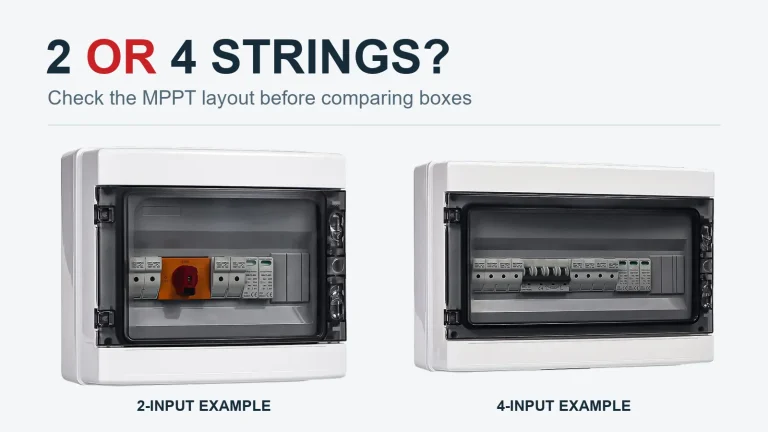
Start with the inverter layout when choosing between a 2 string and a 4 string solar combiner box. Confirm which PV strings may be combined, how many electrically separate output groups the design requires, and whether each receiving inverter input can accept the resulting voltage and current. Four string inputs do not necessarily mean one […]
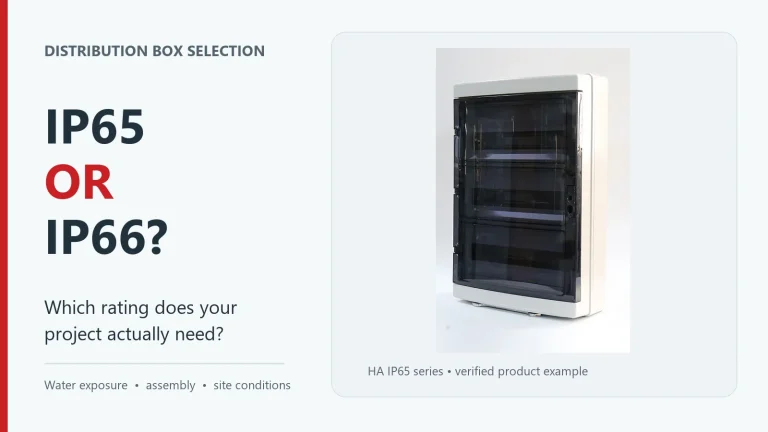
IP65 and IP66 both classify an enclosure as dust-tight, but they differ in water-jet protection. IP65 covers water jets; IP66 covers powerful water jets under the specified test conditions. Neither label, on its own, confirms suitability for immersion, every pressure-washing process, or every outdoor environment. Start with the water exposure the distribution box actually faces […]
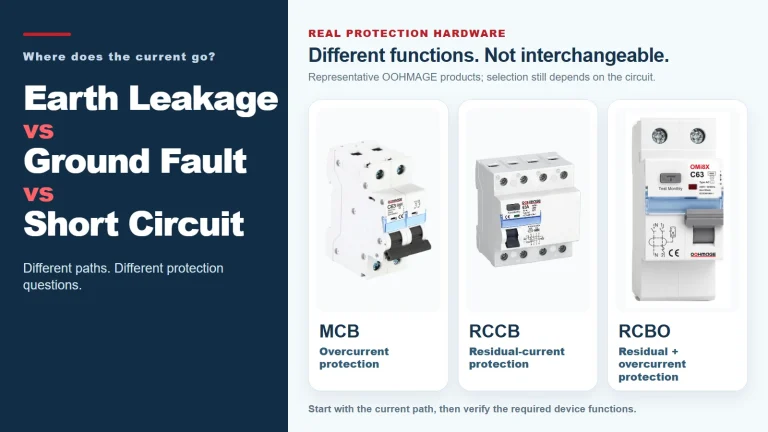
A report of “leakage,” a “ground fault,” or a “short” is not yet a diagnosis. Each term points to a current path, and each path may call for a different protection function. Earth leakage means current has left the intended live and neutral paths; it may be normal in electronic equipment or may indicate deteriorated […]