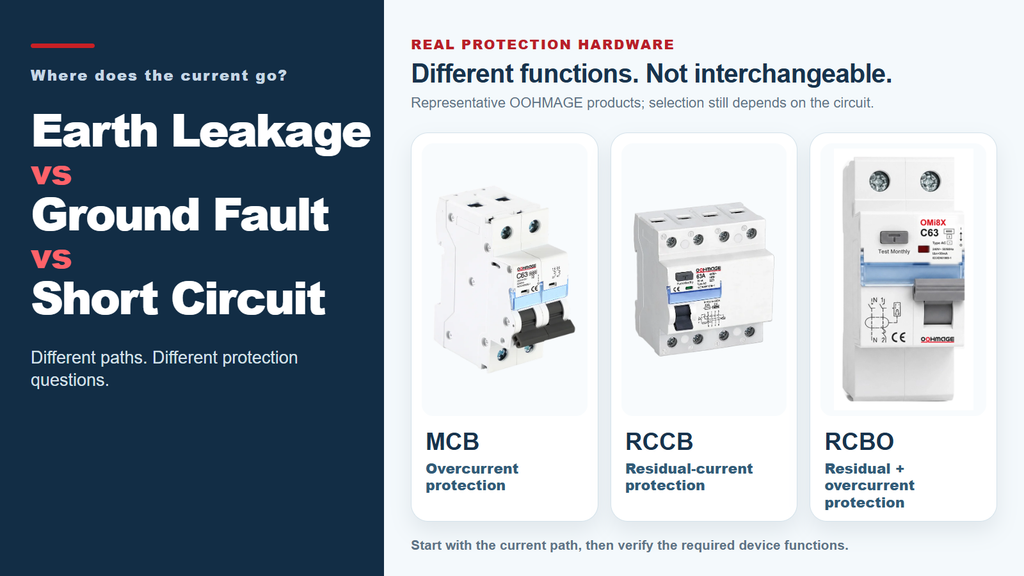
A report of “leakage,” a “ground fault,” or a “short” is not yet a diagnosis. Each term points to a current path, and each path may call for a different protection function. Earth leakage means current has left the intended live and neutral paths; it may be normal in electronic equipment or may indicate deteriorated insulation. A ground or earth fault is an unintended connection from a live conductor to earth, a protective conductor, or exposed conductive metal. A short circuit creates an unintended low-impedance path that can carry very high current. During an overload, current stays in the normal path but exceeds the circuit’s designed load.
These conditions can overlap. Before choosing an RCCB, RCBO, or conventional overcurrent breaker, identify the current path, define the protection functions the circuit needs, and confirm the circuit data. The event name alone does not establish the cause or select the device.
Quick Answer Four Different Electrical Conditions
The useful first question is where the current flows. Earth leakage, a ground fault, a short circuit, and an overload describe different conditions, even when more than one term applies to the same event. The next question is which protection function is intended to detect it.
Condition
Current path
Typical current behavior
Protection function to check
Earth leakage
Part of the current returns through earth, a protective conductor, equipment capacitance, or another unintended path
May be small and continuous, cumulative across equipment, or fault-related
Residual-current protection and the equipment’s normal leakage characteristics
Ground or earth fault
A live conductor is unintentionally connected to earth, a protective conductor, or exposed conductive metal
Can be low or high depending on impedance and the grounding system
Residual-current protection, overcurrent protection, or both, depending on the fault path
Cortocircuito
Current follows an unintended low-impedance path between conductors or from a conductor to earth
Usually rises rapidly and may reach a high prospective fault current
Short-circuit protection and adequate breaking capacity
Sobrecarga
Current remains in the intended path but exceeds the circuit’s designed load
Usually sustained overcurrent rather than an abrupt low-impedance fault
Overload protection matched to the conductor and load
Use the table to separate functions, not to diagnose a live installation. Which device operates depends on the installation, fault impedance, protective-device characteristics, and coordination with upstream and downstream protection.
What Is Earth Leakage
Earth leakage is current that leaves the intended circuit path and reaches earth or a protective conductor by another route. It is often associated with failed insulation, but the presence of leakage alone does not establish that equipment is defective.
Many electronic products use electromagnetic compatibility filters. Their capacitors can pass a small current toward the protective conductor during normal operation. An individual item may have acceptable leakage, yet several on one circuit can add enough residual current to contribute to unwanted RCD operation. The Institution of Engineering and Technology discusses both normal protective-conductor current and leakage caused by insulation problems.
Damaged insulation, contamination, moisture, or another abnormal condition can also produce leakage. “Earth leakage” therefore identifies the path; it does not identify the cause. To decide whether the observed current is expected or hazardous, a competent person needs the circuit design, connected loads, protection arrangement, and test results.
What Is a Ground Fault or Earth Fault
A ground fault, or earth fault in many markets, is an unintended conductive connection between a live conductor and earth, a protective conductor, or metalwork that should not normally carry current. “Ground” and “earth” often reflect regional usage; they do not universally describe separate fault types.
Fault current is not a fixed quantity. A low-impedance path can carry high current; a resistive or otherwise high-impedance path may carry much less. The grounding arrangement also affects the return path and which protection function can detect the fault. Schneider Electric’s fault-current overview distinguishes overloads, short circuits, and ground faults, and explains why distribution-system details matter.
That is why “ground fault” does not establish which particular device trips first. Check the fault loop, current level and duration, device settings or characteristics, and coordination across the installation before drawing a protection conclusion.
What Is a Short Circuit
A short circuit gives current an unintended low-impedance route around the normal load. The connection may be phase to phase, phase to neutral, or live conductor to earth. Current can rise rapidly, placing severe thermal and mechanical stress on the circuit.
A low-impedance phase-to-earth event can therefore be both a short circuit and a ground fault. The labels are not always mutually exclusive: “short circuit” describes the low-impedance path, while “ground fault” tells you that earth or grounded metal is in that path. Treating them as separate events can hide a protection function that also needs to be checked.
Short-circuit protection must interrupt the expected fault current safely. Check the prospective fault current at the installation point against the device’s breaking capacity, as well as its rated current and trip characteristic. See common circuit-breaker protection functions for a broader view of breaker families. Fault-current calculations and installation instructions are outside this article.
Where Does Overload Fit
In an overload, a healthy circuit carries more current than it was designed to carry for too long. The current still flows through the intended conductors and load. Excessive connected load, or equipment operating under an abnormal mechanical or electrical condition, can produce this situation.
A short circuit is different: its unintended low-impedance path bypasses part or all of the load. A thermal-magnetic overcurrent device normally has different response regions for sustained overload and high fault current. Its rating and characteristic still have to match the conductor, load, starting current, ambient conditions, and project requirements. Rated current by itself is not a selection decision.
Why These Conditions Can Overlap
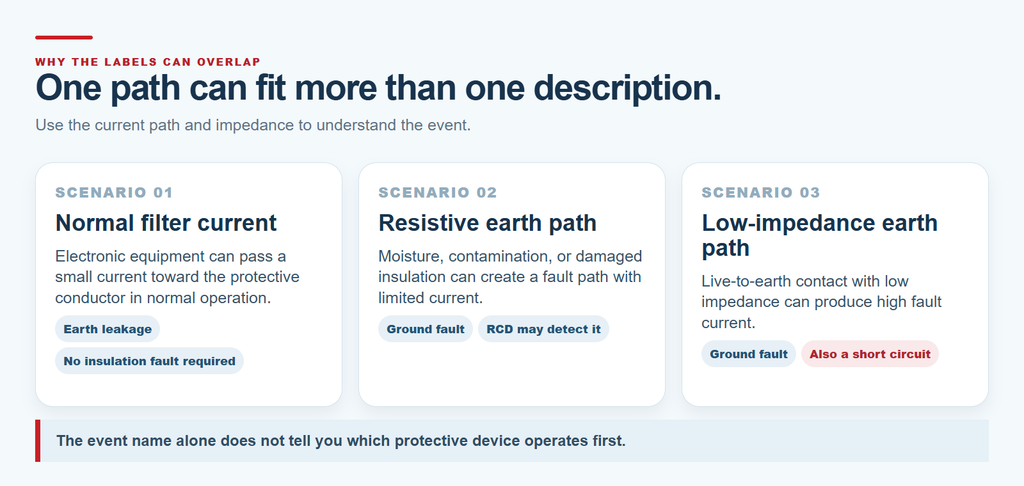
These terms describe different aspects of current flow. One event can therefore fit more than one category, while some leakage occurs without a fault at all.
First, filter components in electronic equipment can produce a small earth-leakage current during normal operation. Put several such devices behind the same residual-current protection and their currents can add up. That cumulative leakage matters even when no single device has an insulation fault.
Second, when a live conductor touches a grounded metal enclosure, current has an unintended path to earth: this is a ground or earth fault. If the path is also low impedance, the event is a short circuit with potentially high fault current. Both overcurrent and residual-current functions may respond, but their operating sequence cannot be assumed without the system details.
Third, moisture, contamination, damaged insulation, or another resistive path can produce an earth fault with enough residual current for an RCD to detect, yet not enough current for a conventional overcurrent breaker to respond quickly. This is why residual-current and overcurrent protection must be specified as separate functions.
These examples explain the relationships; they are not remote diagnostic rules. Repeated trips, visible damage, heat, burning odor, water ingress, or an unknown fault call for assessment by a qualified person. Do not repeatedly reset or bypass protection to keep the circuit running: that can conceal a hazardous condition.
Which Protection Function Responds
“Earth leakage circuit breaker” is a useful description of a problem, but it may refer to different technologies or product families. For a quotation, state the protection functions and applicable standards instead of leaving the supplier to infer them from that nickname.
Device family
Protección contra corrientes de fuga
Protección integral contra sobrecorriente
Buyer caution
MCB or conventional overcurrent breaker
Not inherently provided
Yes, for overload and short circuit according to its declared characteristics
A high-current earth fault may operate it, but that does not make it an RCD
Fabricante y proveedor de interruptores diferenciales (RCCB)
Sí
No
It needs suitable overcurrent protection elsewhere in the circuit design
Detects specified arc-fault signatures; this is a different function
Depends on the particular device design
Do not infer AFDD protection from the name RCCB or RCBO
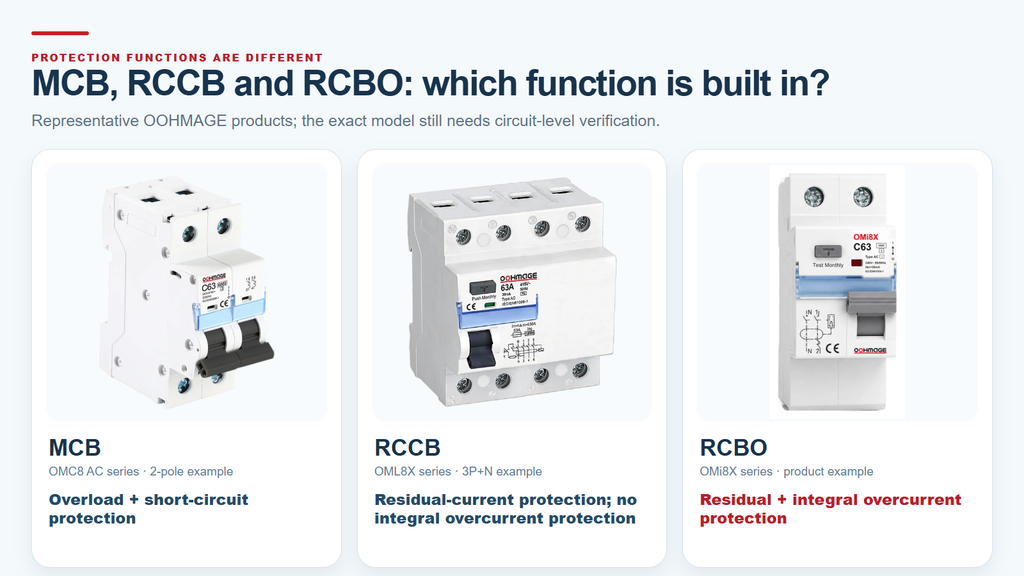
An MCB or other conventional overcurrent breaker responds to overload and short-circuit current according to its specified characteristic. A high-current phase-to-earth fault may operate it too. The breaker does not, however, measure residual current as an RCD does.
An RCCB compares current in the live conductors and operates when the residual imbalance exceeds its defined characteristic. It does not include integral overload or short-circuit protection, so that function must be addressed elsewhere in the circuit design. For terminology and functional boundaries, see RCCB and RCD terminology.
An RCBO combines residual-current protection with integral overcurrent protection for one circuit. Specify the version against the actual requirements: residual-current classification, rated residual operating current, rated current, trip curve, poles, and required breaking capacity. Read more about what an RCBO protects against y RCBO residual-current types.
El IEC 60755 framework provides general safety requirements for residual-current-operated protective devices. The final device and installation requirements still depend on the applicable product standard, local rules, and project specification.
When an RCBO Is the Product Family to Review
Review the RCBO family when a final circuit needs residual-current protection together with integral overload and short-circuit protection. It may also suit a circuit-by-circuit arrangement, where a fault on one branch is less likely to disconnect unrelated branches than it would under broadly shared protection. The actual arrangement still needs coordination and must meet local requirements.
The keyword “earth leakage” alone does not settle that choice. Depending on the objective, a project may use an RCCB with separate overcurrent protection, a residual-current monitor, or another engineered arrangement. Establish whether the design calls for automatic disconnection, monitoring, selectivity, continuity of service, or another outcome before comparing product families.
Once the required functions are clear, compare the OOHMAGE RCBO series. Use that product-family page to begin model verification. It does not establish that any one RCBO can replace another without checking the circuit data.
RCBO Information to Confirm Before Quotation
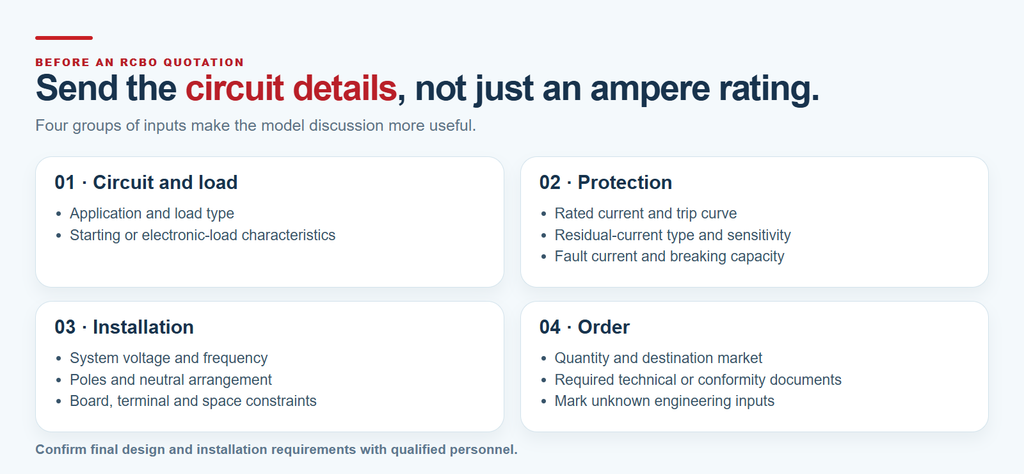
An ampere rating is only one part of an RCBO inquiry. Give the supplier the application and electrical conditions so the required protection functions and the available model can be checked against the same circuit. Include these details where available:
Circuit application and load type, including any relevant starting or electronic-load characteristics.
System voltage and frequency.
Required rated current and overcurrent trip curve.
Number of poles and the neutral arrangement.
Required rated residual operating current and RCD type.
Prospective fault current at the installation point and the required breaking capacity.
Distribution-board compatibility, terminal requirements, mounting constraints, and available space.
Quantity, destination market, and required technical or conformity documents.
If a field is unknown, mark it as an open engineering input. A clear gap is easier to resolve than a guessed value: the supplier can confirm product availability, while the project designer or qualified electrical professional confirms the outstanding circuit decision.
Errores habituales
Calling every leakage current a fault is the first common mistake. Electronic filters can contribute normal leakage; unexpected or increasing leakage still needs proper assessment. It is equally misleading to assume that every ground fault is low current or that a short circuit can never involve earth. The path and its impedance determine the behavior.
Another mistake is choosing an RCBO from its rated current alone. Check the residual-current type and sensitivity, overcurrent curve, pole arrangement, breaking capacity, voltage, and application. Also distinguish a Type B overcurrent curve from a Type B residual-current classification: the shared letter does not make them equivalent.
Repeated tripping is a condition to investigate, not an inconvenience to bypass. Protection may be responding to an abnormal fault, unsuitable circuit grouping, accumulated normal leakage, or another equipment or design issue. A competent inspection and verified circuit information are needed to resolve it safely.
Preguntas frecuentes
Is earth leakage always a fault
No. EMC filter components in electronic equipment can produce a small protective-conductor current during normal operation. Damaged or deteriorated insulation, moisture, and contamination can also cause leakage. The term describes current outside the intended path; equipment data, circuit context, and competent testing are needed to determine why it is present and whether it is expected.
Is a ground fault the same as a short circuit
Not always. A ground or earth fault connects a live conductor unintentionally to earth, a protective conductor, or grounded metal. A short circuit has an unintended low-impedance path and can produce high current. A low-impedance phase-to-earth fault can meet both descriptions; a resistive earth fault may not behave like a high-current short circuit.
Can an ordinary circuit breaker detect earth leakage
An ordinary overcurrent breaker may trip when an earth fault produces enough current to enter its operating range. It does not inherently detect residual current. Lower-current leakage or a high-impedance earth fault may therefore call for an RCD function, depending on the circuit design and applicable requirements.
Does an RCBO protect against earth leakage and short circuits
Yes, an RCBO combines residual-current protection with integral overload and short-circuit protection, making it relevant when a final circuit needs both functions. The device still has to fit the installation: confirm its residual-current type and sensitivity, rated current, trip curve, poles, breaking capacity, and project requirements.
Is an ELCB the same as an RCCB or RCBO
Not as a complete specification. ELCB has described older voltage-operated devices and is also used informally for newer residual-current devices. Because usage varies by market, state the function you need: residual-current protection alone, as with an RCCB, or residual-current protection plus integral overload and short-circuit protection, as with an RCBO.
What information should I send for an RCBO quotation
Send the circuit application and load type; voltage and frequency; rated current and required trip curve; poles and neutral arrangement; residual-current sensitivity and type; required breaking capacity; board compatibility; quantity; destination market; and required documents. Mark unknown items so the supplier can identify the engineering inputs that still need confirmation.
Conclusión final
Start with the current path. Earth leakage means current leaves the intended live and neutral path. A ground or earth fault connects a live conductor abnormally to earth or grounded metal. A short circuit has an unintended low-impedance path, while an overload keeps current in the normal path at a level above the circuit’s designed load. One event may fit more than one label, but the protection functions remain distinct.
If a final circuit needs residual-current protection plus integral overload and short-circuit protection, review the RCBO family. For a model review, send your circuit and order requirements, including the application, system data, ratings, quantity, destination market, and required documents. Qualified personnel must complete the final design, verification, and installation under the applicable project rules.
Start with the inverter layout when choosing between a 2 string and a 4 string solar combiner box. Confirm which PV strings may be combined, how many electrically separate output groups the design requires, and whether each receiving inverter input can accept the resulting voltage and current. Four string inputs do not necessarily mean one […]
IP65 and IP66 both classify an enclosure as dust-tight, but they differ in water-jet protection. IP65 covers water jets; IP66 covers powerful water jets under the specified test conditions. Neither label, on its own, confirms suitability for immersion, every pressure-washing process, or every outdoor environment. Start with the water exposure the distribution box actually faces […]
Figure 1. Board selection starts with the circuit schedule, device space, and planned reserve. A request for a “12 way distribution board” can sound specific, but it leaves the layout unresolved. One project may use mostly single-pole devices; another may need multi-pole devices, an incomer, surge protection, metering, or more terminal space. The same number […]