2 String vs 4 String Solar Combiner Box: Check the MPPT Layout
วันที่เผยแพร่: ผู้เขียน: Whelve
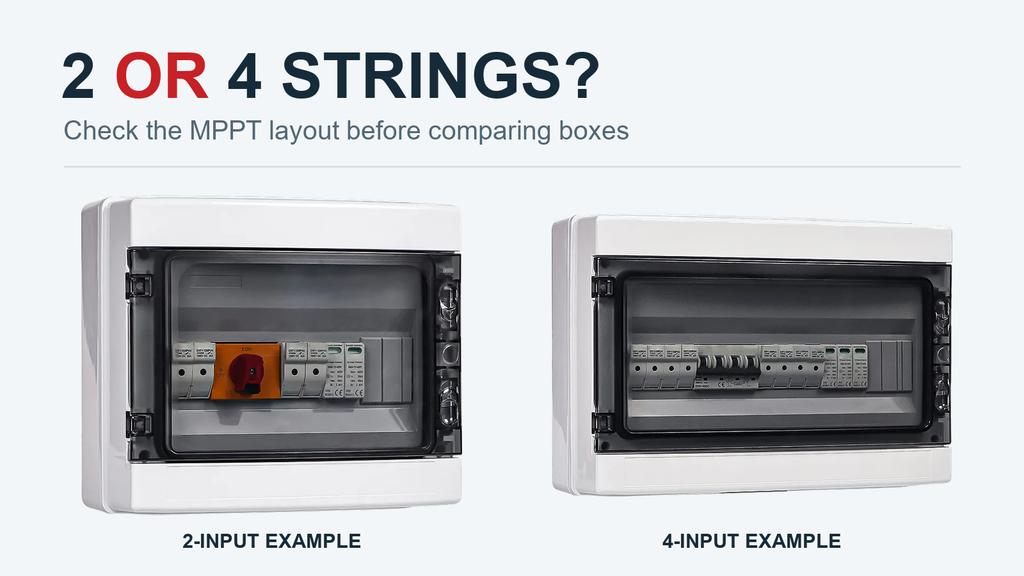
Start with the inverter layout when choosing between a 2 string and a 4 string solar combiner box. Confirm which PV strings may be combined, how many electrically separate output groups the design requires, and whether each receiving inverter input can accept the resulting voltage and current.
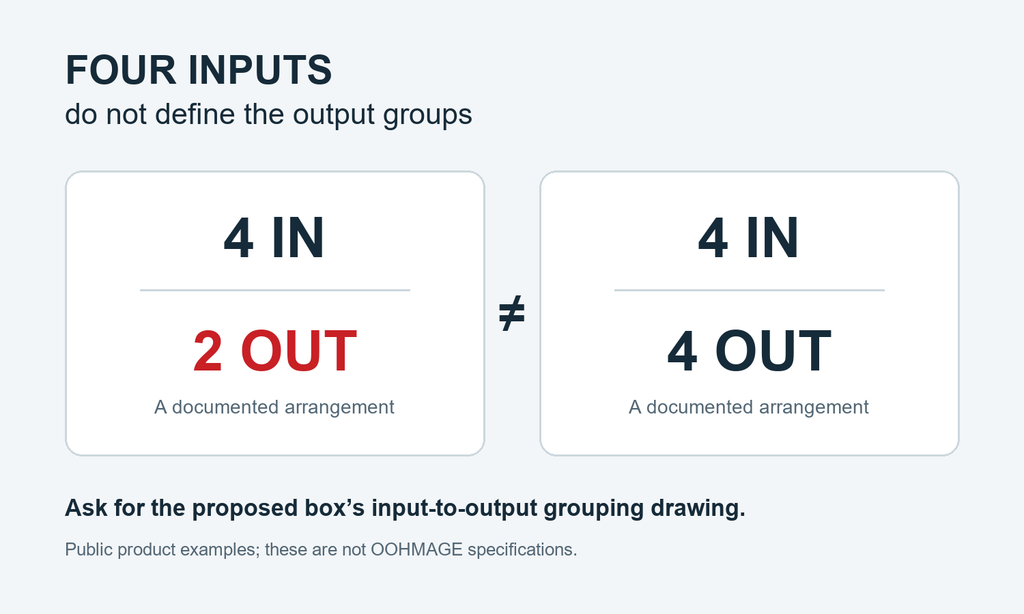
Four string inputs do not necessarily mean one combined output or four independent MPPT channels. Boxes sold as “4 string” can have different input-to-output arrangements. Ask for the grouping drawing before comparing them as equivalent offers.
This guide helps project buyers compare configurations and prepare an enquiry. It is not a wiring procedure or a substitute for a qualified PV designer’s assessment.
First, distinguish a string, an input, and an MPPT
A PV string is a series-connected group of modules. An input is a physical connection to the proposed equipment. An MPPT is an inverter function that tracks an operating point. Physical inverter connectors and independent trackers need not have the same count.
Decide the output groups before comparing box sizes
First, ask the PV designer which strings are assigned to each inverter tracker and which combinations that inverter permits. The proposed combiner drawing should preserve those assignments.
Consider a project schedule with four strings assigned across two independent MPPTs. An offer described only as “4 in, 1 out” does not show whether it keeps those circuits separate. Ask for a drawing that identifies which inputs join each output and where each output connects at the inverter.
This is a check of the proposed documents, not a circuit to install. Do not join separate MPPT circuits because the enclosure happens to have enough cable entries.
Weidmüller’s PV Next documentation identifies inputs, outputs and electrically separated tracker arrangements within its range. Request the same level of clarity for the box you are considering.
Check inverter current limits after combining
When compatible parallel strings are combined, the shared output path carries more current. The inverter’s permitted input current does not increase with it. Check both the output path and the receiving input against the proposed design.
Have the designer confirm that the module and string characteristics, including the relevant voltages, are compatible within each proposed combined group.
Check separately:
The inverter’s permitted operating input current for the relevant tracker or input.
Its applicable maximum short-circuit-current limit.
Any connector-specific limit and permitted connection arrangement.
The declared ratings of the proposed output terminals, conductors and switching equipment.
Weidmüller’s fact sheet on combining PV strings explains why combined current must be checked against the inverter datasheet. A larger enclosure cannot make an incompatible inverter input suitable.
Ask the designer for the design currents and applicable corrections. Module wattage or a single universal current multiplier is insufficient for selecting the complete box.
Verify voltage and the proposed protection components
String count also tells you little about the required DC voltage rating. Use the actual module data, series-module count, site temperature assumptions and inverter voltage limits.
Ask for a component list with the relevant DC ratings and functions of the offered configuration. A fuse link is distinct from its holder; a protective device is distinct from a switch-disconnector; and a surge protective device is distinct from protection against sustained abnormal voltage.
The actual array design, module limits and applicable requirements determine whether string overcurrent protection is needed and how it is coordinated. Do not assume every two-string system uses the same fuse or every four-string box includes the same protective devices.
Compare documented configurations against the same project inputs. The largest ampere number in a product listing is not, by itself, a useful basis for the decision.
Does a four-string box make future expansion easier?
Spare input positions help with expansion only if the future arrangement suits the complete system. Assess the enclosure, components, output path and inverter against that future configuration.
Before paying for spare positions, establish what they actually permit. Are the necessary components included? How are unused entries closed? Would added strings change output current, protection requirements or tracker grouping? Can the existing inverter accept them?
Document the agreed future arrangement separately from the initial supply. “Space for four strings” is not a promise that any four-string array can be added later.
A configuration checklist for comparing supplier offers
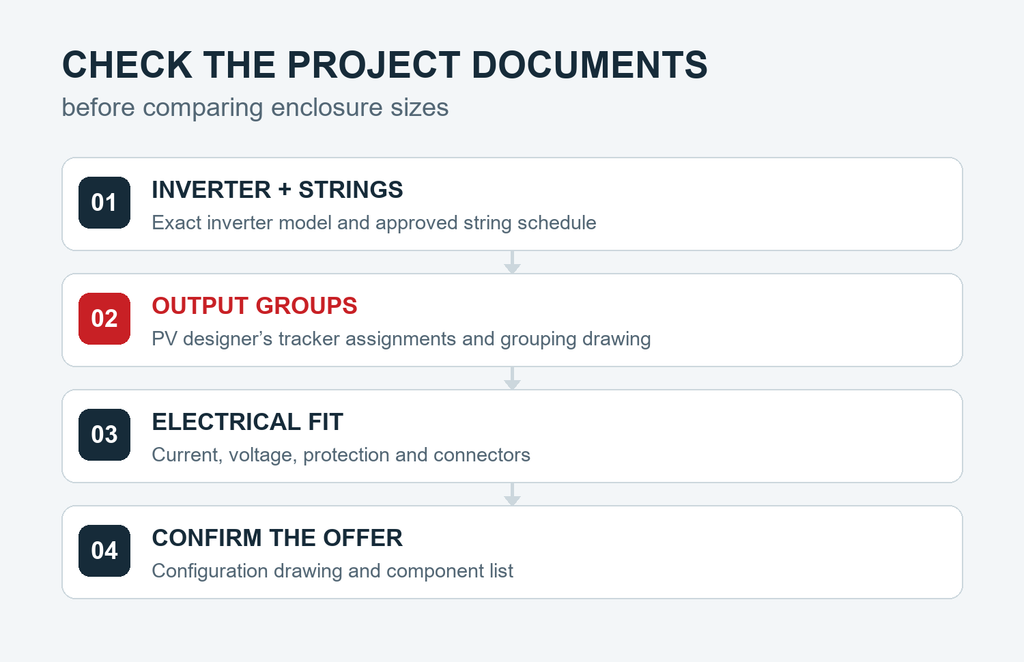
Use the following checklist to get two offers onto the same project basis:
Item to confirm
Information to supply or request
Array information
Module datasheet and approved string schedule
Receiving equipment
Exact inverter model and relevant input documentation
Circuit grouping
Inputs and outputs assigned to each MPPT
Electrical design
Required DC voltage and design current for each circuit group
Included components
Identified fuse links, holders, switching devices and SPDs, as applicable
เงื่อนไขการติดตั้ง
Mounting environment, enclosure requirement and cable-entry arrangement
Connectors
Manufacturer, exact connector type and permitted mating combination
Order documents
Configuration drawing, component list and available supporting documents
For help reading the proposed drawing, use our solar combiner box diagram guide alongside the project’s approved documents. This comparison focuses on how the inputs are grouped.
Request an OOHMAGE project configuration
ดู OOHMAGE combiner-box range, then send the exact inverter model, approved string schedule, required input/output groups, electrical design data, installation conditions, quantity and destination market with your configuration enquiry.
Before ordering, confirm the proposed drawing, component list and configuration. Do not infer string count, MPPT arrangement or included components from the series name alone.
Questions buyers ask
Can I use a four-string box with only two strings?
Possibly, if the manufacturer and PV designer confirm that exact partial-use arrangement. Check the protection, unused entries, grouping and receiving-equipment compatibility; the input count alone is insufficient.
Is a two-string combiner box always necessary?
No universal rule follows from having two strings. Check the inverter inputs, required protection and installation design to determine whether external combining or protection is needed.
Does a four-string box have four MPPTs?
Do not assume so. A box with four incoming string circuits does not necessarily provide four independent tracker channels. Check the circuit-grouping drawing and inverter documentation.
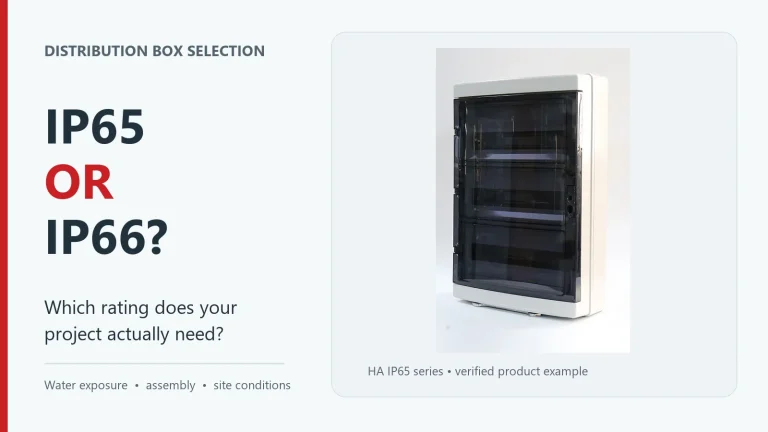
IP65 and IP66 both classify an enclosure as dust-tight, but they differ in water-jet protection. IP65 covers water jets; IP66 covers powerful water jets under the specified test conditions. Neither label, on its own, confirms suitability for immersion, every pressure-washing process, or every outdoor environment. Start with the water exposure the distribution box actually faces […]
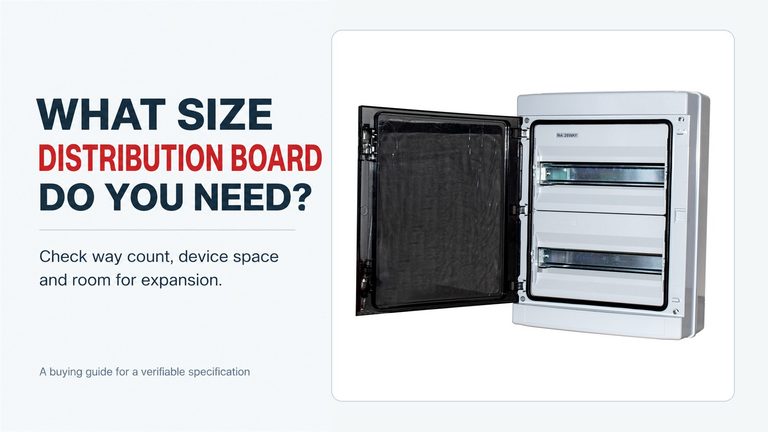
Figure 1. Board selection starts with the circuit schedule, device space, and planned reserve. A request for a “12 way distribution board” can sound specific, but it leaves the layout unresolved. One project may use mostly single-pole devices; another may need multi-pole devices, an incomer, surge protection, metering, or more terminal space. The same number […]
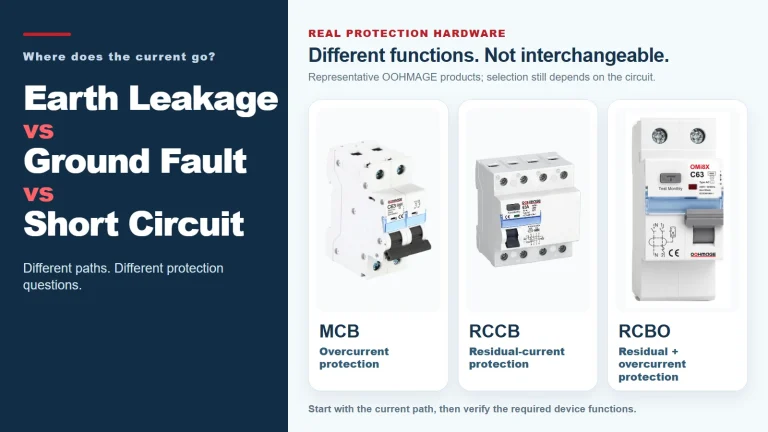
A report of “leakage,” a “ground fault,” or a “short” is not yet a diagnosis. Each term points to a current path, and each path may call for a different protection function. Earth leakage means current has left the intended live and neutral paths; it may be normal in electronic equipment or may indicate deteriorated […]