Surge Arrester vs Surge Protector Which Device Do You Need
Figure 1. A low-voltage SPD example; the product name alone does not determine suitability.
“Surge arrester” and “surge protector” can describe overlapping products. They can also refer to equipment intended for very different electrical systems. Before comparing prices, identify the voltage class, application and declared product standard behind the name.
For a low-voltage distribution panel, the required product may be a surge protective device, or SPD. A transformer arrester enquiry may belong to another equipment category. Neither the word “arrester” nor a large kA value tells you enough to make that distinction.
This comparison helps distributors and project buyers clarify the specification before choosing a model. Final selection and coordination still require the exact product documents and a qualified electrical designer.
Identify the equipment behind the name
Start with the electrical system and the proposed device’s role. A purchase description should establish those before relying on a familiar product name.
Description in the request
What it may refer to
Evidence to request
Panel surge arrester or SPD
A low-voltage surge protective device
Exact model, system voltage, protection modes and declared SPD standard
Transformer or line surge arrester
Equipment for a medium- or high-voltage application
System voltage class and the project arrester specification
Plug-in surge protector
Protection associated with a socket or connected equipment
Product ratings, intended supply and installation instructions
Lightning rod or air terminal
An element of an external lightning protection system
The external lightning protection design
Use these descriptions to route the enquiry, then request the evidence in the final column. If a tender and a quotation use different names, you do not have to settle which wording is “right” before checking whether the equipment matches. The descriptions are clues, not interchangeable specifications; they cannot assign a device from its name alone.
Figure 2. Category sketches distinguish equipment roles; use the corresponding project documents to identify the requirement.
An SPD is intended to limit transient overvoltage and divert surge current. Read its designation together with the declared type, ratings and application. “Arrester” does not automatically mean a utility-line product, and “protector” does not automatically mean a plug-in power strip.
For the wider family and selection criteria, see our surge protective device guide. Here, settle the earlier purchasing question first: are the quotations describing the same category of equipment?
A medium voltage arrester is a different procurement task
“Surge arrester” also describes equipment protecting transformers, cables and other medium-voltage apparatus. ABB’s arrester range provides examples of this usage.
The public scope of IEC 60099-4 covers gapless metal-oxide surge arresters for AC systems with a highest voltage for equipment above 1 kV. By comparison, IEC 61643-11 addresses SPDs connected to AC low-voltage circuits and equipment rated up to 1,000 V RMS.
Two products called arresters can therefore belong to different specifications. These scopes do not make products with either name equivalent or suitable for your project. Check the standard and edition actually declared for the offered model, alongside the destination-market requirements. A reference to an IEC standard is not, by itself, proof of certification.
Keep external lightning protection separate
A lightning rod is not a substitute name for a panel SPD. An air terminal forms part of an external lightning protection design; an SPD addresses transient overvoltage at defined electrical connections. A project can require coordinated measures serving these different roles.
Do not interpret a Type 1 marking as a promise that connected equipment will survive any lightning event. Likewise, protection against a transient does not establish protection against every sustained abnormal supply voltage. Identify the event and protection objective in the design rather than asking for a device that “stops all lightning.”
Use four checks before comparing quotations
Ask each supplier to answer these four questions against the same project documents. That gives you a common basis for comparing the offers before price becomes the deciding factor.
Which electrical system is this for? State AC or DC, nominal voltage, relevant voltage-to-earth conditions, phase and neutral arrangement, and earthing information.
Where does it operate and what is its role? Identify the panel, equipment connection or other installation point and the required protection function.
What exactly is being compared? Request the full model and variant, protection configuration, applicable voltage ratings and current ratings with their test conditions. A shared kA number does not establish equivalence.
Which documents support the offer? Obtain the current datasheet, instructions and required declaration or certificate for that exact product. Include short-circuit and backup-protection information where relevant.
Consider the hypothetical request “40 kA surge arrester for the main panel.” It sounds specific, yet leaves the supply, protection type, voltage rating, configuration and basis of the current rating unspecified.
We would ask for clarification before quoting a model: confirm the panel’s electrical system, provide the relevant drawing, and state the required SPD classification and supporting documents. If the request concerns a transformer-side medium-voltage application, route it to the appropriate equipment specification. Do not quote a low-voltage SPD simply because its label contains 40 kA.
Figure 3. A current rating alone leaves the system, role, exact product and documents to be confirmed.
Request OOHMAGE low voltage SPD information
For a low-voltage panel requirement, review the OOHMAGE surge protective device range. Include the system information, relevant drawing, requested protection type, quantity and destination market with your product enquiry. Those details help keep the discussion focused on the equipment your project actually needs.
An SPD backup fuse or circuit breaker must match the selected surge protective device and the installation conditions. Start with the SPD manufacturer’s coordination information. A discharge rating printed in kA does not, on its own, identify the ampere rating or breaking capacity of the backup device. For buyers, the useful question is: Which documented […]
Figure 1. Three-phase SPD selection starts with system facts, not the largest kA number. A three-phase surge protector should not be selected by the largest kA number on its label. First confirm the system voltage, whether a neutral is present, the earthing arrangement, the installation point, and the required SPD type. Then compare Uc, Up, […]
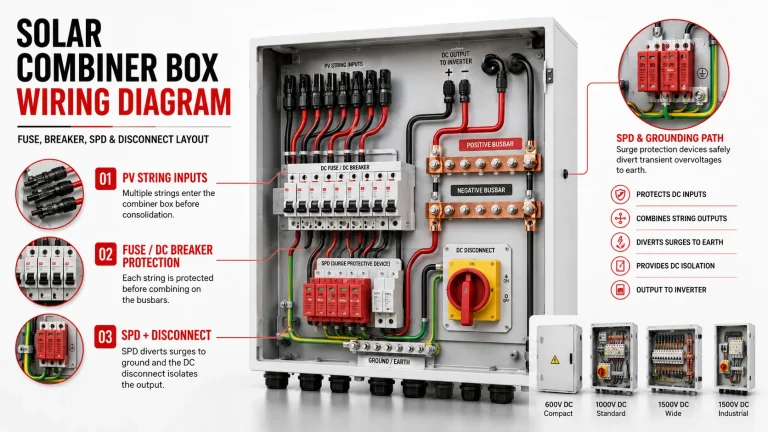
Introduction The wiring diagram of the solar energy combiner box shows how multiple photovoltaic strings enter the combiner box, pass through the string protection device, connect to the positive and negative busbars, ground the surge protection device, and connect to the inverter through the DC circuit breaker. In other words, this diagram not only indicates […]