DC isolator selection starts with the duty, configuration and supplied assembly.
Choose a DC isolator switch by the actual circuit voltage and current, required switching duty, permitted pole connections and supplied enclosure. Identical headline ratings can hide different configurations. Establish what each quotation covers before comparing prices.
First define the task: switching load current, providing isolation after shutdown, or both. Ask for the exact model and connection drawing, then check its documented operating conditions against that task. Keep those documents with the quotation.
Match the rating to the actual configuration
A DC isolator switch provides a means of isolating a DC circuit. It must support the intended switching duty; a familiar ampere marking is not enough. Ask for the declared utilization category and associated switching rating for the proposed DC application.
Obtain the project’s maximum PV voltage, including the applicable cold-temperature correction to string open-circuit voltage, and the design current at the switch position. Parallel strings affect current where they combine. Include the ambient conditions inside the enclosure and the manufacturer’s applicable derating. Have the project designer establish this basis rather than applying one universal multiplier.
For PV applications, distinguish the declared utilization categories before comparing current markings. The IET selection and configuration guidance explains the following duty distinctions. These descriptions help frame the enquiry; they do not replace model-specific ratings or project selection.
PV category
Duty distinction
What the buyer needs to establish
DC-PV0
Disconnection without current; not making or breaking current
Whether the operating sequence ensures no-current operation
DC-PV1
PV circuits without significant overcurrent
Whether this duty covers the proposed circuit
DC-PV2
PV circuits where significant overcurrent or bidirectional current may occur
The available sources and required switching duty
Find the manufacturer’s rating-table row for the offered model and pole arrangement. Read the voltage and current together, with their stated operating conditions. Combining the highest voltage from one part of a range with the highest current from another can produce a configuration the documents never specify.
For example, BENY’s published BYH-32 family specification lists 2P and 4P formats, operating voltages from 500 to 1000 V, and a family current range of 9–40 A. These are separate selection fields, not proof that every current applies at every voltage and connection arrangement. The configuration-specific datasheet closes that gap.
A useful question for the supplier is: “Which table row and connection drawing support the voltage and current in this quotation?” File the answer against the offered part number so the quotation, rating table and drawing refer to the same configuration.
Link the design inputs and switching task to one documented switch configuration.
Read the pole diagram before comparing prices
The number of poles does not, by itself, tell you how many independent PV circuits the device serves. The manufacturer’s diagram must identify the permitted connections and the rating associated with them.
Follow each circuit through the drawing. Which conductors belong together? Which contacts operate together? Do the separate circuits remain separate? An enclosure photograph is unlikely to answer these questions.
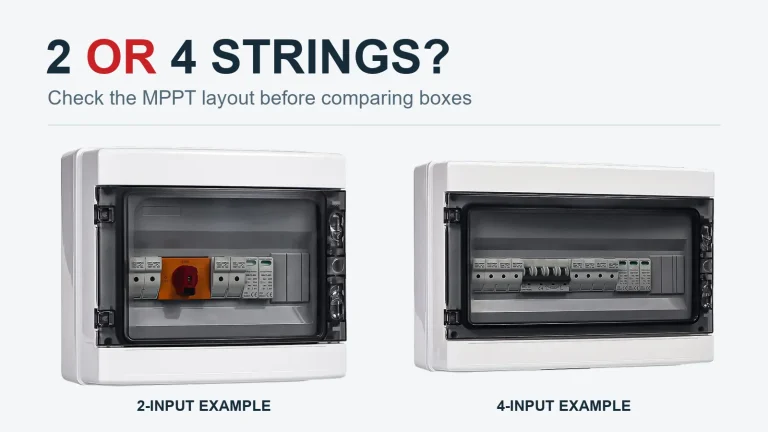
This matters when the switch is offered inside a combiner box. The output arrangement must agree with the receiving inverter layout. Our 2 string vs 4 string combiner-box guide explains that grouping decision. Once the required groups are clear, request the isolator arrangement for those groups rather than selecting it from the string count alone.
Keep the supplier’s approved drawing as the reference. Do not infer a higher voltage rating by adding pole ratings or propose an alternative bridge arrangement without model-specific documentation.
Separate isolation from overcurrent protection
Treat switching and fault protection as separate questions. Establish how the circuit will be disconnected for the intended task, then identify the device responsible for interrupting abnormal current.
Schneider Electric’s ComPacT NSX DC documentation distinguishes circuit breakers and switch-disconnectors. For a purchase, identify the actual functions of each offered device instead of treating the names as interchangeable.
Item to confirm
Evidence to request
Isolation and switching duty
Model-specific operating instructions and declared duty
Overcurrent protection
The offered fuse or breaker specification and coordination information
A device combining functions
Documentation supporting each required function
A breaker may provide an accepted means of isolation when its design and application support that use. An isolator’s current marking alone does not establish automatic overcurrent protection. The correct arrangement depends on the equipment and project requirements, rather than a universal instruction to fit or remove one device.
Read the supply description before comparing prices. A switch mechanism, an enclosed isolator and an isolator fitted inside a complete combiner box are different offers, even when the switch family is the same.
The BYH family specification, for example, distinguishes an IP66 enclosure from an IP20 switch body. The surrounding assembly forms part of the declared configuration. A component rating should not be transferred automatically to a finished box with different entries and accessories.
For an enclosed offer, confirm the supplied housing, operating handle, cable-entry arrangement and unused-opening closures. Establish who supplies each item and which installation instructions apply. Check the mounting dimensions, terminal capacity and any required OFF-position locking provision as well. Match any conformity document to the offered model and supplied version. Ask separately about the exposure at the installation site. Our IP65 vs IP66 guide explains the water-jet distinction and the other environmental questions an IP number does not answer.
Catalogue examples show supply forms, not an interchangeable model pair; products are not shown to scale.
Put two quotations on the same basis
Consider this hypothetical document-review example. Both offers state “1000 V DC, 32 A.” Offer A includes an exact part number, a rating table and declared utilization category for the proposed connection, a drawing showing the required circuits and a defined enclosure supply. Offer B provides a catalogue cover and the same headline numbers.
Request Offer B’s missing documents before treating the offers as equivalent. Offer A is easier to assess because its configuration is documented, but it still needs the project’s electrical assessment. A fuller set of files alone does not prove suitability.
Use the same comparison fields for both offers:
Comparison field
A complete supplier response identifies
Product identity
Exact part number and supplied version
Operating rating
Voltage, current, utilization category and temperature conditions for the offered configuration
Connection arrangement
Approved drawing and independent circuit count
Functional scope
Switching, isolation and any separately required protection
Physical supply
Mechanism, enclosure, handle, entries and included accessories
Supporting files
Applicable datasheet, instructions and requested conformity documents
Identical headline ratings do not establish equivalent configurations or supply scope.
Send both suppliers the same comparison sheet. Resolve a missing part number, configuration rating or supply item before comparing prices.
Send a complete enquiry
For a standalone switch, send the intended DC application, project voltage and current basis, circuit count, switching task, proposed mounting arrangement and required documents. For a complete combiner box, also send the string and output grouping, receiving inverter information, required protection functions and enclosure conditions.
The following request gives the supplier specific points to answer:
Please propose a DC isolator arrangement for the attached PV circuit. Identify the exact part number, rated operating voltage and current for the proposed pole connections, and the independent circuits covered. Include the connection drawing, installation instructions, enclosure and accessory supply scope, and the supporting documents required for our destination market. State any information you still need before confirming the selection.
Higher current alone does not resolve the voltage, connection arrangement, switching duty or enclosure requirements. Compare the complete proposed configuration.
Does an integrated inverter isolator remove every external switching requirement
Check the inverter documentation and the complete installation requirements. The presence of an integrated isolator is one input to that assessment, rather than an automatic instruction to add or remove an external device.
What if the supplier cannot provide the rating table
Leave the selection open until the manufacturer’s model-specific documents are available. If the supplier cannot provide them, request a documented alternative before placing the order.
Figure 1. Start with module data, then check the proposed fuse and holder assembly. Product photographs are examples, not the worked-example selection. Start with the panel datasheet when choosing a solar string fuse. You need the module’s short-circuit current, maximum series fuse rating and the conditions where the fuse will operate. The wattage label leaves […]
Start with the inverter layout when choosing between a 2 string and a 4 string solar combiner box. Confirm which PV strings may be combined, how many electrically separate output groups the design requires, and whether each receiving inverter input can accept the resulting voltage and current. Four string inputs do not necessarily mean one […]
Only “solarcombiner box” in your quotation is far from sufficient. What should be connected to the box? A PV string or an inverter output? They match different jobs. The price and enclosure size can be considered at a later stage. What connects to the input is the top priority. To be more specific, a DC combiner […]