Condensation in Electrical Enclosures Why IP65 Is Not Enough
Figure 1. An IP rating and the installed enclosure’s moisture-management requirements need separate consideration.
An IP65 distribution box can still contain condensation. Ingress protection and internal moisture control answer different questions: one concerns protection provided by the enclosure, while the other depends on humidity, temperature and the complete installed arrangement.
Condensation forms when a surface becomes cold enough for moisture in the surrounding air to turn into liquid water. Increasing an enclosure’s IP rating alone does not establish that its internal surfaces will remain above the dew point.
For a project buyer, this means asking two questions: “Which IP rating do we need?” and “What moisture conditions must the finished box handle during operation and shutdown?” You need an answer to both before deciding what to order.
Why a sealed enclosure can develop condensation
Air inside a cabinet can contain moisture even when no rainwater enters. Humid air may be present during assembly or maintenance. Changes in temperature can then bring internal surfaces below the dew point. Rittal’s enclosure moisture guide explains this relationship between surface temperature and humidity.
The IEC 60529 IP Code classifies protection provided by enclosures. Treat the declared IP rating as one requirement, alongside the environment and thermal conditions. It is not a complete specification for humidity management.
Figure 2. Humid air already inside can condense when an internal surface cools below the dew point.
Distinguish condensation from water ingress
Water in a box calls for an investigation before choosing a remedy. Rain entry, condensation and a cooling-system drain problem can require different responses. Use observations to guide an inspection; they do not approve a repair.
Observation recorded by qualified personnel
Possible explanation to investigate
Evidence needed before selecting a remedy
Moisture follows rain or washing
Entry through seals, glands or an unsuitable installation detail
Enclosure and entry instructions, condition and exposure
Droplets appear after cooling or shutdown
Internal surfaces may cross the dew point
Temperature and humidity records across the operating cycle
Moisture is associated with a cooling unit
Cooling, sealing or condensate drainage may need attention
Exact cooling-unit manual and inspection findings
Water recurs near a cable entry
The entry or cable route may contribute
Gland compatibility, cable route and installation details
Record when the moisture appears and where it collects. Those observations are clues, and several mechanisms can occur together. Hammond’s cooling-unit manual, for example, distinguishes excessive condensation from a condensate drain that fails to discharge.
If moisture is found around electrical equipment, have qualified personnel assess the condition and the required isolation before opening, handling or returning the equipment to service. Switching one device off does not establish that every part of a distribution or PV enclosure is de-energized.
Record the conditions that change the selection
Assess the coldest and most humid parts of the operating cycle, including shutdown. Record the ambient temperature range, humidity, shutdown periods and equipment heat output, along with rain or washdown exposure. Note door-opening frequency and whether moisture follows a particular weather or operating event. These details help the supplier assess conditions that a single running-temperature reading can miss.
Temperature changes can also affect enclosure pressure. nVent HOFFMAN’s technical information discusses pressure differences that may draw moisture through sealing areas. A higher IP label is therefore not a reason to omit the installed seals and entries from the review.
For an outdoor distribution box or solar combiner enclosure, give the supplier the actual mounting location and operating pattern. A sheltered wall installation and an exposed installation need different enquiries even when their circuit counts match. The circuit count alone cannot communicate that difference.
Choose controls for the identified cause
Choose controls after investigating the cause. There is no universal heater size or ventilation arrangement for every box. Ask the designer and supplier to assess the options below against the enclosure, environment and component layout.
Seals and cable entries. Where external water entry is suspected, check the specified seals, glands, unused-entry closures and mounting details. A humidity-control accessory cannot compensate for an unresolved entry defect.
Controlled heating. Where cooling creates condensation risk, suitable heating and control may help maintain the required internal conditions. Heater selection depends on the actual enclosure and its heat balance. Confirm mounting space, clearances, supply and the proposed control. Do not copy a wattage from a differently sized cabinet.
Compatible ventilation or pressure management. A manufacturer-approved accessory may be appropriate in some environments. Hammond’s ventilation kits illustrate how ventilation and enclosure protection are considered together for a specified product. An unapproved drilled hole is not an equivalent solution. An accessory’s individual rating does not automatically establish the rating of the finished assembly.
Cooling and condensate handling. If active cooling is required, verify the exact unit’s operating limits, seals and condensate arrangements. More cooling is not automatically better moisture control. Use its instructions and the inspection findings to decide what needs correction.
These are engineering options for review. We would confirm enclosure compatibility and the quoted supply scope before treating any accessory as included in an OOHMAGE order.
Check the completed box rather than the empty shell
Ask the quotation to identify both the enclosure and its proposed entries and accessories. Agree who is responsible for the installation details and for demonstrating the finished arrangement’s required protection. That responsibility should be clear before the box is ordered.
Check that added equipment leaves the necessary space around protective devices, terminals and conductors. Include any maintenance requirements in the supplied documentation. A modification that addresses moisture still needs to suit the electrical and mechanical arrangement.
Figure 3. The enclosure is an example; entries, accessories and the finished protection requirement still need confirmation.
Required circuit layout, component list and mounting arrangement.
Ambient temperature range, humidity information and shutdown pattern.
Rain, washdown or other relevant exposure, with the cable-entry plan.
Equipment heat load and any separately proposed climate-control accessories.
Required protection for the finished arrangement, quantity and destination market.
If condensation has already occurred, include the inspection findings and when it happened. Confirm enclosure and accessory compatibility before ordering. You need a documented configuration that addresses the site conditions; a higher IP number alone leaves the moisture question unresolved.
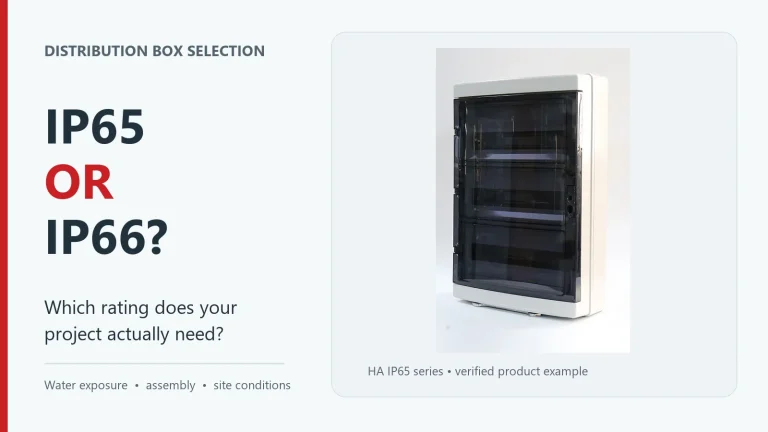
IP65 and IP66 both classify an enclosure as dust-tight, but they differ in water-jet protection. IP65 covers water jets; IP66 covers powerful water jets under the specified test conditions. Neither label, on its own, confirms suitability for immersion, every pressure-washing process, or every outdoor environment. Start with the water exposure the distribution box actually faces […]
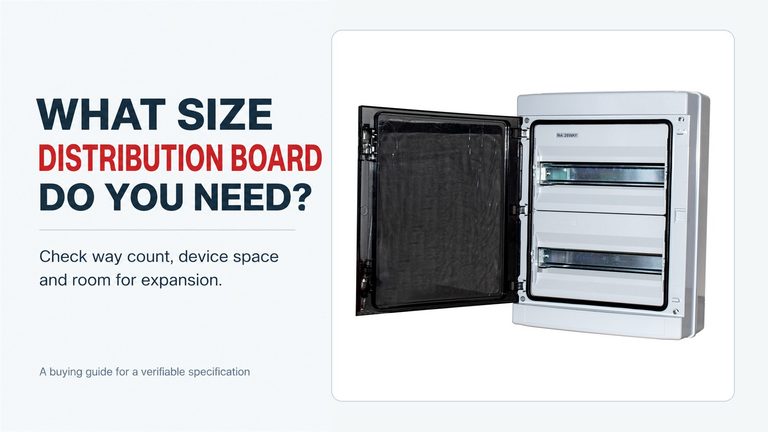
Figure 1. Board selection starts with the circuit schedule, device space, and planned reserve. A request for a “12 way distribution board” can sound specific, but it leaves the layout unresolved. One project may use mostly single-pole devices; another may need multi-pole devices, an incomer, surge protection, metering, or more terminal space. The same number […]
Only “solarcombiner box” in your quotation is far from sufficient. What should be connected to the box? A PV string or an inverter output? They match different jobs. The price and enclosure size can be considered at a later stage. What connects to the input is the top priority. To be more specific, a DC combiner […]