Can an MCCB Be Repaired? What’s Repairable, What’s Not, and How to Return to Service Safely
Published: Author: Conor
Your MCCB stopped working.
It won’t close. It won’t reset. Or maybe it keeps tripping under normal load.
At that point, the question is obvious: can you repair it?
The honest answer is: sometimes—but only in very specific situations. And that depends on two things: what actually failed, and what “repair” really means for a molded case circuit breaker.
This is where many teams get stuck. MCCB repair isn’t like fixing a motor or a pump. You can’t open it up, replace a few worn parts, and expect it to be “good as new.” Most MCCBs are sealed or semi-sealed by design. Field service options are limited on purpose.
You can replace certain external components. You can correct connection and accessory issues. What you usually can’t do is rebuild internal mechanisms or restore damaged contacts safely.
We’ve seen both sides of this go wrong. Teams waste days trying to repair breakers that should have been replaced immediately. Others scrap perfectly serviceable breakers because they don’t know what’s actually repairable. Either way, the result is the same—lost time and unnecessary cost.
This guide lays it out clearly: what you can repair, what you should never touch, and how to decide which path makes sense for your situation.
Can an MCCB Be Repaired?
Yes—but only in a limited, very specific sense.
MCCBs can sometimes be repaired by replacing accessible components. What that usually means in practice is part replacement, not rebuilding internal mechanisms.
On many modern designs, you can replace modular elements like electronic trip units. You can swap out terminals, lugs, and mounting hardware. You can also replace external accessories such as shunt trips or auxiliary contacts.
What you generally cannot do is just as important. You can’t safely repair damaged main contacts, replace arc chutes, rebuild operating mechanisms, or fix internal springs and linkages in the field.
That’s not an oversight. Manufacturers don’t design MCCBs for deep field service. They design them to operate reliably within a defined life, then be replaced once internal components degrade.
What “Repair” Means for MCCBs (And Why the Term Causes Confusion)
For MCCBs, the word “repair” doesn’t mean what most people think it means.
In practice, repairing an MCCB usually means replacing an accessible, modular component or correcting an external issue—not rebuilding or fixing internal assemblies. That gap between expectation and reality is where most confusion starts.
Repair vs Replace Parts vs Replace the Breaker
Repair usually means restoring function by replacing a failed module. You’re not fixing the part itself—you’re swapping it out.
Replace parts means changing specific components, such as a trip unit, terminals, or accessories, while the breaker body remains in service.
Replace the breaker means removing the entire unit and installing a new one.
Once you see this difference clearly, most MCCB “repair” decisions become much easier to evaluate.
MCCB Serviceability Basics: Why Many Internal Repairs Aren’t Recommended
Most internal MCCB repairs aren’t discouraged because they’re inconvenient. They’re discouraged because they break the safety, certification, and liability assumptions the breaker was designed around.
Manufacturers intentionally seal critical internal components, and they do it for several reasons that all reinforce each other.
Safety comes first.
Internal contacts and arc chambers operate under extreme electrical stress. During fault interruption, arc energy, heat, and mechanical forces reach levels that are dangerous even for trained technicians. Once you open or modify these assemblies, you introduce risks that can’t be controlled or verified in the field.
Certification depends on intact internal assemblies.
Listings from organizations like UL are based on the breaker being manufactured, assembled, and tested as a complete unit. Opening sealed sections or altering internal components voids those assumptions. At that point, the breaker may still “work,” but it no longer meets the conditions under which it was certified.
Liability shifts immediately when internals are modified.
If an internally modified breaker fails to trip during a fault, responsibility no longer sits with the manufacturer. It sits with whoever performed the modification—and with the organization that approved returning it to service. That risk transfer is often overlooked until something goes wrong.
Cost is a design decision, not a shortcut.
Fully field-serviceable low-voltage breakers exist, but they cost significantly more. For most MCCB applications, manufacturers balance reliability, protection, and affordability by limiting field service to modular, replaceable components rather than internal rebuilds.
The result is intentional. You get controlled repair options through external accessories and modular replacements—but not internal reconstruction. That boundary isn’t arbitrary. It’s what keeps MCCBs predictable, certifiable, and safe in real-world systems.
Common MCCB Problems That Trigger This Question (Symptoms Checklist)
Understanding the symptoms is the first step in deciding whether repair is even on the table. In many cases, the breaker tells you very clearly when it’s beyond repair—you just have to know what to look for.
Won’t close: The handle moves, but the contacts never engage—or the latch refuses to set. This usually points to internal mechanical failure, not an external issue.
Won’t reset after trip: If the mechanism won’t reset after clearing the fault, it’s often because internal components were damaged during interruption. Mechanical shock from a high fault current can leave parts misaligned or fractured.
Handle feels wrong: Grinding resistance, loose travel, or uneven movement are all warning signs. When the operating feel changes, internal linkages or springs are usually compromised.
When you see these symptoms, repair options are limited. In most cases, they indicate internal damage you can’t safely correct in the field.
ii) Performance Symptoms: Nuisance Tripping, Trips Under Normal Load, Won’t Trip When Expected
Performance-related symptoms are different. They don’t always mean the breaker is destroyed—but they do mean its protective function may no longer be reliable.
Nuisance tripping: If a breaker trips without an obvious overload, the cause could be incorrect settings, a failing trip unit, or intermittent load conditions you’re not seeing. In some cases, this is repairable through adjustment or trip unit replacement.
Trips under normal load: When load current is clearly within rating but the breaker still trips, the issue is often thermal—either from degraded contacts generating excess heat or from a malfunctioning trip unit.
Won’t trip when expected: This is the most dangerous performance symptom. If the breaker fails to trip during an overload or fault, its protective function has failed. At that point, repair options are extremely limited, and replacement is usually the only responsible choice.
Performance symptoms sometimes point to repairable causes—but only when they can be clearly identified and verified through testing.
Condition-related symptoms are the most decisive. When they appear, the repair-versus-replace question is usually already answered.
Overheating: If terminals or the case are hot to the touch, the breaker has likely experienced prolonged thermal stress. Internal degradation may already be present, even if it isn’t visible.
Burning smell: Persistent odor indicates insulation breakdown or severe overheating. This type of damage is almost never repairable.
Discoloration: Darkened plastic, melted areas, or heat marks are signs the breaker has exceeded its design limits over time.
Visible damage: Cracks, deformation, or melted components are immediate stop signs. These breakers should be replaced without further evaluation.
When condition symptoms are present, replacement isn’t a conservative choice—it’s a necessary one.
What Can Usually Be Repaired (Repairable Scope)
The repairable scope for MCCBs is intentionally narrow. When repairs are possible, they’re limited to components the manufacturer designed for field replacement—and nothing beyond that.
Repairable/Replaceable Accessories and External Components
Most manufacturers clearly identify which MCCB components can be serviced or replaced in the field. These typically include:
Trip units (on modular designs): Electronic trip units are often replaceable as complete assemblies. You’re not repairing the electronics—you’re restoring function by installing a new, tested module.
Terminals and lugs: Overheated or damaged terminals can often be replaced, provided there’s no evidence of internal heat damage.
Operating handles: External handle assemblies are commonly serviceable and straightforward to replace.
Auxiliary Contacts, Shunt Trips, and Undervoltage Releases: These accessories mount externally and are designed for replacement without disturbing the breaker’s internal structure.
When repairs stay within this boundary, risk remains manageable—and verification testing can confirm the breaker is safe to return to service.
Example: Shunt Trip Replacement Within Repairable Scope
A manufacturing facility in Tennessee had an MCCB that wouldn’t accept a close signal from their control system. The issue wasn’t the breaker mechanism—it was a failed shunt trip module. They replaced the shunt trip (cost: $85, time: 15 minutes), and the breaker returned to service immediately. Replacing the entire breaker would have cost approximately $650, not including downtime.
This kind of outcome is only possible when the failure is well-defined and the repair does not involve internal breaker components.
Connection-Related Issues That Are Often Misdiagnosed as “Breaker Failure”
Some of the most common “failed breaker” calls turn out to be connection problems, not breaker defects.
Typical examples include:
Loose Connections: Loose terminals create resistance, heat, and voltage drop. These conditions often trigger thermal trips that look like breaker failure.
Incorrect Torque: Over-tightened or under-tightened terminals can both cause overheating. Following the manufacturer’s torque specifications often resolves the issue immediately.
Corrosion at Terminations: Oxidation or contamination increases contact resistance and heat buildup, especially in humid or corrosive environments.
Incorrect Conductor Type or Size: Mismatched conductors can cause chronic heating that mimics internal breaker problems.
Example: Repeated Tripping Caused by Improper Conductor Termination
A data center in Arizona experienced repeated trips on a critical MCCB and prepared for replacement. A closer inspection revealed aluminum conductors installed without anti-oxidant compound. Cleaning the terminations, applying the correct compound, and re-terminating the conductors eliminated the problem entirely. That breaker has remained in service for years.
Before replacing or “repairing” an MCCB, always rule out external connection issues. They’re inexpensive to fix and frequently misdiagnosed.
Electronic Trip Unit–Related Service (Where Applicable)
Modern MCCBs with electronic trip units often provide more service options, but only within defined limits.
Common trip unit–related service actions include:
Setting Corrections: Incorrect pickup or time-delay settings are a frequent cause of nuisance tripping. Reprogramming may resolve the issue without replacing any hardware.
Calibration Drift: Over time, electronic components can drift out of tolerance. Some trip units allow recalibration; others require full module replacement.
Display or Indicator Failures: Failed LCDs or LEDs often affect visibility rather than protection. In most cases, the solution is trip unit replacement.
Communication Module Failures: Network or monitoring cards can usually be replaced independently of the breaker itself.
Example: Trip Unit Display Failure Without Loss of Protection
At a chemical plant in Louisiana, an MCCB’s electronic trip unit display failed, preventing operators from monitoring load current. The breaker still protected correctly, but visibility was lost. Replacing the trip unit restored full functionality in under 30 minutes at a cost of $320—far less than the $1,200 required for full breaker replacement.
Trip unit–related repairs make sense only when the breaker design supports them and proper testing follows.
What Should NOT Be Repaired (Stop Rules / No-Go Conditions)
Some MCCB conditions leave no room for judgment. When these signs are present, repair should stop immediately and replacement should be the only option.
Evidence of Severe Fault Stress or Heat Damage
Heat damage is one of the clearest indicators that an MCCB has exceeded its design limits.
Common signs include:
Discolored or Melted Case Plastic
Indicates prolonged overheating or severe fault energy. Internal insulation and mechanical tolerances are likely compromised.
Burned or Discolored Terminals
Suggests sustained thermal stress that often extends beyond the terminal into internal conductors.
Persistent Burning Odor
Points to insulation breakdown or internal material degradation. This type of damage is not repairable in the field.
Once heat damage is visible externally, internal components have almost certainly degraded—even if the breaker still appears functional.
Signs of Severe Fault Interruption or Mechanical Shock
Every fault interruption causes wear. Severe faults cause irreversible internal damage.
Stop-rule indicators include:
Breaker Will Not Reset After a Fault:
A breaker that trips during a high-energy fault and refuses to reset has likely suffered internal mechanical or contact damage.
Mechanical Binding or Abnormal Resistance:
Grinding, sticking, or inconsistent handle movement indicates damaged linkages or springs.
Recent Short-Circuit Interruption:
After a significant short-circuit event, internal arc chambers and contacts may be eroded or cracked—even if no external damage is visible.
Attempting repair after severe fault stress means guessing about internal condition. That guess carries unacceptable risk.
Unknown or Unverifiable Service History
A breaker’s history matters as much as its symptoms.
If you cannot confidently answer the following, repair should not proceed:
How many fault interruptions has this breaker experienced?
Has it been modified or partially disassembled before?
Has it been exposed to overloads, environmental stress, or improper installation?
Unknown history means unknown degradation. Without a reliable baseline, you cannot verify that a repaired breaker will behave predictably under fault conditions.
Why These Are Stop Rules, Not Judgment Calls
Internal MCCB damage is largely invisible. You cannot inspect arc chutes, contact erosion, or internal insulation without destructive disassembly. External “repairs” do not restore internal integrity.
Once any of these conditions are present, repairing symptoms does not repair the breaker. It only hides underlying failure modes until the next fault—when the consequences are far more serious.
In these cases, replacement is not the safe option.
Who Should Repair an MCCB? OEM vs Third-Party vs In-House Maintenance
Who performs an MCCB repair matters just as much as what is being repaired. The right choice depends on repair scope, application criticality, and your ability to verify the breaker before returning it to service.
This isn’t about convenience. It’s about who carries the technical and legal responsibility if something goes wrong.
When OEM Service Is the Safer Choice
OEM service is the right path when the repair involves complexity, risk, or compliance requirements that go beyond routine maintenance.
Choose OEM support when:
Electronic trip unit issues are complex or unclear
Internal components are suspected to be damaged
The breaker serves a critical application (life safety, emergency power, essential process loads)
Warranty or certification must be preserved
Formal test documentation is required
The breaker model is specialized or uncommon
OEM service costs more, but it provides certainty. Factory-trained technicians, approved procedures, proper test equipment, and traceable documentation reduce both technical risk and liability exposure.
Using Qualified Third-Party Repair Providers
Third-party providers can be a viable option—but only when they meet strict technical and quality requirements.
Before engaging a third-party service, confirm they can demonstrate:
Technician training specific to the breaker model
Access to calibrated electrical test equipment
Use of OEM or certified equivalent replacement parts
Defined repair and verification procedures
Insurance and liability coverage
Clear turnaround commitments and documentation
Well-qualified third-party providers can reduce repair costs by 30–50% compared to OEM service without compromising safety. Poorly qualified providers, however, create significant technical and legal risk.
Third-party repair is not a shortcut. It’s an alternative that only works when standards are enforced.
In-House Maintenance: Where the Line Should Be Drawn
In-house maintenance teams play an important role—but only within clearly defined limits.
Your maintenance team can safely perform:
Replacement of external accessories (shunt trips, auxiliary contacts, undervoltage releases)
Terminal and lug replacement
Connection inspection, cleaning, and re-termination
Basic electronic trip unit setting adjustments
Visual inspection and mechanical operation checks
Your maintenance team should not perform:
Internal mechanism repairs
Arc chute replacement or modification
Contact replacement or refacing
Unauthorized disassembly or modifications
Repairs requiring specialized test equipment not available on site
Crossing this boundary shifts risk directly onto your organization. What looks like a cost-saving measure can quickly become a liability issue if the breaker fails during a fault.
Return-to-Service Verification After Repair (What Needs to Be Proven)
Any MCCB that has been repaired—no matter how minor the repair appears—must be verified before returning to service. Verification is not optional. Without it, you have not repaired the breaker; you’ve only changed parts.
The goal of verification is simple: prove the breaker will behave predictably under both normal operation and fault conditions.
Minimum Verification Goals After Any Repair
After any repair, you must be able to demonstrate that:
Insulation integrity remains intact
Contact resistance is within acceptable limits
Trip mechanisms operate correctly
Mechanical operation is normal and repeatable
All safety and protective functions work as intended
If you cannot prove these points, the breaker should not be re-energized.
Minimum Tests Required After Repair
At a minimum, post-repair verification should include:
Visual Inspection: Confirm no loose hardware, damaged insulation, or disturbed components.
Insulation Resistance Test: Ensure insulation has not degraded during service.
Contact Resistance Measurement: Confirm low and balanced resistance across poles.
Functional Trip Test: Verify the breaker trips correctly under simulated conditions.
Load Current Verification (Where Practical): Confirm stable operation under normal load.
For critical applications, primary injection testing should be performed to validate full trip characteristics under controlled conditions.
A Cautionary Example: When Verification Was Skipped
A manufacturing plant in Michigan replaced a failed shunt trip module on an MCCB. The repair itself was straightforward, and the breaker was returned to service without formal verification testing.
Three weeks later, the breaker failed to trip during a ground fault. The investigation revealed that the repair process had inadvertently disconnected the main trip mechanism.
Basic functional testing after repair would have caught this immediately. Instead, it caused $45,000 in equipment damage.
The repair wasn’t the problem. Skipping verification was.
Documentation and Traceability: What to Record
Verification without documentation offers little protection—technically or legally.
At a minimum, record:
The original failure mode
The repair performed
Parts replaced (including part numbers and sources)
Test methods and results
Technician or service provider
Date of repair
Next inspection or maintenance interval
This documentation establishes accountability, supports compliance, and provides a baseline for future troubleshooting.
Repair or Replace? A Practical Decision Framework for Maintenance Teams
The decision to repair or replace an MCCB should never be based on instinct, convenience, or short-term cost. It should be based on risk, repair scope, and your ability to verify performance after the work is done.
Use the framework below to make decisions that are defensible—technically and operationally.
Step 1: Screen for Stop Rules
Before considering repair, confirm that none of the following conditions are present:
Visible heat damage or persistent odor
Evidence of severe fault interruption
Mechanical binding or abnormal operation
Unknown or undocumented service history
Critical life-safety or essential-service application
If any of these conditions apply, the decision is already made: replace the breaker.
Step 2: Confirm the Failure Is Repairable by Design
If stop rules are not present, determine whether the failure falls within the manufacturer’s supported repair scope.
The problem is clearly related to connections or terminations
The breaker uses a field-replaceable electronic trip unit, and the fault is isolated to that module
Replacement parts are genuine or certified equivalents
If the repair requires opening sealed internal assemblies or modifying internal components, replacement is the correct path.
Step 3: Evaluate Application Criticality
The same breaker failure can justify different decisions depending on where it is used.
Replacement is usually the safer option when the breaker serves:
Life-safety systems
Emergency power or standby generation
Critical process equipment
Loads with high fault energy or severe consequences of failure
For non-critical applications, limited repairs may be acceptable—but only when verification is possible.
Step 4: Compare Cost With Risk, Not Just Price
Cost comparisons should account for more than parts and labor.
Repair tends to make sense when:
Repair cost is less than 40% of replacement cost
Downtime for replacement is significant
The breaker is relatively new and well-documented
Replacement should be favored when:
Repair cost exceeds 60% of replacement
Multiple repairs have already been performed
Parts availability is uncertain
Testing and verification capabilities are limited
The middle ground is not a decision—it’s a signal to escalate.
Step 5: Verify Before Returning to Service
No repair decision is complete without verification.
A repaired breaker must pass appropriate mechanical, electrical, and functional testing before re-energization. If you cannot perform or obtain proper verification, repair is not a valid option—even if the repair itself was simple.
Repair, Replace, or Escalate: A Simple Decision Matrix
REPAIR when all of the following are true:
Failure is external and clearly identified
Repair is supported by the manufacturer
Parts are available and traceable
Application is non-critical
Verification testing can be performed
REPLACE when any of the following apply:
Stop rules are present
Internal damage is suspected
Breaker age exceeds 15–20 years
Service history is unknown
Application is safety-critical
ESCALATE when:
Symptoms are unclear
Repair scope is uncertain
Cost difference between repair and replacement is marginal
The breaker is high-value and expert diagnosis is justified
Escalation is not indecision. It is a risk-control step.
A Real-World Example: When Escalation Prevented the Wrong Decision
A food processing facility in Wisconsin experienced intermittent tripping on an MCCB feeding a refrigeration system.
Initial diagnosis pointed toward a possible trip unit failure. Estimated repair cost was $400. Full replacement was quoted at $850.
Instead of choosing immediately, the team escalated the issue. Specialist analysis revealed harmonic currents from VFD-driven compressors causing thermal trips.
The solution was not breaker repair or replacement. A harmonic filter was installed, and the breaker was upsized during the next replacement cycle.
That escalation prevented unnecessary repair, avoided premature replacement, and addressed the real system-level problem.
Closing Thoughts
Repairing an MCCB is sometimes possible. Knowing when not to repair is far more important.
External, well-defined issues—such as accessory failures or supported trip unit replacements—can often be addressed safely. Internal damage, heat stress, unknown history, or unverified repairs cannot.
The rule is simple: if a repair stays within the manufacturer’s supported scope and you can prove the breaker will perform correctly afterward, repair can be justified. If you cannot prove it, replacement is the responsible choice.
Many of these repair-or-replace decisions could have been avoided with earlier inspection and proper MCCB maintenance.
When the decision isn’t clear, escalation isn’t hesitation. It’s risk control.
If you’re evaluating whether to repair or replace MCCBs in a critical system, Oohmage works with maintenance and engineering teams to review breaker condition, repair scope, and verification requirements—so decisions are based on risk, not guesswork.
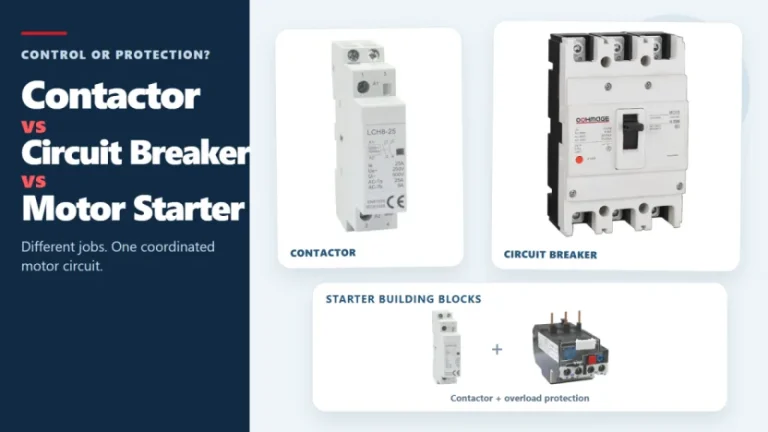
Figure 1. Contactors, circuit breakers, and motor starters solve different control and protection tasks. These three devices often appear in the same motor-control panel, but they solve different problems. A contactor handles frequent, remote, or automatic switching during normal operation. A circuit breaker interrupts abnormal current within its rated capability. A motor starter normally combines […]
Introduction The concept of remote tripping is simple, but in actual operation, project teams often encounter difficulties in specifying the components. The panel factory may require circuit breakers triggered by fire alarm relays, PLC outputs, building management system instructions, or other coordinated control. At this point, “diversion tripping” is only the first step in the […]
The main types of circuit breakers used in low-voltage distribution include miniature circuit breakers (MCBs), molded case circuit breakers (MCCBs) and residual-current devices such as RCCBs and RCBOs. They are not interchangeable. MCBs and MCCBs are selected for overcurrent protection in different circuit roles, an RCCB provides residual-current protection without integral overcurrent protection, and an […]