< img height="1" width="1" src="https://www.facebook.com/tr?id=1523171142290993&ev=PageView&noscript=1"/>
RCBO vs RCD: What Trips, What Stays On, and What Buyers Should Specify

RCBO vs RCD: What Trips, What Stays On, and What Buyers Should Specify

Introduction The RCBO integrates residual current protection with overload and short-circuit protection, and can independently protect and disconnect individual circuits. While an RCD is a general term for residual current protection devices, it may not include overcurrent protection; in many distribution cabinets, a shared RCD or RCCB needs to be used in conjunction with independent […]
Read More
What Is a Shunt Trip? How It Works in Circuit Breakers and What Buyers Should Specify

What Is a Shunt Trip? How It Works in Circuit Breakers and What Buyers Should Specify

Introduction The concept of remote tripping is simple, but in actual operation, project teams often encounter difficulties in specifying the components. The panel factory may require circuit breakers triggered by fire alarm relays, PLC outputs, building management system instructions, or other coordinated control. At this point, “diversion tripping” is only the first step in the […]
Read More
Why Does an RCBO Keep Tripping?8 Common Causes and a Step-by-Step Diagnostic Checklist

Why Does an RCBO Keep Tripping?8 Common Causes and a Step-by-Step Diagnostic Checklist

Introduction An RCBO on the socket circuit seemed normal after resetting, but the water heater’s switch tripped again as soon as it started heating. In another case, after the distribution cabinet was upgraded, even when all the electrical appliances were unplugged, the same tripping phenomenon occurred. Both circuits were experiencing “frequent tripping”, but the underlying causes […]
Read More
MCCB kA Rating: How to Choose the Right Breaking Capacity Before You Buy

MCCB kA Rating: How to Choose the Right Breaking Capacity Before You Buy

Introduction The kA rating refers to the maximum short-circuit current that a circuit breaker can safely interrupt under specified conditions. For MCCB, this value constitutes a part of its interrupting capacity rather than its normal rated operating current. Choosing the correct kA rating helps to prevent the circuit breaker from malfunctioning when the fault current […]
Read More
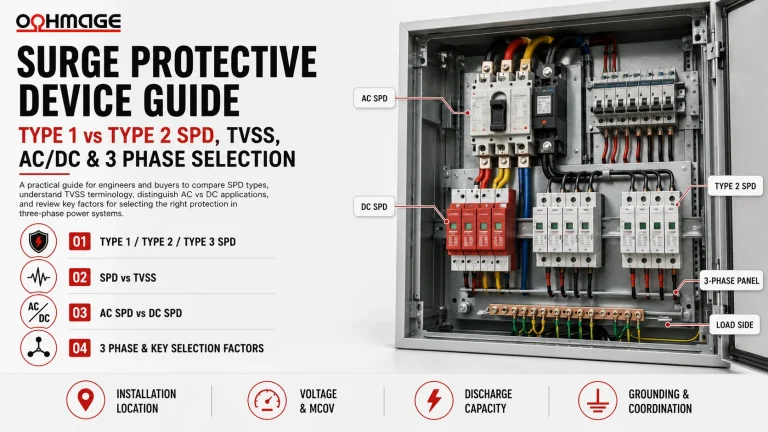
Surge Protective Device Guide: Type 1 vs Type 2 SPD, TVSS, AC/DC & 3 Phase Selection

Surge Protective Device Guide: Type 1 vs Type 2 SPD, TVSS, AC/DC & 3 Phase Selection

Introduction Transient overvoltage problems are not limited to the field of household power socket plugs. In low-voltage distribution systems, control cabinets, commercial buildings, industrial equipment, communication rooms, and solar/pv (PV) projects, brief surge events can cause sensitive components and the connected loads to endure extremely high voltage stress. For procurement personnel and engineers, the key […]
Read More
+86-18757092555 Phone info@oohmage.com E-mail Chat on WhatsApp WhatsApp